
🤓 Latest Submissions
NightShift Ops
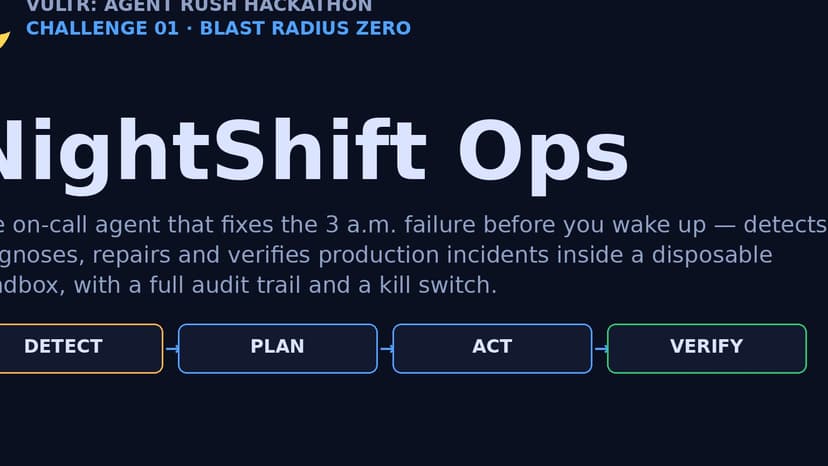
The 3 a.m. failure, handled before you wake up. NightShift Ops is an autonomous on-call agent for the failures that page humans at night: a bad deploy, a killed process, a full disk. It runs the whole incident lifecycle alone — built so its blast radius is zero. HOW IT WORKS A demo storefront runs inside a hardened Docker sandbox (loopback-only, capped, wipeable). A monitor probes it every 2 seconds; sustained failure opens an incident. A Vultr Serverless Inference model returns a diagnosis citing the evidence, plus an ordered fix plan built only from allowlisted tools. The executor runs it inside the sandbox only — every step passes a policy gate and a kill-switch check first. An independent verifier probes the service directly — health green on 3 consecutive checks, error sample ≤ 10% — before the incident closes; a failed verification reopens it and triggers one replan. Every action and refusal lands on a public audit timeline, and proven fixes are recalled when a fault repeats. BLAST RADIUS ZERO The agent can execute exactly seven tools (read_logs, check_health, check_disk, restart_service, clear_temp_files, rollback_deploy, run_health_suite), only against the sandbox fleet. Anything else is refused and logged: ask it to "delete the orders database" and the policy gate refuses the translated delete_database call. Nothing executes. A kill switch halts the agent before its next tool call, mid-incident if necessary. HOW VULTR IS USED Hosted on Vultr Cloud Compute (Dallas, via the Vultr API). ALL LLM calls run on Vultr Serverless Inference: primary deepseek-v4.1-flash-1017, fallback qwen3.8-flash-next. PROOF, NOT PROMISES 20 tests pass. 10 live drills on the production deployment passed, including a double-break drill and a kill-switch halt mid-incident. Three drill-found defects were fixed with regression tests. Try it: open the live demo, press "Ship bad deploy", and watch. Then ask it to delete the database, and watch it refuse.
8 Nov 2026

