
🤝 Top Collaborators


🤓 Latest Submissions
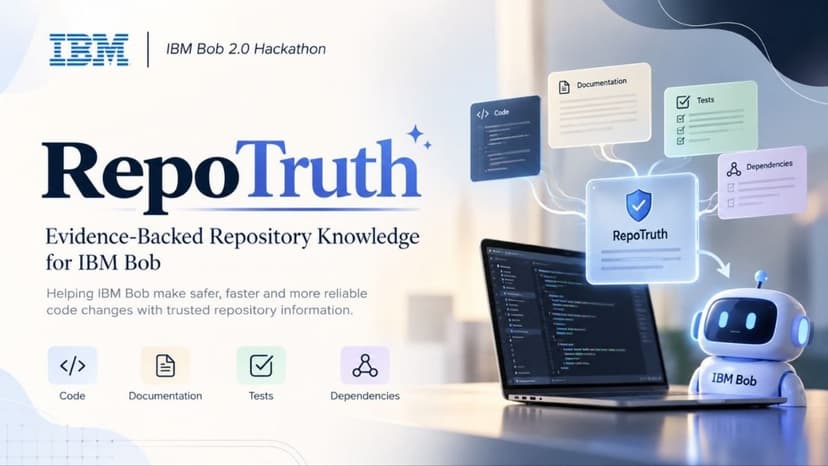
RepoTruth- Verified Software Knowledge for IBM Bob
RepoTruth - Evidence-Backed Repository Knowledge for IBM Bob The Problem: Enterprise software repositories don't tell one story — they tell many, and they disagree. The same business rule gets restated across executable COBOL, copybooks, JCL jobs, README files, inline comments, and test assertions. Over time these sources drift. A threshold changes in the code but not the docs. A dependency is renamed in one place but not another. A test is never written for a critical paragraph. This drift becomes actively dangerous the moment an AI coding agent enters the picture. IBM Bob reads the repository before making changes — but if it contains contradictions, Bob inherits them silently. If Bob trusts the README, it will "fix" working COBOL to the wrong number. More context doesn't help. A longer prompt still contains both the correct IF statement and the stale documentation, and the model can quote either one. The missing layer is not more data. It is a check that says which source wins, how confident that verdict is, and which line is the evidence. The Solution RepoTruth is that layer — a pre-flight, evidence-backed knowledge pipeline that runs before IBM Bob acts on any repository. One click — Analyze IBM Z sample — sends the repository through six specialist agents: Repository Analyst — inventories programs, paragraphs, copybooks, JCL jobs, and tests Code Semantics — extracts business rules, inputs, outputs, and purpose from COBOL Dependency Tracer — maps USES_COPYBOOK, CALLS, IMPLEMENTS_RULE, TESTED_BY Documentation Truth — classifies claims as ACCURATE, STALE, MISSING, CONTRADICTORY, or AMBIGUOUS Test / Behavior — determines TESTED, PARTIALLY_TESTED, UNTESTED, or CONFLICTING_TEST per entity Adjudicator — ranks conflicting evidence by authority, not by vote When sources disagree, the Adjudicator applies a strict hierarchy: Executable code → Tests → Configuration → Documentation → Comments This produces an unambiguous result for contradictions like Issue #04: the README states transactions above $50,000 require review; the executable COBOL and TEST-014 both use 100000; a comment also contains the stale 50000. RepoTruth prioritizes executable and test evidence, labels the record DOCUMENTATION_CONTRADICTION (HIGH severity), and recommends Update README — no human required. Every entity exits the pipeline with a structured knowledge record: entity_id, purpose, relationships, quality, evidence pointers, final_label, confidence, and review_state. Records above 0.85 confidence are verified automatically. Only genuinely undecided cases route to the human review queue — human time is reserved for ambiguity, not for contradictions the system can already resolve. The verified dataset exports as JSONL, JSON, or CSV. Target Users: Primary: IBM Bob and the developer invoking it before a maintenance or modernization task on an IBM Z repository. Secondary: the developer or team lead who reviews flagged ambiguous records before approving a change. What Makes It Creative and Unique: Most approaches add more retrieval — more files, larger context windows, better embeddings. RepoTruth takes the opposite position: the problem is not volume, it is trust. Repository artefacts are treated as competing witnesses, not a single knowledge source, and a ranked adjudicator rules instead of a majority vote. A vote between a README, a comment, and a COBOL IF can crown the documentation. A ranked adjudicator cannot. The system runs without a GPU, without watsonx in the loop, and without hardcoded thresholds — a deterministic COBOL and JCL parser pipeline with live-streamed results and a verifiable benchmark against 100 gold-labeled cases. How It Addresses the Challenge: RepoTruth eliminates the manual reconciliation step that precedes every AI-assisted change. Instead of asking Bob to resolve which conflicting repository statement is correct — a task it was not designed for — RepoTruth hands Bob a pre-resolved, evidence-ranked knowledge record.
27 Sep 2026
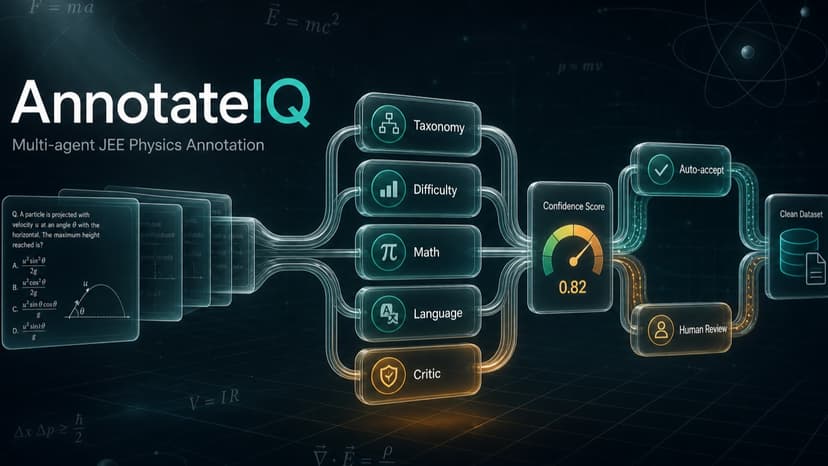
AnnotateIQ
AnnotateIQ is a multi-agent annotation system built for JEE Physics. Coaching platforms and EdTech teams generate huge volumes of practice questions every year, but turning those questions into clean, consistent training data is still mostly manual, slow, and uneven. AnnotateIQ was designed to solve that gap. Instead of relying on a single black-box model, AnnotateIQ runs specialist agents in parallel. They label chapter and concepts, difficulty and Bloom level, mathematical structure, and language mix. A separate critic then validates the merged result against a clear rubric. High-confidence annotations can be auto-accepted, while uncertain ones are sent to a human review queue where every agent draft and disagreement stays visible. Nothing important is hidden. The system also uses honeypot checks and confidence scoring so quality is measurable, not assumed. The final output exports as ML-ready JSONL, JSON, or CSV — ready to train models that can support smarter, more personal learning help for JEE aspirants. In short, AnnotateIQ turns raw Physics questions into trustworthy labeled data, with transparency at every step and humans in the loop only where it truly matters
10 Aug 2026


