
Adullah Qaasim@qaasimfalade_abdullah689
2
Events attended
1
Submissions made
Nigeria
4+ years of experience
About me
I’m the type who geeks out on AI and edtech, then switches to strength sessions, football games, and playlist curation. I love hopping into Discord hackathons, swapping architecture tips, memes, and late-night build sprints with other founders. Photography, wallpapers, and visual design keep my creative side fed, while racing games and action series keep the fun dial maxed. Always down for collabs, quick voice notes, or spontaneous chats about the next move.
🤓 Latest Submissions
PR Pre-Flight Guardian
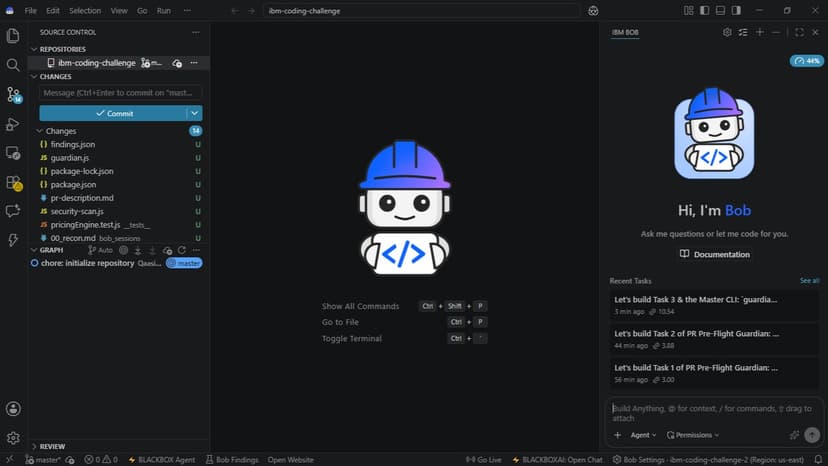
Problem & Challenge: Modern software engineering teams face critical quality and velocity bottlenecks at the pull request (PR) boundary. Developers routinely spend 45+ minutes per PR context-switching between fragmented tools: manually reviewing code diffs for leaked secrets, rushing boilerplate unit tests under deadline pressure (often skipping boundary edge cases), and copy-pasting terminal logs into PR descriptions. This manual friction leads to cognitive fatigue, high-entropy secrets and unsafe dynamic execution (such as unescaped eval() and SQL string concatenations) leaking into production, inconsistent documentation, and lengthy review delays. Our Solution: PR Pre-Flight Guardian transforms this fragile workflow into an autonomous, 30-second pre-flight verification gate. Operating via a single CLI command (node guardian.js --repo ./target-repo), Guardian orchestrates four chained phases: 1. Static Security Scan: Performs AST and pattern matching to detect hardcoded API keys (e.g. sk_live_...), SQL injection concatenations, and dangerous dynamic code execution (eval), generating CVSS 3.1 severity scores and actionable remediation patches. 2. Automated Test Execution: Executes Jest unit test suites across core business logic (such as tiered volume discounts and loyalty stacking in pricing engines), verifying 100% green assertion pass rates. 3. PR Documentation Synthesis: Merges audit findings and test telemetry into standardized GitHub pull request markdown summaries (pr-description.md and pr-comment-preview.md) complete with risk matrices and reviewer checklists. 4. Interactive HTML Dashboard: Renders a standalone, dark-mode report (guardian-report.html) featuring filterable findings and color-coded readiness scorecards. Target Users & Interaction: Designed for software engineers, DevOps practitioners, and code reviewers. Developers run Guardian directly within Bob Shell or CI/CD pre-commit hooks, receiving instant ANSI scorecards and an exit code 1 blocker verdict if critical risks are detected. Creativity & Uniqueness: Unlike standalone linters that only report errors, Guardian unifies security auditing, test execution, patch suggestions, and PR documentation into a single self-contained agentic pipeline with zero external runtime dependencies. It bridges developer ergonomics with enterprise-grade gatekeeping.
27 Sep 2026

