
🤓 Latest Submissions
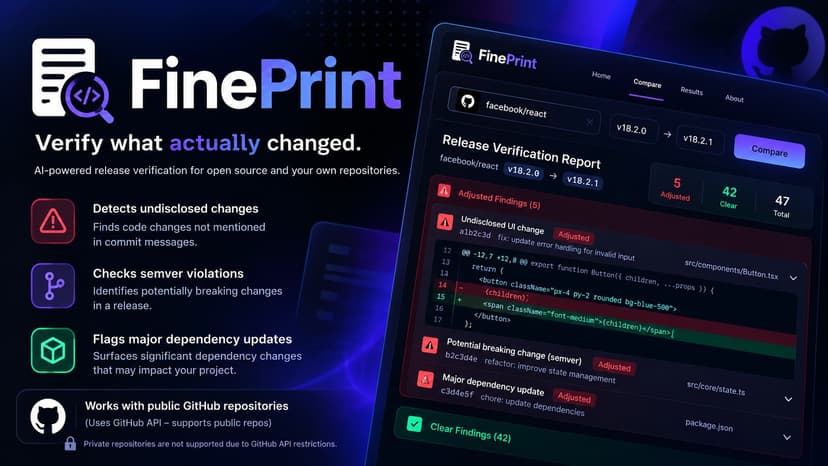
FinePrint: Release Integrity Checker
FINEPRINT — PROBLEM & SOLUTION STATEMENT. THE PROBLEM: Every release depends on developers accurately describing what changed. In practice, they often don't — not out of malice, but because commit messages are written quickly, under time pressure, and rarely double-checked against the actual diff. A commit labeled "small tweak" can quietly change a token format. A "patch" release can secretly contain a breaking API change. A dependency bump can jump a major version with no mention in the message at all. This is a documented, measured problem: an industry survey of 300 mobile engineers found teams spend around five hours per release on low-value manual verification, roughly 130 wasted engineering hours per developer annually, with over three-quarters of teams reporting incidents needing hotfixes every three to five releases. Academic research (ARENA, UT Dallas/University of Sannio) found manually writing accurate release notes can take up to eight hours. A real open-source maintainer (XWiki) logged two hours to a full day per release just on this task. Existing tools — GitHub's auto-generated notes, Release Drafter, semantic-release — only summarize what commit messages say; none of them check whether those messages are telling the truth about the actual code change. They trust the label; they never read the diff. THE SOLUTION: FinePrint reads the real diff between two release tags — not the commit messages describing it — and checks whether the message accurately represents what actually happened in the code. It runs three deterministic checks per commit. First, diff-vs-message mismatch: does the commit's message name the areas of the codebase it actually touched? If a commit changes files in an area never mentioned in its message, FinePrint flags it and shows exactly which unclaimed files changed. Second, semver violation: does a patch or minor version bump secretly contain a breaking change? Third, dependency bump: did any dependency jump a major version, regardless of what the message says? Results render as a single-glance "receipt" — a monospace, itemized list styled like a real paper receipt, with a health bar showing routine versus flagged commits at a glance, and tap-to-expand evidence, the actual code diff, for every flagged item, so nothing is asserted without proof. FinePrint is a zero-install web app: paste any public GitHub repo URL and two tags, get a receipt. It runs entirely client-side against GitHub's public API, with no backend, no account, and no secrets. Validated on two real cases: it correctly flagged a deliberately undisclosed change in our own test repository, showing the exact unclaimed diff as evidence, and ran cleanly against a real FasterXML/jackson-databind release with zero false positives, correctly ignoring routine, mechanically-generated commits such as release-plugin bumps and merge commits that would otherwise create noise. The result: a release-readiness check that catches what commit-message-based tools structurally cannot see, in the time it takes to paste a URL.
27 Sep 2026

SkillForge — AI Job Navigator
SkillForge is an AI-powered career intelligence platform that analyzes live job market data to match users with relevant roles, identify skill gaps, track market demand, and generate personalized learning roadmaps through a multi-agent workflow inspired by CrewAI. The platform is powered by Qwen3-32B, a 32B parameter reasoning model from Alibaba Cloud chosen for its strong instruction-following, structured JSON generation, and reliable skill extraction from real-world job descriptions. Qwen3 drives the core intelligence behind job analysis, market insights, and personalized roadmap generation. SkillForge uses live Adzuna job data to analyze hiring trends across domains like software engineering, marketing, finance, sales, and design. Users receive ranked job matches, matched and missing skills, top in-demand skills, and actionable learning guidance with curated resources and projects. The project is architected for deployment on AMD MI300X GPUs via AMD Developer Cloud and optimized for ROCm-based inference workflows. Due to payment verification constraints during development, the live demo currently uses Groq-hosted Qwen3 inference APIs, while the codebase remains ready for direct AMD MI300X deployment through a simple inference endpoint switch.
10 May 2026


