

Rama Chandra@ramachandraai
3
Events attended
3
Submissions made
India
10+ years of experience
About me
Founder and builder focused on privacy-first AI, Web3, automation, and practical digital systems. I am currently building OmniEdge Local AI, a consent-based hybrid AI workspace that combines local inference with cloud GPU acceleration only when user consent is given. I am interested in AI agents, developer tools, privacy-first workflows, and real-world product MVPs.
🤝 Top Collaborators


🤓 Latest Submissions

AI Evaluation Lab: Reliable Agents on AMD
AI Evaluation Lab is an independent engineering project focused on making AI agents easier to test, verify and improve. For the AMD AI League, I am developing a shared foundation for source-grounded information retrieval and test-verified code repair. The retrieval workflow is designed to extract specific answers from documents or websites, preserve the supporting sources, and return no answer when the available evidence is insufficient. The code-repair workflow will reproduce a failure, propose a focused patch, and check it against relevant tests before reporting the outcome. The planned implementation uses Python, open-source models and AMD ROCm, with Docker containers tailored to each match's requirements. Evaluation will cover answer correctness, citation accuracy, repair success, regression failures, latency and GPU memory use. Separate test cases will help check whether improvements generalize beyond the public examples. This solo entry builds on my work in AI evaluation, benchmark development and OmniEdge RouteIQ from AMD ACT II. The project is currently in development; AMD runtime validation and official challenge scores are pending.
1 Dec 2026
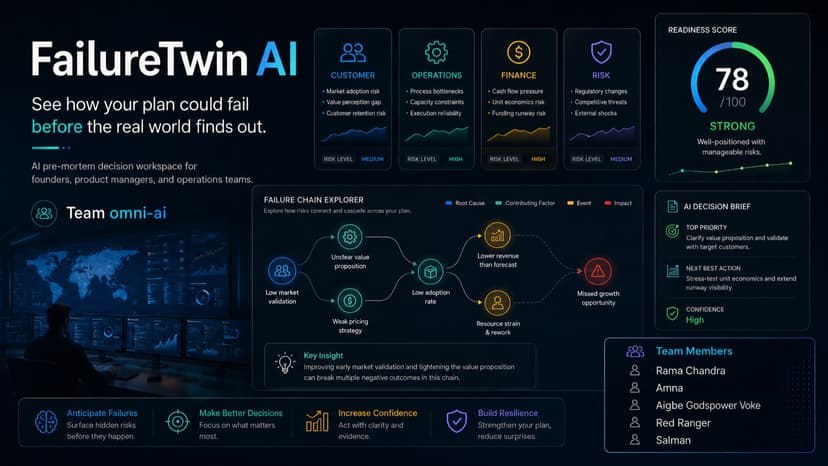
FailureTwin AI
FailureTwin AI is an AI-powered pre-mortem decision workspace designed to help founders, product managers and operations teams discover how a plan could fail before committing time, money or resources. Instead of simply generating a plan, FailureTwin challenges it from four perspectives: Customer, Operations, Finance and Risk. Users describe a launch, workflow, automation or business decision, answer focused follow-up questions, and receive a structured analysis of weak assumptions, evidence gaps and high-impact risks. FailureTwin then connects those risks into failure chains, showing how one weak assumption can cascade into operational, financial or customer consequences. The Decision Room recommends safeguards that users can accept or reject while the readiness score updates from an immutable baseline, preventing scoring drift. The workflow ends with an explainable Go, Revise or Stop Decision Brief containing the most important risks, safeguards, confidence level and next actions. The project includes guided scenarios for AI customer support, delivery expansion and hospital claim automation, plus custom simulations. A deterministic fallback engine keeps the experience reliable if the live AI path is unavailable. Our goal is simple: help teams find expensive mistakes while they are still inexpensive to fix.
10 Aug 2026
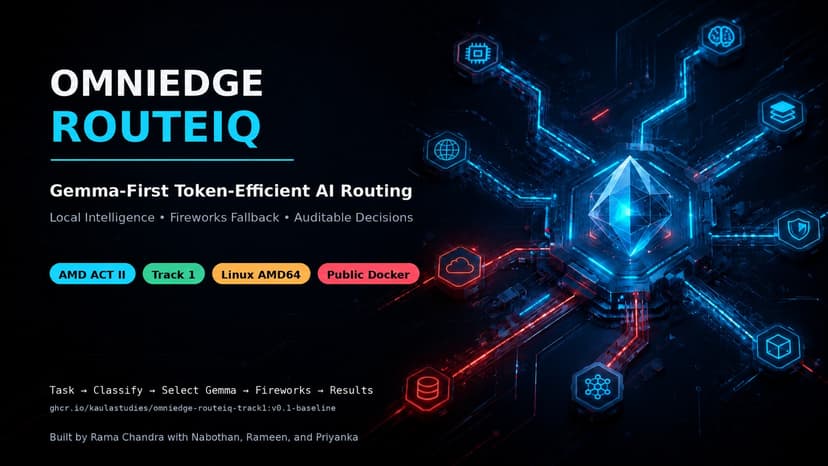
OmniEdge RouteIQ — Local-First Intelligent Router
OmniEdge RouteIQ is a general-purpose AI agent built for AMD ACT II Track 1. It processes eight benchmark categories: factual knowledge, mathematical reasoning, sentiment classification, summarization, named entity recognition, code debugging, logical reasoning, and code generation. The scoring agent runs inside a public Linux AMD64 Docker container. At runtime, it reads tasks from /input/tasks.json, uses only the models supplied through ALLOWED_MODELS, routes all requests through the evaluator-provided FIREWORKS_BASE_URL, and writes structured answers to /output/results.json while preserving each task_id. RouteIQ follows a Gemma-first model policy. When an approved Gemma 4 model is available, it is selected before permitted fallback models. The implementation avoids hardcoded credentials and model assumptions, supports evaluator-controlled API access, and writes progressive results so completed work survives interruptions. The wider project also includes a FastAPI routing backend and a Next.js command dashboard for demonstrating route decisions, provider status, simulations, metrics, and audit visibility. The benchmark container remains self-contained so automated judging can pull and run it independently.
13 Jul 2026


