
🤓 Latest Submissions
AEGIS//GRID
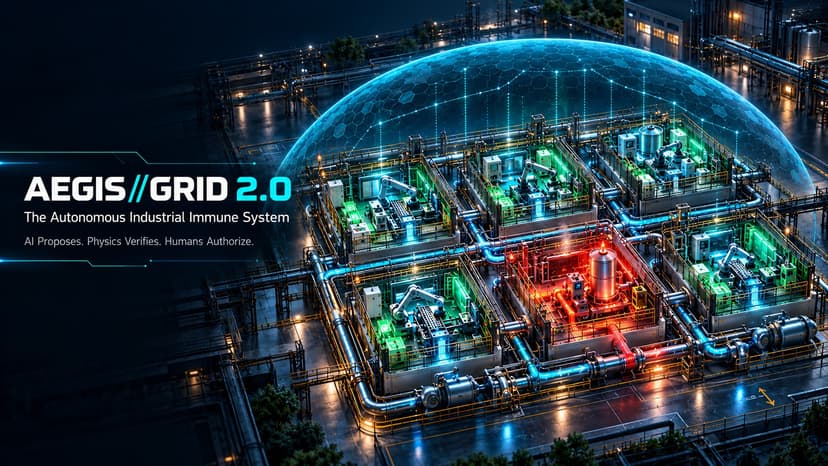
AEGIS//GRID 2.0 is an industrial AI prototype designed to make automated investigation and recovery decisions safer, more explainable, and auditable. The system combines a native C++20 digital twin of six interconnected manufacturing cells with a physics-based anomaly detector. It models thermal behavior, shared coolant flow, and equipment faults, including sensor spoofing and restricted cooling. When an anomaly is detected, a LangGraph multi-agent workflow uses AMD Token Factory hosted inference to investigate potential causes. Pinecone retrieval supplies contextual evidence from 1,235 synthetic plant records and 103 external reference records. AI-generated recovery options are evaluated using native counterfactual simulation and independent safety rules rather than being executed directly. AEGIS//GRID separates intelligence from execution authority. An operator must authorize an incident-specific action through WebAuthn. The independent executor then verifies a short-lived cryptographic capability, checks simulator state and safety constraints, and records an auditable execution receipt. In a verified commissioned simulator demonstration, an authorized safe stop reduced the hottest cell temperature from 42.37°C to 33.45°C over 120 simulated seconds. Simulator evaluation achieved 73% fault-diagnosis recall, 100% precision within the evaluated test set, and 70% thermal-hazard forecasting recall. The project also passed 453 automated checks across Python, C++, Node.js, and Chromium. AEGIS//GRID demonstrates a practical approach to trustworthy industrial autonomy: AI proposes, physics verifies, humans authorize, and independent safeguards control simulator execution. This is a simulator-validated prototype, not a certified production or physical-factory control system.
18 Oct 2026
