🤓 Latest Submissions
Abitda
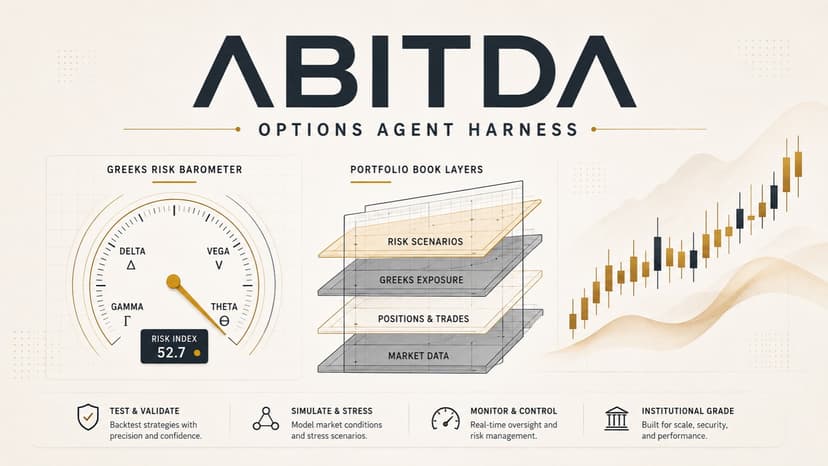
Most AI trading submissions build fragile bots that fire unhedged options orders and blow up the moment volatility spikes. ABITDA was built on a different premise: the options market doesn’t need another toy bot; it needs an institutional evaluation harness—a "SWE-bench for options finance"—that proves an autonomous agent can survive a crisis before it is ever granted broker execution privileges. ABITDA provides a standardized evaluation protocol (`OptionsAgentProtocol`) and a Python package (`pip install abitda`) that stress-tests candidate LLMs against deterministic bar-by-bar replays of 5 historical crises: the Aug 5 2024 Yen Carry Crash (+181% VIX surge), 2018 Volmageddon, the SVB bank run, 1987 Black Monday, and a calm-bull baseline. Each simulation outputs an institutional Fiduciary Scorecard graded A+ to F. On the Aug 2024 crash, our Floor Committee preserved 99.44% of capital (max drawdown -1.23%, zero Greek breaches), while an un-harnessed momentum bot suffered a -42.8% margin blowout. Before any agent action reaches the market, three code-enforced mathematical firewalls sit between model decisions and broker execution: 1. Greeks Gatekeeper: Hard analytical Black-Scholes limits capping aggregate book Delta at ±0.25 and Vega at $150. 2. Regime-Flip Emergency Exit: Liquidates short volatility exposure immediately upon macro shock detection (>12% VIX spike). 3. Statistical Edge Guardian: A rolling binomial Z-score monitor that autonomously self-suspends broker access if win-rate decays. An integrated FastMCP server exposes six quantitative tools to external agents (Claude, Cursor, Gemini CLI), while a live React/FastAPI cockpit operates at https://abitda.up.railway.app. Real execution is independently verified on Alpaca Paper Account PA382FDPI5IO with Options Level 3 clearance. The options market doesn't need more bots. It needs an institutional harness deciding which bots are safe to trade. That is ABITDA.
4 Sep 2026
RepoSense
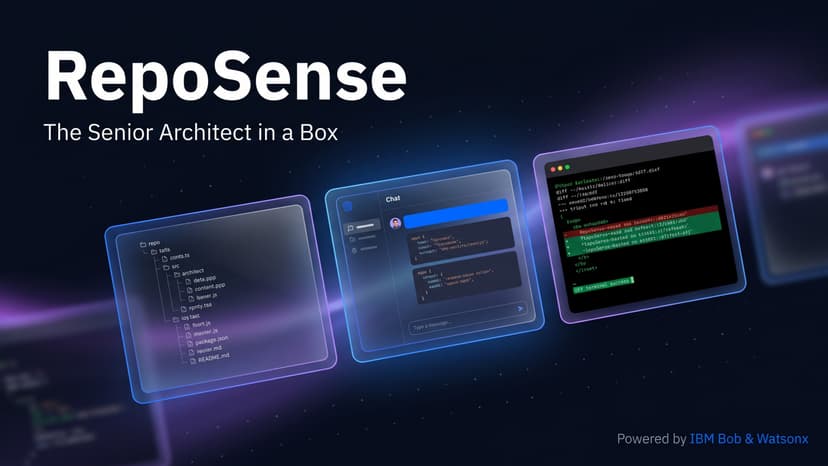
Every developer knows codebase paralysis — the overwhelming feeling of joining a new project with no idea where to start. Traditional onboarding takes 14 days on average and costs organizations ~$15,000 per hire in lost productivity before a single line of production code is written. RepoSense fixes this in 9 seconds. Paste any public GitHub URL and receive a complete onboarding report: architecture breakdown, ordered key files guide, step-by-step roadmap, gotchas and warnings, and a downloadable Markdown export. Two interactive tools complete the experience — an Ask Bob chat for zero-hallucination, context-grounded Q&A, and a BobShell terminal where IBM Bob finds a beginner-friendly issue, writes the fix, and delivers a pull-request-ready diff instantly. RepoSense is built as a deep native integration of all four IBM Bob SDK modes: Plan Mode maps architecture, Ask Mode powers Q&A, Code Mode generates surgical diffs, and Orchestrator Mode chains them into a complete automated pipeline — all running on IBM Watsonx Granite with a silent Groq fallback for 99.9% uptime. What makes RepoSense truly unique: it was entirely built by IBM Bob. Every file across the React 18 frontend, FastAPI backend, and AI orchestration layer was autonomously architected, coded, and debugged by Bob — including self-healing a critical DNS error mid-development without human intervention. Target users: new engineers, open-source contributors, and engineering managers who need to eliminate onboarding friction and accelerate time-to-first-commit. RepoSense turns strangers into contributors on Day 1.
17 May 2026


