
Muhammad Ayyas@rbhnlvng
3
Events attended
2
Submissions made
Indonesia
4+ years of experience
About me
Muhammad Ayyas (Yas) is an IT Business-System Analyst and Project Manager at PT Dahana (Persero), where he designs and delivers production software systems across full-stack web and cloud environments. He holds a degree in Information Systems from Universitas Pendidikan Indonesia (2025) and has hands-on experience building AI-integrated applications — including an AI-powered logistics platform using Azure OpenAI, developed as an individual competitor in the Dicoding × Microsoft AI Impact Challenge. He published a book on machine learning with Python and cloud services in 2024, and actively contributes to tech literacy through BOCIL (Bocah Digital), a digital education initiative he founded for children. He's interested in applied AI, system architecture, and building things that work in production.
🤝 Top Collaborators

🤓 Latest Submissions
OnboardOps Copilot
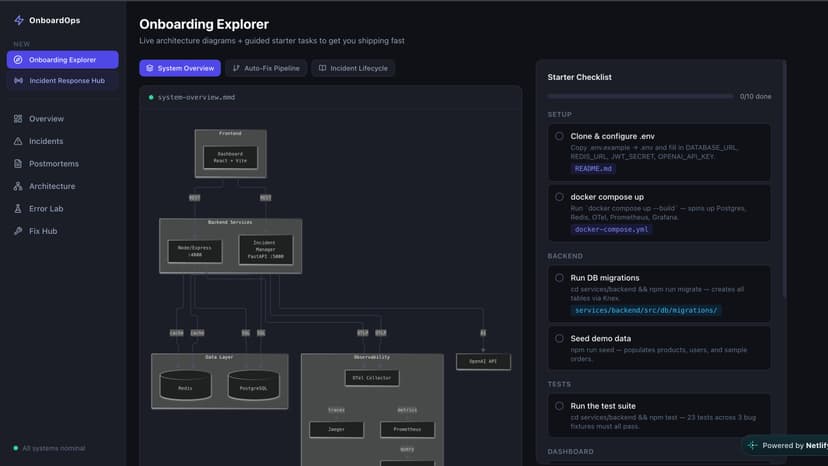
Modern software development suffers from severe context-switching and prolonged ramp-up times. New engineers often spend weeks deciphering complex monorepos, distributed architectures, and legacy services due to fragmented or stale documentation. When production incidents strike, cognitive load peaks as teams struggle under high pressure to parse cryptic stack traces, reproduce bugs in local sandboxes, and craft reliable regression tests. Compounding this, postmortems and incident learnings rarely feed back into onboarding workflows, creating repetitive regressions and persistent developer toil. **OnboardOps Copilot** bridges this divide between codebase onboarding and production resilience using an agentic developer platform powered by IBM Bob 2.0. Its Smart Codebase Onboarding & Architecture Explorer ingests unfamiliar codebases to generate live, interactive Mermaid UML diagrams covering system topology, component flows, and state transitions, alongside automated setup checklists and curated starter tasks with step-by-step guidance. For operational resilience, the platform runs an Autonomous Incident Postmortem & Test-Fix Hub with a 5-phase automated pipeline. It parses stack traces to classify root error patterns like race conditions or timeout cascades, maps vulnerable code across services, synthesizes executable Vitest or Pytest regression tests to reproduce the failure, and generates targeted, minimal patches verified against test suites. It then outputs standardized SRE postmortems complete with root cause analyses, timelines, and remediation plans. Developers manage these workflows via an interactive React and TypeScript control plane that provides real-time architectural visualization, live incident triage, an error simulation lab, and single-click bug remediation. This integrated approach drives measurable operational gains: it reduces developer ramp-up time by 80%, enabling new hires to contribute validated fixes on Day 1, cuts Mean Time to Resolution (MTTR) by 75% through automated bug reproduction and patch verification, and enforces a Zero-Regression Guarantee via actor-critic test-driven verification before any patch merges.
27 Sep 2026

Gradelytics: AI Syllabus & VibeGrading
Gradelytics is an advanced, startup-ready academic co-pilot designed to streamline course preparation and objective evaluation for educators. Built as a high-fidelity full-stack MVP, the platform directly addresses administrative burnout in modern education through two core agentic workflows: the Syllabus Architect and the VibeGrading Simulator. Pundits can instantly map granular learning competencies into structured weekly timelines or execute deep, semantic evaluations of student essays based on completely customizable rubric constraints. Architected for flexibility and production-grade reliability, Gradelytics implements a powerful Hybrid AI Inference engine. For scalable cloud operations, the application securely orchestrates high-throughput serverless models via the Fireworks AI API gateway. To ensure absolute data privacy for enterprise and on-premise institutional rollouts, the reasoning engine is fully optimized to run locally on native AMD hardware infrastructure. The pipeline was benchmarked and validated on AMD RDNA 3 (gfx1100) hardware with 51.5 GB VRAM utilizing PyTorch bindings over the ROCm compute platform. Featuring robust JSON contract parsing, dynamic collapsible sidebar UI states, live analytics charts, and client-side markdown or print-ready PDF reporting, Gradelytics balances sophisticated enterprise architecture with maximum practical market potential. The entire ecosystem is fully containerized, making it instantly ready for deployment and continuous localized iterations.
13 Jul 2026


