
🤓 Latest Submissions
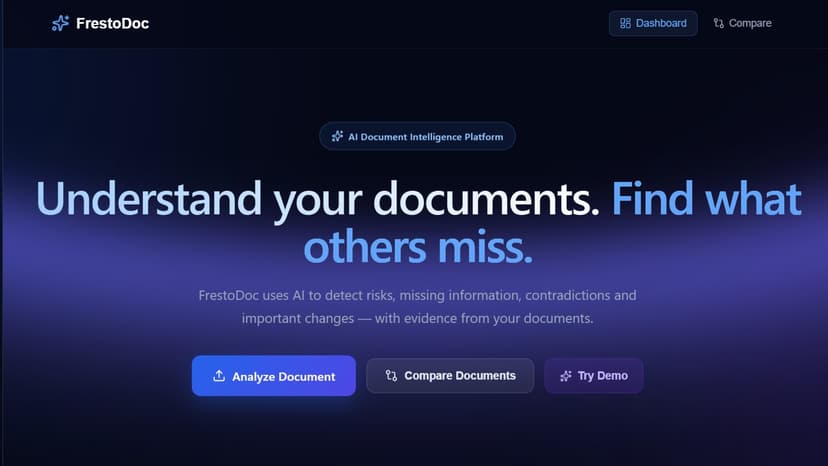
FrestoDoc – AI Document Intelligence
## Problem People and organizations often work with contracts, reports, policies, applications, agreements, and other important documents. Reading these documents manually can be time-consuming, and important details such as risks, missing information, inconsistencies, or required actions can easily be overlooked. Traditional document tools mainly focus on searching or summarizing content, but a summary does not necessarily tell users what they may have missed or what they should do next. ## Solution FrestoDoc is an AI-powered document intelligence platform designed to go beyond basic document summarization. Users upload a PDF, DOCX, or TXT document and FrestoDoc analyzes its contents using Google Gemini. The platform identifies important risks, missing information, key findings, and actionable items. It also provides evidence from the source document so users can understand where an AI-generated finding came from instead of relying on an unsupported answer. Users can ask questions about the uploaded document through an AI-powered Q&A interface and compare documents to identify differences or potential contradictions. FrestoDoc also converts important findings into actionable tasks, helping users move from simply understanding a document to deciding what needs attention. ## Target Users FrestoDoc can be useful for students, researchers, employees, business teams, administrators, and anyone who regularly needs to review lengthy or important documents. ## User Interaction A user opens FrestoDoc, uploads a document, and starts an analysis. The platform processes the document and presents structured results including risks, missing information, evidence, summaries, and actions. Users can then ask questions about the document or compare documents when additional context is required. ## Creativity and Uniqueness The core idea behind FrestoDoc is to treat documents as sources of decisions and actions rather than simply text to summarize. Instead of only answering "What does this document say?", FrestoDoc focuses on questions such as "What might be missing?", "What should I pay attention to?", "Where is the evidence?", and "What action should follow?" This combination of AI analysis, evidence-backed findings, document comparison, Q&A, and action generation creates a workflow from document understanding to action. ## Technology The application uses React and Vite for the frontend, Node.js and Express for the backend, Google Gemini for AI-powered analysis and question answering, MongoDB Atlas for data storage, Render for backend deployment, and Vercel for frontend deployment.
27 Sep 2026
