
🤓 Latest Submissions
AEGIS - Autonomous Adaptive Portfolio Hedge Agent
AEGIS is an autonomous quantitative multi-agent system designed for the Alpaca Hackathon 2026. It transforms portfolio hedging from a static, reactive manual chore into a continuous, closed-loop protection system. By monitoring live Alpaca paper portfolios, AEGIS dynamically assesses market risk, evaluates competing options hedge structures, enforces deterministic risk gates, executes multi-leg orders, and adapts protection as regimes shift. The Core Problem & Solution Traditional hedging relies on rigid rules (e.g., "buy puts if the index drops 5%"), which bleed cash through theta decay and ignore volatility surfaces. AEGIS autonomously resolves five fundamental questions: What systemic and asset-specific risks exist in the portfolio? How much downside protection is required and for what horizon? Which options structures (Protective Put, Bear Put Spread, Zero-Cost Collar) fit best? Which structure optimizes the protection-to-cost trade-off? When should the hedge be rolled, trimmed, or closed? Architecture & Multi-Agent Pipeline Built on Python 3.11, FastAPI, and LangGraph, the system executes through distinct phases: Analysis Council: Gathers beta, sector concentration, IV percentiles, and news into a typed HedgeContext. Strategy Manager: Simulates candidate hypotheses—Puts, Spreads, Zero-Cost Collars, and an explicit No-Hedge baseline. Deterministic Risk Gate: A strict mathematical firewall that validates Value-at-Risk (VaR), Greeks limits, margin sufficiency, and slippage before execution. Alpaca Multi-Leg Execution: Submits atomic multi-leg orders directly to the Alpaca API. Adaptive Rebalancing Loop: Continually monitors delta drift and volatility shifts to roll, adjust, or remove protection.
4 Sep 2026
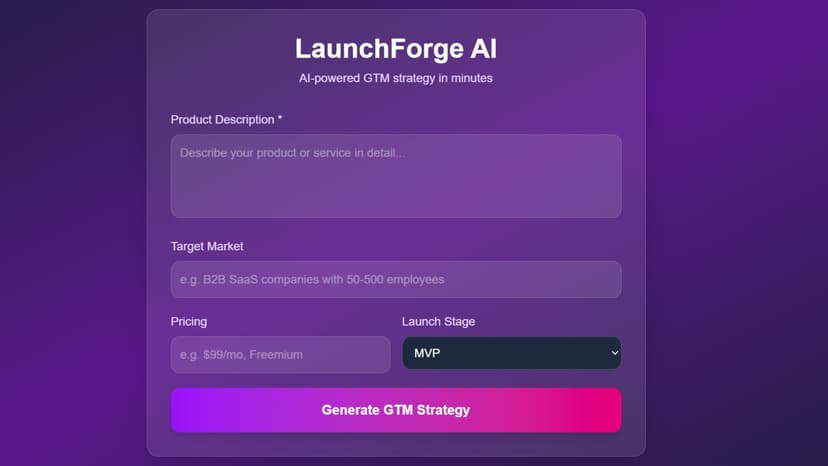
LaunchForge AI
Most products don't fail because of the product. They fail because the go-to-market strategy was an afterthought — disconnected documents, generic content, and positioning that was never tied to a real customer profile. LaunchForge AI fixes that in under 3 minutes. Describe your product in plain language. That's the only input required. From there, a pipeline of 6 specialized AI agents takes over — each one receiving the validated output of the previous one and building on it. Here's what that looks like in practice: Agent 1 defines your positioning — your category, differentiation, messaging pillars, and value proposition. Agent 2 builds your Ideal Customer Profile directly from that positioning — demographics, pain points, buying triggers, objections, and willingness to pay. Agent 3 constructs a phased launch timeline around your ICP's buying triggers, with KPIs, budget assumptions, and channel logic. Agent 4 writes 29 channel-native content assets — LinkedIn posts, email sequences, ad variations, video scripts, landing page headlines, and more — all grounded in the positioning and ICP that came before them. Then Agent 5 scores the entire plan from 0–100 and flags anything that doesn't hold up. Agent 6 runs a 4-dimension strategic audit and issues a final verdict. The output is a complete, validated, downloadable GTM plan — not a template, not a prompt response. A strategy where every piece connects to every other piece. LaunchForge AI is production-ready: 11 user stories, 28 tasks, zero open blockers. Built to ship — and built to help you do the same.
2 Mar 2026

HygiaAI -- Qdrant-Powered Clinical Memory System
HygiaAI: Qdrant-Powered Clinical Memory System HygiaAI is an AI-powered Clinical Memory System for rural and low-resource clinics. It captures doctor–patient conversations, converts them into structured SOAP notes, generates multimodal embeddings (text, labs, imaging), and stores them in Qdrant as long-term semantic memory. The Problem: Doctors in low-resource clinics lack access to prior patient cases or institutional memory. Critical data—past conversations, medical images, test results—often remain fragmented or lost, leading to repeated misdiagnoses and preventable errors. How It Works: Real-time transcription → Medical entity extraction → SOAP note generation → Multimodal embedding (BioBERT/CLIP/AudioCLIP) → Qdrant storage → Instant similar case retrieval (<300ms) → RAG-based clinical insights → Continuous learning. Key Capabilities: Similar case search (top 3–5 past cases), temporal filtering, outbreak detection via clustering, trend analysis, HIPAA/GDPR compliant with local-first deployment. Value: Enables instant retrieval of similar past cases, treatment histories, and clinical patterns—even fully offline. Qdrant's vector search, payload filters, multi-vector embeddings, and temporal clustering make HygiaAI a continuously learning system capable of outbreak detection and trend analysis. By combining multimodal AI + Qdrant, HygiaAI empowers rural doctors with decision support, structured documentation, and clinical knowledge that improves with every patient encounter.
19 Nov 2025

AstraOps
A comprehensive dashboard for space mission management that includes real-time orbital monitoring, AI-assisted planning, and 3D visualization. Designed for space experts and fans to improve satellite operations and space exploration efforts. Core Capabilities: 1. CesiumJS 3D globe enables real-time satellite tracking. 2. DeepSeek AI assistant for mission planning includes automated trajectory optimization methods. Secure JWT authentication system NASA Astronomy Picture of the Day Integration Technical Highlights: Frontend: React + TypeScript + Tailwind CSS. Backend: FastAPI + Python + SQLAlchemy. AI: DeepSeek-R1 using OpenRouter API DevOps: Docker + GitHub Actions + Vercel/Railway. Developed to connect space data analysis with operational decision-making via modern web technologies and AI integration. Objectives include increased mission efficiency and collaborative space operations management.
9 Feb 2025


