

Riya Bhadauria@riyabhadauria89
1
Events attended
1
Submissions made
India
1 year of experience
About me
I am Riya Bhadauria, a second-year IoT-CS engineering student at the University of Engineering and Management, Kolkata, with a passion for technology, creativity, and continuous self-improvement. I am an aspiring AI/ML Engineer and Software Developer who enjoys exploring how technology can solve real-world problems. My journey in programming began with web development, and I am continuously strengthening my skills in Python, Java, HTML, CSS, and JavaScript. I am particularly interested in artificial intelligence, machine learning, and full-stack development, and I enjoy turning innovative ideas into practical projects.
🤓 Latest Submissions
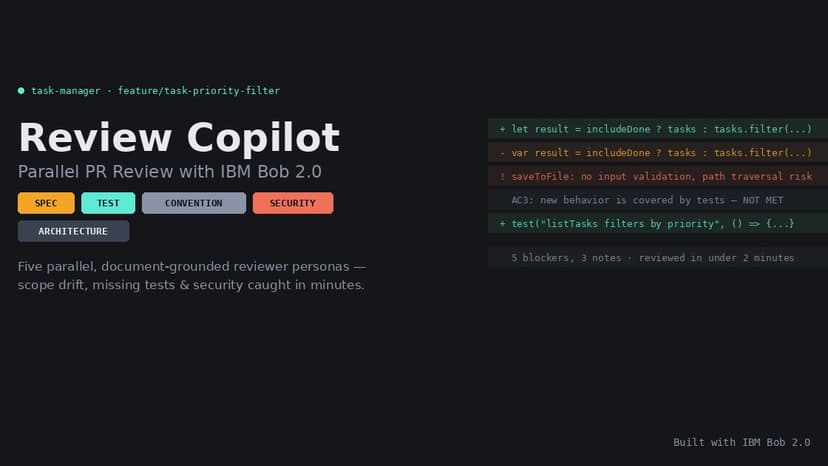
Review Copilot: Parallel PR Review with IBM Bob2.0
Code review is the slowest, leakiest stage of the software development lifecycle. A single reviewer is expected to hold too many lenses at once: does this match the ticket, does it follow team conventions, is it tested, is it secure, does it respect past architecture decisions. In practice, PRs sit in a review queue for 1–3 days, 20–30% of review comments are mechanical issues that cost expensive senior-engineer attention, and issues caught after merge cost 5–10x more to fix than issues caught at review time. Review Copilot targets this directly using IBM Bob 2.0. Instead of one linear AI assistant pass, Bob's Agent mode acts as an orchestrator: it reads a PR diff, decides which of five specialized subagent personas apply, and dispatches them in parallel — spec-compliance, convention, test-coverage, security, and architecture-fit. Each persona is grounded via document understanding in the team's real artifacts (the linked ticket, CONTRIBUTING.md, ADRs) rather than generic best-practice advice, so findings are specific to the actual repo, not boilerplate. The target users are engineering teams who currently spend disproportionate review time on mechanical issues while cross-cutting concerns (does this match the spec, does it violate an old architecture decision) get missed entirely. Developers interact with it the same way they already talk to Bob — "review the changes on this branch" — and get back one deduplicated, severity-ranked review instead of a wall of duplicate comments from five separate checks. In a real test run against a planted PR, Review Copilot went from prompt to a complete, cross-domain review in under two minutes. It caught a scope-drift violation against both the linked ticket and an existing ADR, a missing-test gap against a stated acceptance criterion, and a path-traversal security vulnerability that emerged from the security persona's own reasoning about untrusted input — not from a scripted rule. It correctly deduplicated findings that two personas flagged independently, and proposed a concrete, actionable path to a mergeable PR. What makes this original is that it isn't a single AI reviewer — it's a small team of narrowly-scoped, parallel reviewers coordinated by Bob's Agent mode, each with read-only access to only what it needs, producing one coherent review instead of a merged pile of comments.
27 Sep 2026

