🤓 Latest Submissions

Industrial Fault Copilot
Long Description Industrial Fault Copilot is an AI-powered troubleshooting assistant designed to help industrial maintenance teams diagnose equipment faults faster and more reliably. The system receives machine symptoms and alarm codes, consults technical documentation, and produces a structured diagnosis with actionable recommendations and references to the relevant manual sections. When the available evidence is insufficient, the system explicitly flags uncertainty and escalates the case for human review instead of inventing an answer. The project combines a Java 21 and Spring Boot backend with Evolus agent capabilities and a knowledge base built from industrial equipment documentation. Our planned workflow connects fault reports to document-grounded analysis, traceable recommendations, and human escalation. The MVP focuses on the ABB ACS580 variable frequency drive and its standard control program manual. We will evaluate the assistant against a curated set of test cases, measuring citation accuracy, escalation behavior, unsupported answers, and response latency. The goal is to demonstrate a practical, auditable AI assistant for industrial maintenance that improves access to technical knowledge while keeping safety and human oversight central.
18 Oct 2026
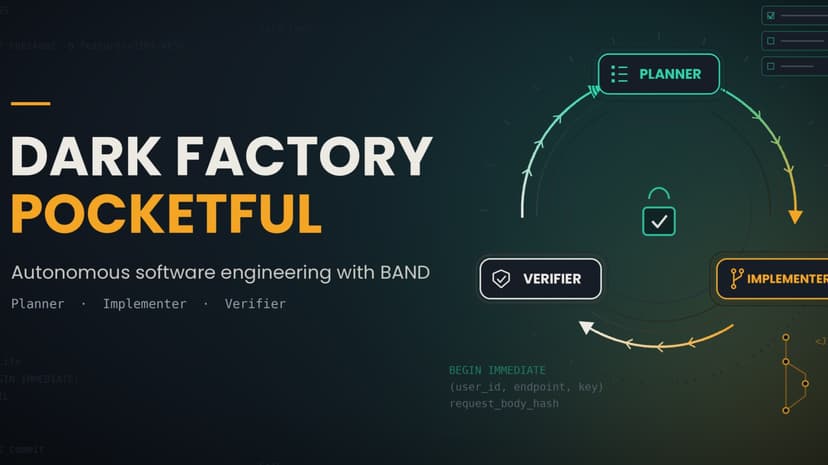
Dark Factory Pocketful
Dark Factory Pocketful is an autonomous software factory built with BAND to demonstrate how specialized AI coding agents can collaborate on a real software project. The factory separates responsibilities between three agents: a Planner coordinates the work and manages Jira tasks, an Implementer writes the code following GitFlow, and a Verifier independently reviews the implementation and runs the required tests. The workflow is intentionally structured as Planner → Implementer → Planner → Verifier → Planner, creating a traceable development loop instead of allowing agents to modify and approve their own work. For the Pocketful track, the factory builds a payments and wallet API where correctness under concurrency is a core requirement. The implementation uses atomic SQLite transactions, integer minor-unit arithmetic, idempotency keys, request-body hashing, authentication, and explicit error handling to prevent duplicated or lost money during retries and concurrent operations. GitHub, Jira, GitFlow, automated tests, and BAND/OpenCode are integrated into the workflow so implementation work remains traceable through branches, commits, verification evidence, and Jira tasks. The goal is not simply to generate code with AI, but to demonstrate a repeatable software-engineering process where AI agents coordinate, implement, review, and continuously advance a project while preserving clear ownership and verification boundaries.
6 Oct 2026

Choir Corrector
Choir Corrector is an AI-powered mobile application designed to help choir directors analyze rehearsals more effectively. It compares a choir rehearsal against a reference performance and identifies where the performance deviates in pitch and timing. The application uses a Kotlin Multiplatform and Compose Multiplatform mobile client connected to a Java and Spring Boot backend. Audio is uploaded using streaming multipart requests, allowing the application to process long WAV recordings without loading the entire file into mobile memory. On the analysis side, Choir Corrector combines chroma-based audio features with Dynamic Time Warping (DTW) to align a real choir performance with its reference, making the approach more suitable for polyphonic recordings than a simple monophonic pitch detector. The backend produces time-aligned segments with pitch deviation measured in cents, timing information, and severity indicators. The project was validated end-to-end with real choir audio, including a mobile upload, asynchronous analysis, polling, and visualization of thousands of detected segments. Choir Corrector aims to turn a long and difficult-to-review rehearsal recording into actionable information, helping directors quickly identify sections that require attention and giving singers more focused feedback.
16 Sep 2026

Alpaca Options Agent
Alpaca Options Agent is an AI-assisted options trading decision engine designed around a simple principle: AI can analyze and explain a potential opportunity, but deterministic risk controls remain in charge. The system obtains real market data through Alpaca and detects bullish technical setups using SMA(9) and SMA(21) crossover analysis. A Large Language Model then independently evaluates the technical setup and provides an explicit confirmation together with its reasoning. LLM confirmation alone can never approve an operation. Deterministic risk gates validate maximum account risk, daily operation limits, option expiration constraints, maximum loss ratio, and required risk data. Any failed gate produces a rejection. Every evaluated decision is recorded with a timestamp, status, and reasoning, distinguishing APPROVED, LLM_REJECTED, and RISK_REJECTED outcomes. This provides an auditable trail and a foundation for future P&L reporting. The prototype is implemented with Java 21, Spring, Spring AI/ChatClient, Alpaca CLI, JUnit, and Mockito. The current implementation has 22 automated tests passing with zero failures and zero errors. The project focuses on explainability, controlled AI assistance, deterministic safety boundaries, and traceable trading decisions rather than unrestricted autonomous trading.
4 Sep 2026


