

🤝 Top Collaborators


🤓 Latest Submissions
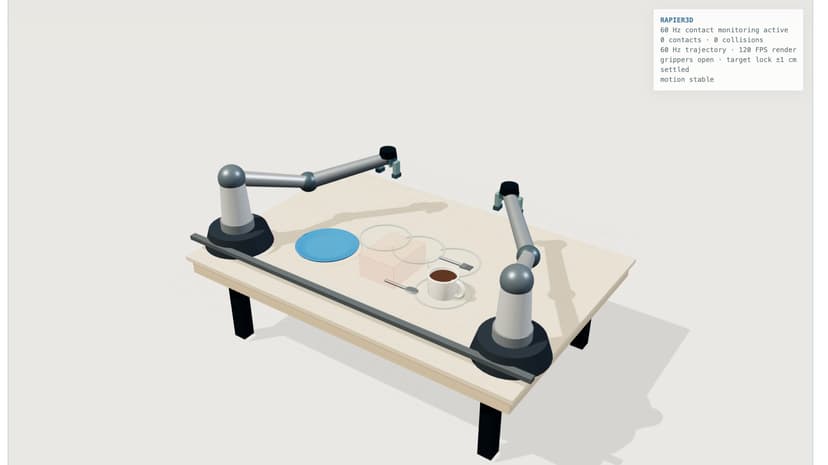
VoxHands
VoxHands is a voice-first dual-arm tabletop assistant that separates language from action. A Groq-powered tool loop turns a command such as "set the table for two" into a bounded set of workcell tools, never raw motor commands. A deterministic Python validator enforces workcell bounds, collision rules, and no-go safety zones before anything moves, refusing unsafe requests outright. The Python simulation owns authoritative object and arm state, while the browser renders the workcell and confirms contact through Rapier3D physics at 60 Hz. The deployed service runs a real MuJoCo backend: two SO-101-style six-DOF arms driven by Jacobian inverse kinematics, kinematic grasp and release, and gravity-settled placement, with overhead and operator camera views. MuJoCo's offscreen renderer needs an EGL/OSMesa GL stack that Render's native Python runtime cannot install, so the blueprint builds a Docker image (Python 3.13, mujoco, Pillow, OpenVINO); the robot adapter now reports available live instead of falling back to the deterministic simulator. VoxHands also carries a real Intel optimization path, not a stand-in: the policy network is exported to a genuine OpenVINO IR, quantized to INT8 with NNCF post-training quantization, and benchmarked on CPU. INT8 reaches 1.21x to 1.71x speedup on compute-bound models and 5,003 inferences/second asynchronous throughput, while we state plainly that the tiny workcell policy is dispatch-bound and gains nothing from INT8. All figures are measured on the live host. That honesty is the point: we report what is verified and gate what is not, with GPU and NPU acceleration explicitly unverified until it runs on Intel Core Ultra hardware. The result is a reproducible, MIT-licensed testbed for physical AI where optional backends, MuJoCo, OpenVINO vision, and browser physics, activate when present and degrade gracefully when absent. Grasping and placement remain simplified and no physical robot is driven: everything executes in simulation.
16 Sep 2026

RazorStack Trading
RazorStack Trading is an AI-assisted research and paper-trading workspace designed to make quantitative decision-making more explainable, measurable, and risk-aware. The platform combines AI research agents, a quantitative signal engine, portfolio analytics, backtesting, and a server-side risk gate into one integrated workflow. Users can discover market opportunities, inspect the evidence behind a signal, evaluate historical behavior, review data quality and portfolio implications, and submit only eligible proposals for risk review. At the center of RazorStack is a transparent quant engine that combines momentum, trend, volume confirmation, mean-reversion bias, and volatility quality into a structured BUY, SELL, or HOLD signal. Each output includes supporting indicators, market-regime context, drawdown measures, realized volatility, strategy rationale, and data-source metadata. The platform is intentionally designed around a clear safety boundary: quantitative and AI components may propose, but the risk service remains the sole approval authority. The browser cannot bypass risk controls or access broker credentials. HOLD signals cannot create orders, and every proposal is intended to move through an auditable lifecycle—from proposal and approval to adjustment, rejection, submission, or failure. RazorStack currently supports offline and mock-broker workflows for safe development and demos, with an architecture prepared for Alpaca paper trading, persisted strategy outcomes, richer data-quality tracking, correlation analysis, options metrics, and live paper-performance monitoring.
4 Sep 2026


