
Sameer Chaudhary@sameer14om26631
2
Events attended
1
Submissions made
India
3+ years of experience
About me
I am Sameer Chaudhary, a driven and adaptable individual with a strong focus on emerging technologies and continuous personal development. My technical foundation includes hands-on exposure to drone technology and a solid understanding of online safety protocols, allowing me to navigate modern digital landscapes with confidence and foresight. I bring a balanced approach to my work, combining technical curiosity with strong collaborative abilities. Whether participating in structured, synchronized group activities or stepping into formal professional settings, I value teamwork, coordination, and presenting myself with polish and purpose. Outside of my core pursuits, I draw inspiration from travel and shared experiences across Maharashtra, which keeps me grounded and open to new perspectives. At 20 years old, I am focused on leveraging my technical insights and team-oriented mindset to tackle complex challenges. I aspire to continue growing my expertise in technology while taking on roles that push me to think critically, collaborate effectively, and drive meaningful progress.
🤝 Top Collaborators



🤓 Latest Submissions
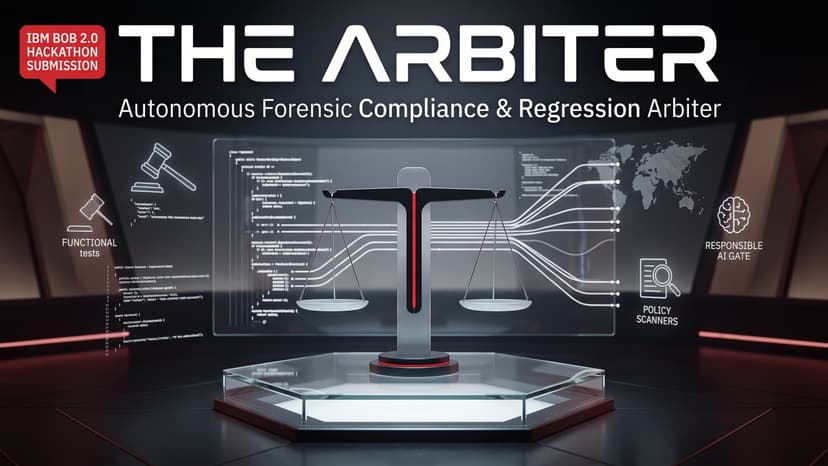
The Arbiter
Modern CI/CD pipelines isolate functional regression testing from security and governance enforcement. When developers rush to resolve broken builds, they frequently introduce compliance violations—such as logging user identifiers or hardcoding credentials to rapidly debug a failure. Engineers and security teams must manually correlate stack traces, git blame history, and policy documents, producing immense DevOps toil while compounding enterprise compliance risk. The Arbiter is an agentic forensic remediation engine that treats codebase regressions and policy violations as the exact same class of forensic problem. Operating on a deterministic 8-layer cognitive state machine, The Arbiter subpoenas repository evidence, traces suspect commits via line-level git blame, formulates root-cause hypotheses, and autonomously drafts remediation patches. Built with provider-agnostic flexibility via a dynamic agent factory, The Arbiter allows teams to plug in any LLM API as its reasoning engine—empowering enterprises to use Granite, Claude, GPT, or custom self-hosted models. Target users include software development teams, DevSecOps leads, and compliance auditors. Users interact with The Arbiter through a courtroom-themed CLI or automated CI/CD webhooks. The system presents rich terminal visualizations of collected evidence, severity classifications, and patch iterations. Once a remediation is verified, The Arbiter generates an auditable, Markdown-formatted "Docket" detailing the incident, suspect commits, validation proofs, and parole guardrails, pausing at an interactive Human Approval Gate for operator review. What makes The Arbiter unique is its courtroom forensic architecture and its adversarial Dual-Validation Engine. Conventional AI coding tools evaluate patches solely against test suites; The Arbiter treats functional correctness and organizational governance policies as co-equals. If the active model generates a patch that resolves an infinite retry loop but introduces a plain-text PII log, the Dual Validator rejects the patch, feeds the scanner diagnostic back into the model's context window, and forces an iterative rewrite. Responsible AI guardrails prevent unconstrained autonomy: high-risk modules (such as authentication or payments), low confidence scores (<0.75), or policy violations mandate human sign-off, while every state transition is committed to an immutable, append-only JSONL audit ledger. The Arbiter addresses codebase degradation effectively and efficiently by consolidating disparate triage steps into a continuous agentic loop. By pairing automated git attribution with simultaneous test and policy verification across any backend model, it compresses multi-hour debugging and compliance review cycles into minutes, eliminates fix-induced regressions, and delivers audit-ready documentation for every change.
27 Sep 2026

