
🤝 Top Collaborators


🤓 Latest Submissions
BugForge
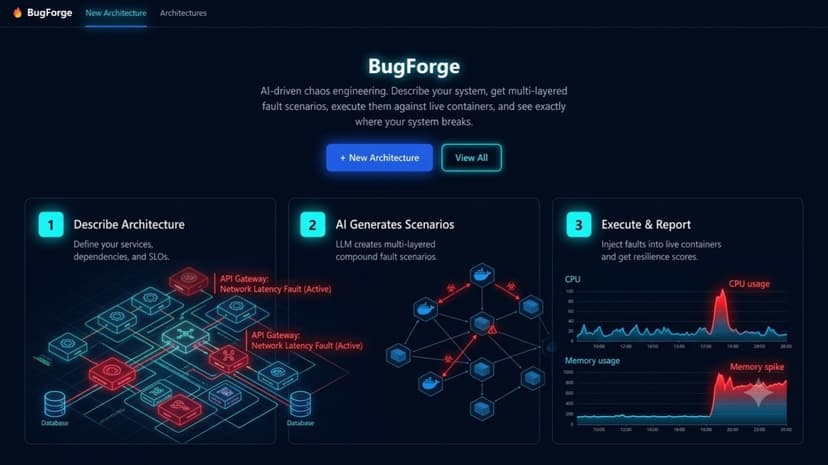
BugForge — AI-Driven Chaos Engineering Platform The Problem Modern systems fail in compound, unpredictable ways — not just one thing at a time. Yet engineers practicing chaos testing almost always test simple, single-fault scenarios: kill one container, inject one latency. They rarely combine multiple simultaneous failures. The result is a false sense of resilience — systems that pass every individual chaos test but collapse when two or three failure modes hit at once. Traditional chaos tools also lack structure: no scenario review before execution, no automatic fault revert, and no standardized reporting. The Solution BugForge uses an LLM (OpenAI GPT-4o or IBM watsonx Granite) to generate compound, multi-layered fault scenarios that human engineers rarely think to combine — like "inject 300ms latency on the API while the database is frozen while the worker is under 90% CPU stress." These are the scenarios that expose real weaknesses: missing retry logic, absent circuit breakers, connection pool exhaustion. A human-in-the-loop approval step ensures no fault is ever injected without explicit sign-off. Once approved, BugForge executes faults directly against live Docker containers using 6 fault types — container kill, process freeze, network partition, CPU stress, memory stress, and latency injection — all automatically reverted after each step. Real-time container logs and CPU/memory metrics are streamed during execution. A structured report then shows per-step pass/fail results, peak resource charts, and an optional LLM-written resilience score from 1 to 10. Target Users Site reliability engineers, platform engineers, and backend developers operating microservice systems on Docker or Docker Compose environments. What Makes It Unique AI-generated compound scenarios — the LLM designs failure combinations humans would not think to test Human-in-the-loop approval — no fault touches a container without engineer sign-off End-to-end in one platform — design, approve, execute, observe, and report in a single tool The entire workflow — from describing a system to reading the final resilience report — takes minutes, not days.
27 Sep 2026
