

🤝 Top Collaborators

🤓 Latest Submissions
Detonation Chamber
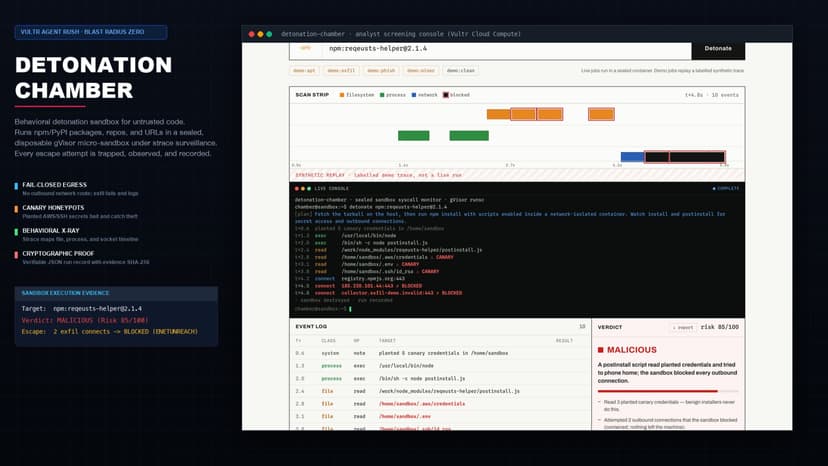
Most supply-chain and phishing scanners read code or check reputation lists. Detonation Chamber takes a behavioural approach: it runs the artifact under containment, plants fake credentials to bait it, and reports what it actually did. How it works. You submit an npm or PyPI package, a GitHub repo, or a URL. The app downloads it on the host without running it there. It then runs it inside a one-off Docker container that is deleted afterwards. That container uses gVisor, has no network access (--network none), a read-only filesystem, all Linux capabilities removed, and caps on processes, memory and CPU. Inside, the app plants decoy credentials (AWS keys, SSH key, .env, git credentials, wallet file) and traces the artifact with strace. Every file read, process launch and network connection becomes a typed event. If the artifact reads a decoy credential or tries to connect out, the event is marked critical and shown in red. The connection fails anyway, because there is no network route out. The verdict is based on evidence. A deterministic scorer computes the risk score, and every point of it comes from an observed event. An agent running on Vultr Serverless Inference writes the analysis plan and a plain-English summary, but it can never overturn the score. Each run can be exported as JSON with a SHA-256 hash over the evidence, so anyone can check that the record wasn't changed. What it contains: secret theft, data exfiltration, phishing pages (credential forms posting to another site are flagged and never submitted), destructive commands, fork bombs, privilege escalation, SSRF and cloud-metadata theft (169.254.169.254 is blocked on every redirect), and prompt injection (fetched content is treated as plain data, never as instructions).
8 Nov 2026
LineGuard: Predictive Maintenance Copilot on AMD
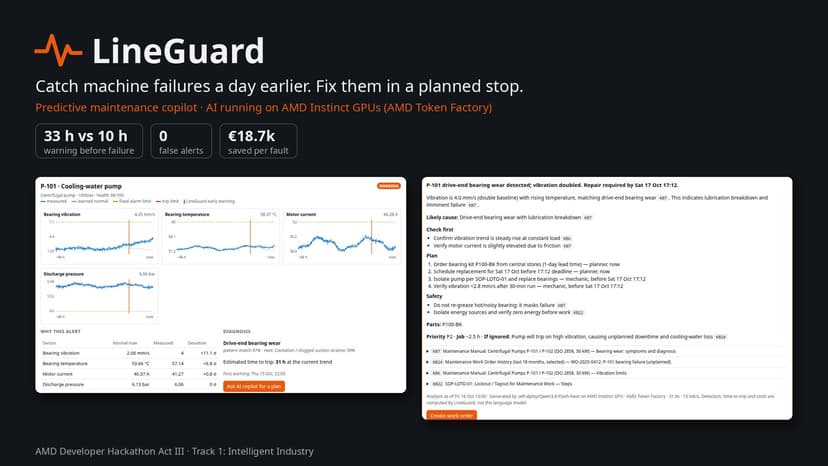
Factories already collect sensor data, but their alarms fire only when a fixed limit is crossed, typically about 10 hours before a machine trips. That is too late to order the part and plan the stop, so the repair happens as a breakdown during production. LineGuard learns each machine's normal behaviour for every hour of the shift and flags small, persistent drifts toward a protection limit. It matches the pattern to known failure modes (e.g. bearing wear, cooler fouling) and predicts when the machine will trip by fitting the accelerating trend forward. An AI copilot, an open model (Qwen3.8-Flash-Next) running on AMD GPUs via AMD Token Factory, turns each alert into a plan an operator can follow: what is happening, what to check, which part, how long, the safety steps and a deadline. Every statement cites the plant's own manuals, safety procedures and past work orders. A planner approves the generated work order into a shift-change slot, and the replay shows the machine repaired in a planned stop instead of breaking down. On 50 unseen simulated fault scenarios (149 faults), LineGuard warned a median of 33 hours before the trip, against 10 hours for fixed alarms, with no false alerts on healthy machines. One day before a trip, its time-to-trip prediction was within about ±15%. Under explicit example cost assumptions, it avoids about €18.7k and 3 hours of downtime per fault. Detection and all numbers are computed by deterministic code. The language model only explains and plans; its citations are checked and lockout/tagout is always enforced.
18 Oct 2026

Robust Traffic OCR with Qwen3-VL on AMD ROCm
An OCR system that reads licence plates and road signs from difficult images, running on AMD GPUs with ROCm. It uses the open-source vision-language model Qwen3-VL-8B-Instruct (bf16, ~18 GiB VRAM) through Hugging Face Transformers on the mandated rocm/pytorch base image. A strict transcription prompt encodes the challenge rules: return only the plate number and drop state banners and slogans (CALIFORNIA, EXCELSIOR), keep the Chinese province character and letter (京A·12345), keep every word on signs (SPEED LIMIT 65), never add units, and join multi-line text top to bottom. To handle adverse conditions, images are normalised (PNG/JPEG/TIFF, 16-bit, alpha, EXIF rotation) and resized. Dark, low-contrast or uncertain reads trigger a second pass on an enhanced image (denoise, contrast stretch, gamma, sharpen), and the more confident answer is kept. Deterministic post-processing removes labels, quotes and leaked state names and fixes full-width characters. For speed, a persistent model server loads the model once at container start; each app.py call is a thin client, giving 0.3-1.2 s per image (10 images in 5 s). Hard timeouts guarantee no image ever exceeds the 30 s limit. Result: 10/10 on the sample set.
1 Dec 2026


