

Shamveel Mazhar@shamveelmazhar
4
Events attended
2
Submissions made
Pakistan
1 year of experience
About me
I’m a Mechanical Engineering graduate from UET Lahore, and I’m interested in using AI to solve real engineering problems. I have worked in maintenance for a public transport bus fleet and as a trainee engineer at a large polyester manufacturing plant, where I monitored a gas turbine and checked vibration and bearings on high-speed spinning machines. Working with machines that run day and night showed me how much depends on catching a problem early. I want to predict when a bearing, a cutting tool, or a machine part is about to fail, before it stops the line. I want to turn vibration and sensor readings into warnings an engineer can trust, use plant data to cut downtime and energy losses, and use computer vision for inspection work still done by eye. My final year project, “Tool Wear Prediction Using Machine Learning,” was my first step in this direction. I mainly program in Python and I’m building my skills in machine learning and AI. I also practice on LeetCode to improve my logic. I want to build things that actually work in the real world, not just models that perform well on a dataset. I enjoy hackathons because they let me experiment, learn from others, and turn ideas into working solutions. At the Fortyguard Hackathon 2026, my team and I built CoolCore, a heat-aware commute route guidance tool. At the Alpaca AI Trading Agents Hackathon on lablab.ai, we built RaptorClick, a paper-trading prototype where AI agents propose portfolio hedges and a rule-based Risk Governor approves them before execution. Both taught me to build systems whose outputs can be checked, not trusted blindly. My long-term goal is to work at the intersection of AI and engineering and use both to solve practical, complex problems.
🤝 Top Collaborators


🤓 Latest Submissions
RepeatFix
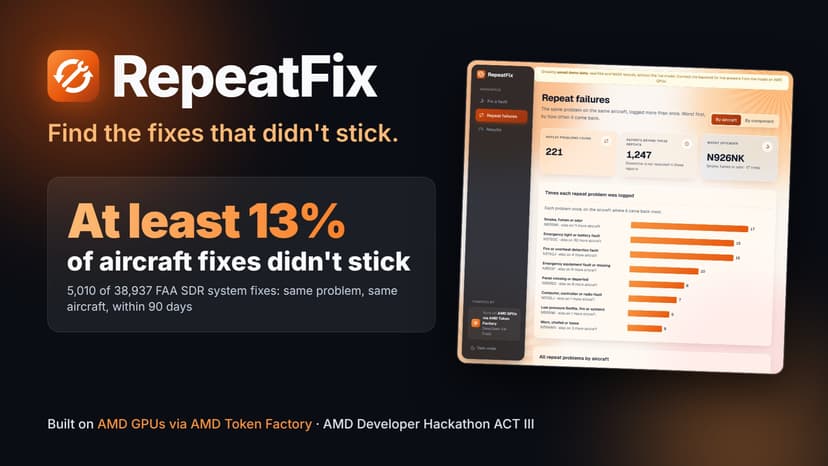
Airlines lose aircraft availability when a fix doesn't hold and the same fault comes back. The evidence is already in the maintenance logs, but it sits in messy free text that nobody has time to read. In 180,012 real FAA Service Difficulty Reports (2024 to 2026) we found that at least 13% of fixes didn't stick: in 5,010 of 38,937 system fixes, the same problem came back on the same aircraft within 90 days. RepeatFix is a reliability-engineering tool for that problem. It reads raw logbook entries (FAA SDR and NASA ASRS reports) and turns them into structured job cards with an ATA chapter, a component, a failure mode and the action taken. A deterministic repeat engine then ranks the "bad actors": 16,473 repeat groups in the full set, such as one A320neo (N926NK) with 17 cabin fume events. When a new fault comes in, RepeatFix shows the most similar past fixes, the likely causes, the matching procedure from FAA AC 43.13-1B or the AMT Handbooks (FAA-H-8083-30B/31B/32B) cited by chapter and page, and a draft work order. A supervisor edits and approves it; nothing runs on its own. All model calls run DeepSeek on AMD GPUs via AMD Token Factory. The backend is FastAPI on Railway (extraction, TF-IDF retrieval, repeat engine) and the frontend is Next.js on Vercel. Measured: 68% agreement with a keyword parser's labels (not hand labels), a 15.9 s median answer and 20 tokens/s.
18 Oct 2026
raptorclick
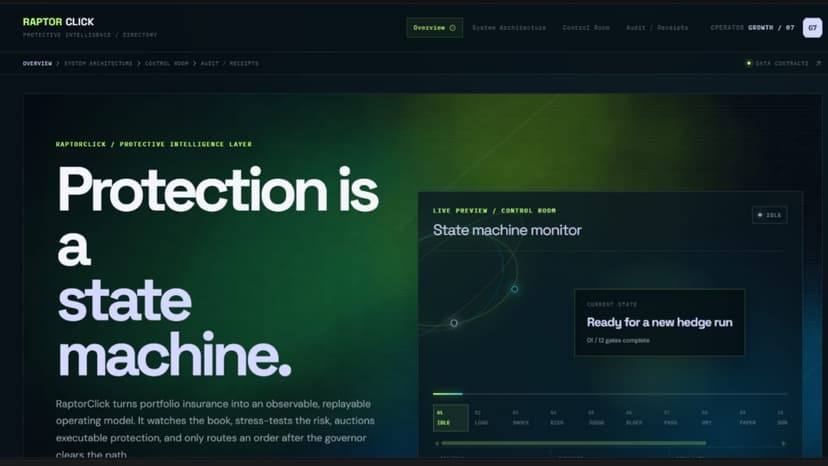
RaptorClick is an AI-assisted portfolio-protection market built for Alpaca paper trading. Instead of treating hedging as a single opaque recommendation, RaptorClick asks specialized hedge agents to propose protection for an existing portfolio. Each proposal is typed, scored through deterministic risk logic, and compared before the system can progress toward paper execution. The system reads Alpaca paper-account state, including account equity and positions, then evaluates hedge candidates against portfolio exposure, concentration, drawdown, premium cost, protection coverage, and execution constraints. A Risk Governor applies explicit approval rules. An agent cannot override those rules. The platform also maintains a Shadow Book: an unprotected comparison state used to calculate Protection Delta, making the cost and expected protection of a hedge visible rather than hidden behind an AI recommendation. RaptorClick includes: • Alpaca paper portfolio integration • Typed hedge proposals and deterministic risk scoring • Portfolio, exposure, and protection monitoring • A control-room dashboard with replayable agent activity • FastAPI REST endpoints and event-stream architecture • Paper execution disabled by default for safe review For this hackathon prototype, we focus on transparent, paper-only portfolio protection. No live-money trading or unsupported performance claims are made.
4 Sep 2026


