
Khalid Hussain@sheikh_khalid_hussain
2
Events attended
2
Submissions made
Pakistan
2+ years of experience
About me
Computer Engineer from Karachi, Pakistan building Android applications, modern web platforms, and engineering-focused software using Java, Python, React, Firebase, and contemporary development technologies. Focused on delivering practical software across mobile applications, AI-assisted web systems, automation platforms, operational workflows, and real-world engineering solutions. ~20+ Apps & Platforms Built ~5+ Published & Production Projects ~2.5+ Years of Active Development ~2024 13 Dimensions Studio Founded
🔥 Own Projects


🤓 Latest Submissions
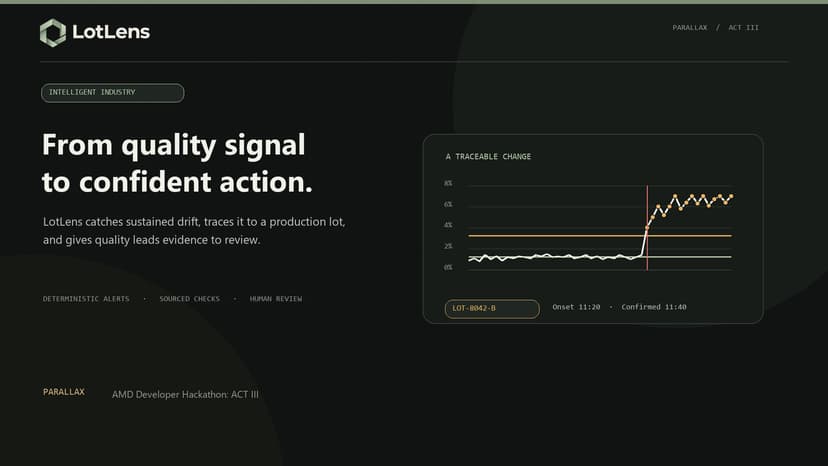
LotLens — Quality Drift Investigator
Manufacturing quality teams need to connect a changing defect trend to the production lot and evidence behind it. LotLens turns timestamped inspection readings into an explainable drift alert, identifies the affected line, lot, and time window, and presents the supporting readings alongside synthetic procedure excerpts. The detector calculates its baseline and alert locally using a transparent sustained-change rule. When AMD model access is configured, an AMD-hosted open model turns the calculated finding and supplied procedure excerpts into a concise investigation brief with source-linked possible checks and visible uncertainty. The model does not calculate the alert or determine a root cause. A quality lead reviews the finding and decides what to do. LotLens also includes an inventory-impact workflow that maps an alerted lot to a synthetic SKU and order snapshot. It compares affected reservations and unallocated orders with unaffected stock, then presents a human-reviewed allocation suggestion. It does not change inventory or orders. The demo uses synthetic readings and synthetic procedure excerpts, including a factory-derived synthetic fixture that is not an independent production export. LotLens has no live factory or inventory connection and is not validated for industrial quality control.
18 Oct 2026
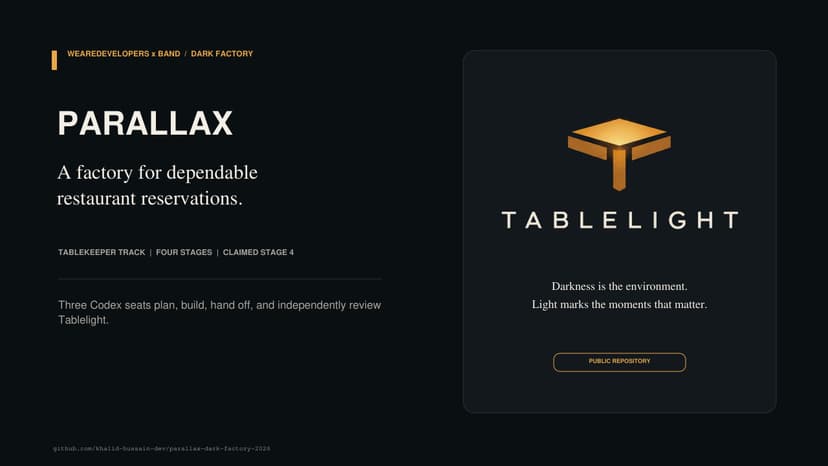
PARALLAX / Tablelight
PARALLAX built Tablelight for the tablekeeper track: a restaurant reservation service developed by a three-seat factory in BAND Desktop. The Planner scopes a complete stage task and coordinates integration, the Implementer owns a separate implementation slice, and the Reviewer independently checks the requirements and rechecks corrections. The factory carried one service through four stages: an idempotent reservation API with atomic operations; a browser booking flow and combined tables; effective-dated policies, truthful reservation history, and recurring reservations; then deterministic closure replanning and recurring-series amendments. During Stage 4 review, the Reviewer found that a standalone booking did not advance the restaurant revision, allowing an old closure preview to appear current. The fix corrected revision accounting, and the Reviewer reproduced the stale-plan rejection on the exact corrected commit. The cumulative isolated harness reported 120/120 Stage 1, 25/25 Stage 2, 7/7 Stage 3, and 6/6 Stage 4 checks, claiming Stage 4. BAND displayed an estimated $4.24 for the main room and $0.07 plus $0.01 for setup rooms. Separate agent-card estimates total $4.31 and do not reconcile with room-header figures, so we report them separately. Total hands-on time was not measured. The public repository contains the factory documentation, generic mandates, room export, stage services, run instructions, and evidence.
6 Oct 2026

