
🤝 Top Collaborators


🤓 Latest Submissions
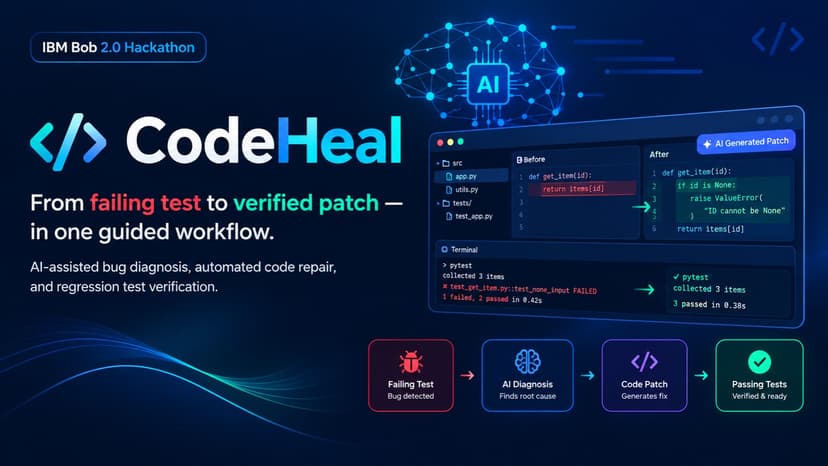
CodeHeal — AI-Powered Bug Repair
1. Problem - Software debugging often involves a repetitive sequence of manual steps. When a test fails, developers need to reproduce the failure, understand the root cause, locate the affected code, implement a fix, create or update a regression test, and then verify that the change does not introduce another failure. Moving between these steps can make debugging slower and harder to track. 2. Solution - CodeHeal is an AI-assisted software debugging and code repair platform that connects these activities into one guided workflow. It takes a failing software scenario and moves through diagnosis, reproducible testing, repair, and verification while making the progress visible to the developer. 3. How CodeHeal works - A user selects a seeded bug scenario through the web interface and starts the CodeHeal pipeline. The system first runs the existing tests and displays the failure. An AI-assisted diagnosis stage analyzes the failure and identifies the likely root cause and affected file. CodeHeal then generates a reproducible test designed to capture the reported behavior. After the failure is confirmed, the repair stage generates a targeted code change. The proposed change is validated and applied to the repository, after which the relevant tests are executed again to verify the repair. The interface exposes the stages of the process rather than hiding them behind a single automated action. Users can see the initial test result, diagnosis, generated test, repair stage, and final verification result. A before-and-after code diff also makes the proposed change reviewable. 4. Demonstrated scenarios - The prototype contains three seeded bug scenarios. The first involves missing validation for a None input that produces a TypeError. The second involves a broken API route caused by a visually similar Cyrillic character being used instead of the expected ASCII character. The third involves an off-by-one boundary condition where a negative list-slice start produces an incorrect result when the requested number of items exceeds the list length. 5. Target users - CodeHeal is designed for software developers, students, coding teams, and developers learning debugging and automated testing. A user interacts with the frontend, chooses a scenario, starts the pipeline, and reviews the diagnosis, generated test, proposed repair, and verification result. 6. Technology - The frontend uses React and Vite. The backend uses Python and FastAPI for pipeline orchestration, repository handling, and test execution. IBM watsonx.ai with an IBM Granite model provides AI-assisted diagnosis and repair support. pytest is used for automated testing and post-fix verification. The frontend is deployed on Vercel and the backend on Render, with the source code maintained in GitHub. 7. What makes CodeHeal distinctive - CodeHeal combines AI-assisted debugging with reproducible regression testing and explicit post-repair verification. Instead of presenting an AI-generated code change as automatically correct, the workflow uses test results to provide evidence about whether the repair resolves the observed failure. The generated diff and visible pipeline stages also allow developers to inspect what happened at each step. Human review remains part of the process before accepting or deploying a generated change.
27 Sep 2026
