🤝 Top Collaborators

🤓 Latest Submissions
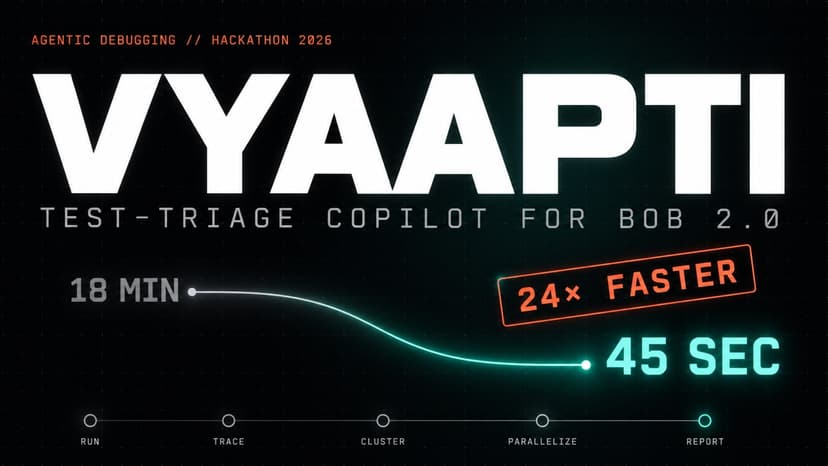
Vyaapti Test-Triage Copilot
PROBLEM In fraud-detection pipelines, a single bug in a shared utility (e.g. a timestamp conversion or threshold constant) can silently break multiple, seemingly unrelated tests across different risk factors. Today, a developer diagnoses each failing test independently -- reading the stack trace, tracing the call chain, and re-deriving the same root cause multiple times without realizing several failures share one origin. In our sample project Vyaapti (an RTGS Risk-Chain Analyzer that scores transaction chains against five fraud indicators), one bad line in a time-span helper broke 5 tests across two different risk factors, a wrong threshold constant broke 3 structuring tests, and a separate comparison typo broke 1 circular-pattern test -- 9 failures total from just 3 bugs. Manually diagnosing all 9 took approximately 18 minutes, most of which was duplicated investigation. Worse, raw test output gives no indication that failures are related, and does not flag which failures represent compliance-relevant regressions versus routine bugs -- a critical distinction in regulated financial systems. SOLUTION We built Vyaapti Test-Triage Copilot, an IBM Bob 2.0 agent workflow that automates the entire diagnosis pipeline: 1. Bob runs the failing test suite autonomously (Agent Mode) 2. Reads the scoring logic in chain_scoring.py and the compliance reference document RISK_SCORING.md (Document Understanding) 3. Clusters the 9 failures into groups sharing the same root cause 4. Spawns parallel subagents -- one per failure cluster -- to investigate independently (Subagents + Parallel Tasks) 5. Each subagent identifies the exact buggy line, explains why it causes the observed failures, cross-references RISK_SCORING.md to determine compliance impact, and proposes a fix 6. Merges all subagent results into a single structured triage report 7. Applies the fixes and re-runs tests to confirm all pass TARGET USERS Any developer or QA engineer working on a codebase where shared utilities cause cascading test failures -- especially in regulated domains (finance, healthcare, compliance) where distinguishing "flaky test" from "compliance regression" matters. WHAT MAKES IT UNIQUE Most AI coding assistants help with one test at a time. Our workflow operates at the suite level -- it clusters, parallelizes, and cross-references domain documentation to produce a report that a human would need 18+ minutes to assemble. The compliance-awareness (flagging that a structuring bug means missed RBI filings) is something no generic test runner provides. RESULTS Manual diagnosis: ~18 minutes for 9 failures Bob 2.0 workflow: ~45 seconds for the same 9 failures, with compliance flags included All 3 root causes correctly identified, clustered, and fixed in a single pass.
27 Sep 2026
