

Ramzi Hobeishy@silent_key_technologies630
4
Events attended
2
Submissions made
Saudi Arabia
8+ years of experience
About me
Founder of Silent Key Technologies in Riyadh, established in 2025. I design and build privacy products for organisations using AI: NOAI+, a gateway that hides names, ID numbers and medical details before any text reaches an AI model and keeps a signed record of what was sent; Kontra+, contract review for Gulf construction; and SilentBOX, an encrypted personal vault app. NOAI+ runs live on Gemma 4 on AMD GPUs. Inventor on two patent applications filed with the Saudi Authority for Intellectual Property in 2026. Also founder of Knockout Media Lebanon (2018).
🤓 Latest Submissions
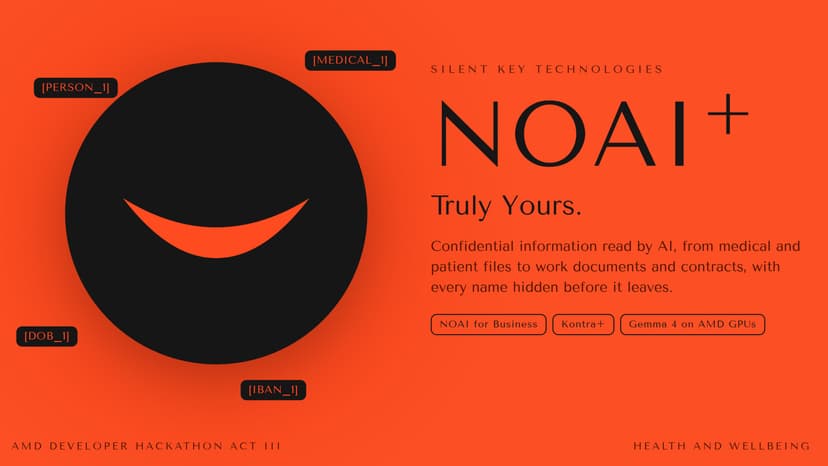
NOAI+: AI reads confidential files, names hidden
NOAI+ by Silent Key Technologies. Truly Yours. AI saves the most time on confidential files, and that is where it is hardest to use. A nurse drafting a discharge letter pastes in the patient's name, ID, birth date, phone and diagnosis. A contracts manager pastes in the parties, the signatory and the bank account. All of it goes to whoever runs the model, and nobody can later show what was sent. NOAI+ sits between staff and the model. Before text leaves, it swaps names, Saudi ID and Iqama numbers, phones, IBANs, addresses, Hijri and Gregorian birth dates, record numbers, hospital names and listed medical terms, in Arabic and English, for placeholders like [PERSON_1] and [MEDICAL_1]. The model writes around them, and the gateway puts the real values back as the answer streams in. Every call leaves a signed, chained receipt with a SHA-256 hash of the exact bytes sent. It runs on AMD: every call goes first to Google's open Gemma 4 on AMD GPUs through AMD Token Factory. Its address is a .cn domain, and only placeholder text ever reaches it, which is the point. If AMD fails or stalls, a backup on Amazon Bedrock answers and the receipt says so. Measured on 14 Oct through the public URL with 40 made-up Saudi patient files and subcontracts carrying 440 planted private values: all 40 answered by Gemma 4 on AMD, none of the 440 reached the model, 159 of 160 restored exactly, median 3.6 seconds per file. Limits, stated plainly: it hides what it recognises and nothing more, it does not make data anonymous or anyone compliant with a law, and patient output is a draft for a person to check, never medical advice. Open source under Apache 2.0.
18 Oct 2026

Silent Key RAG: cited answers on AMD ROCm
Silent Key RAG is a single container built on the mandated ROCm PyTorch base image, with its layers kept byte for byte so the base check passes. One resident process loads Qwen3-VL-8B once and keeps the index in memory, so each question pays only for retrieval and one model call. Every file goes through a defensive parser. Empty folders, unreadable and encrypted files, and unknown formats are skipped and logged instead of crashing the run. Images are read by the vision model, so answers that only exist inside a picture are still found. Retrieval is exact BM25 over chunks. The model proposes an answer and its sources; deterministic code then checks that the answer really occurs in a readable file, keeps exactly one answer file (current over superseded) plus a second only when it is a genuine bridge, and runs a short yes or no check that turns near misses into refusals, because citations are graded as an exact set. When nothing in the corpus supports an answer, the container refuses rather than guessing. The image ships its own weights, needs no network at evaluation, and is sized for the 1 to 48 GiB VRAM window. Match 4 (Intelligent Web Information Retrieval): the form has no Mini Challenge 4 Image field yet, so the image is listed here. Mini Challenge 4 Image: ghcr.io/silentkeytech/mc4-web:v1 (public). It answers each question with one exact value and its source page, runs on the same ROCm base image, and scored 10 of 10 on our own tasks on an AMD Radeon Pro W7900D.
1 Dec 2026


