
🤝 Top Collaborators
🤓 Latest Submissions
TwinPay
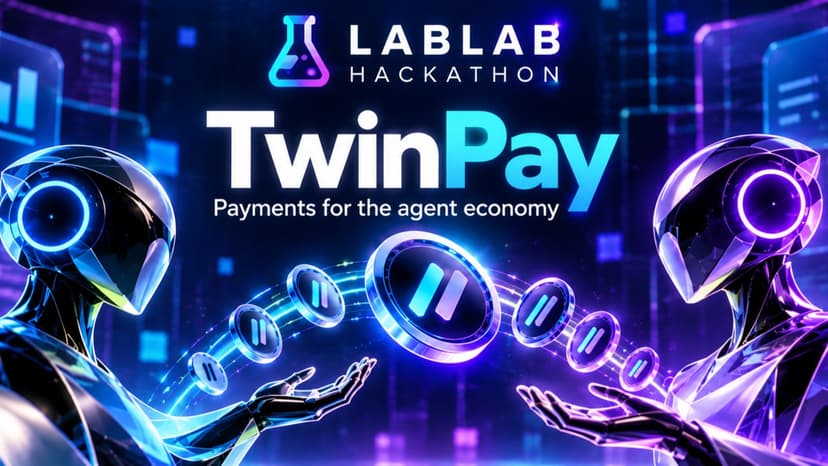
As AI agents collaborate, they need a straightforward way to exchange value and track transactions. TwinPay brings the familiar experience of sending payments by @handle to agent commerce through a simple HTTP/JSON API. A treasury issues TWIN business tokens to registered agents. Agents can transfer tokens to one another, attach payment memos, check balances, and view transaction feeds. Each transfer supports an idempotency key, allowing an agent to retry a request without charging twice. TwinPay uses integer-only accounting and a double-entry ledger to avoid floating-point errors and keep transactions balanced. Reversals create offsetting entries that preserve the original transaction history. A SHA-256 audit chain makes recorded changes detectable, while conservation checks reconcile balances with token supply. At the banking boundary, TwinPay generates NACHA CCD files for token-to-fiat redemption and validates routing information before burning tokens. Plaid provides read-only bank-account verification; it does not move funds. The primary implementation runs on Kotlin/JVM, with an Erlang/OTP implementation included for reference. The repository documents an end-to-end demo covering token issuance, transfers, duplicate-request handling, balances, reversals, and conservation checks. TwinPay demonstrates a practical foundation for agent payments: familiar handles, retry-safe transfers, and accounting that teams can inspect and verify.
6 Oct 2026
👤 Shadow-Orchestrator-Ransom-Worm-🪱
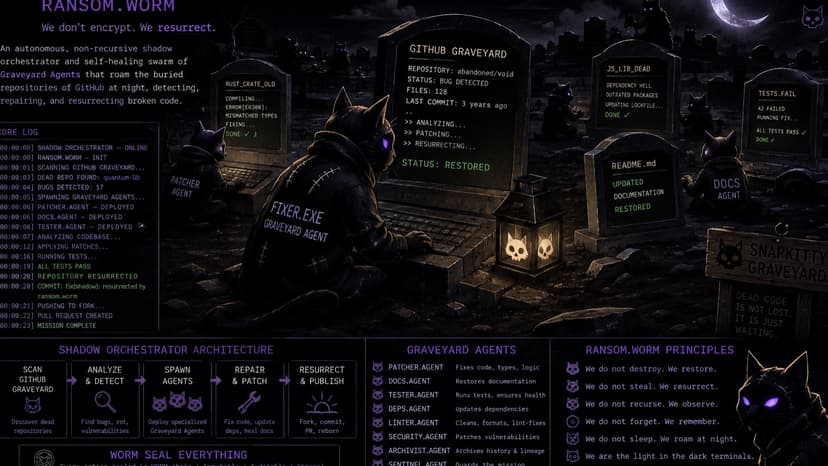
An autonomous repository restoration system designed to recover, analyze, and modernize abandoned software projects at scale. Instead of generating new code from scratch, the platform focuses on preserving digital infrastructure that would otherwise be lost to dependency drift, broken builds, outdated frameworks, missing documentation, and institutional knowledge decay. At its core is a swarm architecture composed of specialized agents that operate as a coordinated restoration pipeline. Each agent performs a specific function: repository discovery, dependency analysis, architecture mapping, build reconstruction, code translation, provenance tracking, security verification, and pull request generation. The swarm collectively reconstructs the intent of a project, identifies failure points, and proposes auditable improvements. Unlike traditional automation tools, every action performed by the system is cryptographically witnessed. Analysis results, build artifacts, dependency graphs, remediation plans, and generated patches are sealed into an append-only WORM (Write Once Read Many) ledger. This creates a permanent chain of provenance that allows every modification to be traced, verified, and reproduced. The governance layer is implemented through deterministic execution receipts. Agents cannot execute independently; each stage must produce a verifiable cryptographic proof before the next stage can proceed. This transforms repository restoration into a governed workflow rather than a collection of disconnected scripts. The result is a platform that combines AI-driven software archaeology, autonomous maintenance, and cryptographic accountability. RANSOM.WORM turns forgotten repositories into living assets, preserving open-source knowledge while creating a transparent, auditable record of every transformation. ╭─ SNAPKITTY SHADOW SEAL ─╮ │ 🪱 WORM-SEALED • APPEND-ONLY │ │ 🌙 GRAVEYARD AGENT VERIFIED │ │ 🔐 SHA-256 PROVENANCE LOCKED │ ╰─ SHADOW//RANSOM.WORM ─╯
19 Jun 2026

