🤓 Latest Submissions
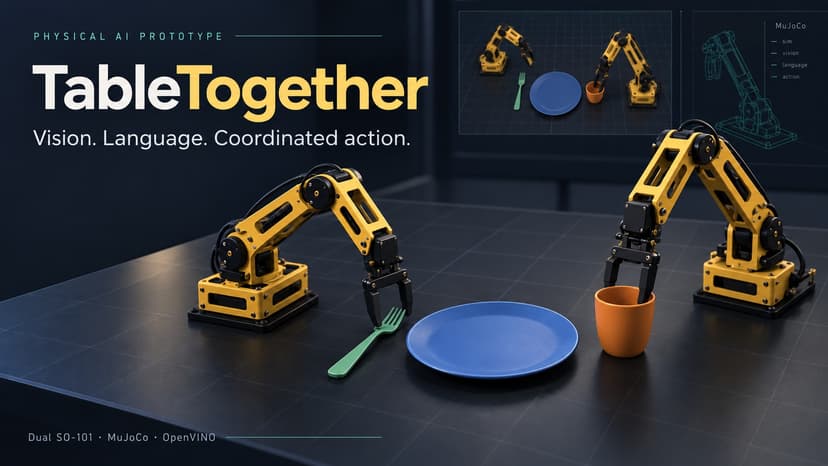
TableTogether: Dual-Arm Physical AI
TableTogether explores how two robot arms can coordinate everyday table-setting tasks using camera observations and language instructions. The prototype controls two simulated SO-101 arms in MuJoCo to place a cup and utensil beside an existing plate, supporting cup-first and utensil-first instructions. A task-specific vision-language policy processes RGB images, instruction tokens, joint observations, and the current action stage to predict joint targets and motion durations. We trained it on 75 successful demonstrations containing 1,350 keyframes. During learned execution, objects move through simulated physical contacts, with no scripted expert fallback. A local web interface displays the simulation and reports placement outcomes. The revised policy reduced validation joint-target error by approximately 26% and improved complete validation success from 6/8 to 7/8 episodes. Fresh OpenVINO evaluations achieved 5/10 successful episodes for each instruction order. Our ten-seed video includes every outcome, and 50 additional episodes test lighting, background, mass, friction, and object-size variations. The public repository includes training data, model checkpoints, simulation assets, evaluation code, and OpenVINO exports. Current execution is verified on a Core Ultra Series 1 system. Series 2/3 CPU compatibility is supported in principle, but target-hardware validation remains outstanding. This is a constrained research prototype toward assistive robotics, with reliability and recovery as the next priorities.
16 Sep 2026

TailGuard AI: Autonomous Options Insurance
Most trading agents optimize for returns. TailGuard optimizes for survival. A user defines a maximum portfolio loss and hedge budget in plain English. TailGuard reads the connected Alpaca Paper account, market clock, QQQ price, and live indicative options chain. A deterministic optimizer—not the language model—selects the contract symbols, expiry, limit debit, and quantity. It rejects naked risk, stale or unusable quotes, excessive bid/ask spreads, premium-budget violations, inactive accounts, and expiries outside policy. The winning defined-risk spread is transformed into a valid Alpaca multi-leg order payload and staged, not submitted. The dashboard then exposes the account state, market source, scanned-contract count, candidate count, payoff limits, policy gates, and complete JSON audit receipt. The production build deliberately keeps `ALLOW_PAPER_EXECUTION=false`, demonstrating a fail-closed boundary between AI interpretation and financial execution. This makes TailGuard useful as a safety layer for retail portfolios, adviser tooling, or any autonomous trading system that needs explainable downside protection.
4 Sep 2026

