

🤝 Top Collaborators


🤓 Latest Submissions
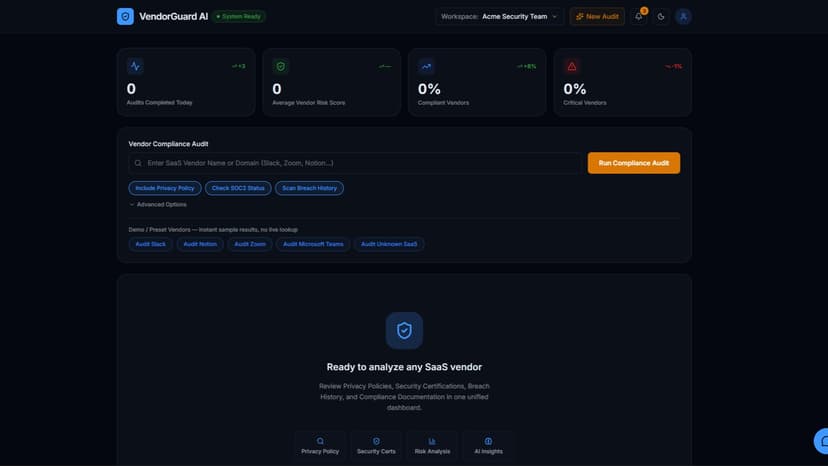
VendorGuard AI: Agentic Risk Assessment Platform
Enterprise procurement and security teams spend weeks manually reviewing software vendors to ensure compliance with data privacy laws and security certifications (such as SOC2, ISO 27001, and GDPR). This manual "Trust and Safety" bottleneck delays critical software adoption and exposes companies to massive risks if a hidden vulnerability is overlooked. VendorGuard AI is an AI-powered SaaS product and internal business tool built to completely replace this manual process. By combining real-time web scraping with frontier Large Language Models, VendorGuard AI acts as an agentic multi-step application, condensing a 6-week manual audit lifecycle into a 15-second autonomous workflow. How It Works: Autonomous Scraping (Bright Data MCP): Our agentic workflow safely bypasses bot protections to scrape a target vendor's official domain, privacy policies, and public security documentation in real-time, converting messy HTML into clean markdown. AI Reasoning (AI/ML API): The backend ingests the scraped markdown, utilizing strict JSON-schema prompting to extract compliance metrics, cross-reference breach databases, and calculate a weighted Trust Score. Evidence Explorer: To eliminate AI hallucinations, every compliance claim generated by the LLM includes a direct citation, a confidence score, and a link back to the exact source text on the vendor's website. Built entirely on Native.builder, VendorGuard AI features a premium, Series-A grade glassmorphic command center. It includes a live terminal-execution log, real-time risk gauges, interactive compliance checklists, and a frictionless local session manager that allows procurement officers to run audits instantly without database bottlenecks.
10 Aug 2026
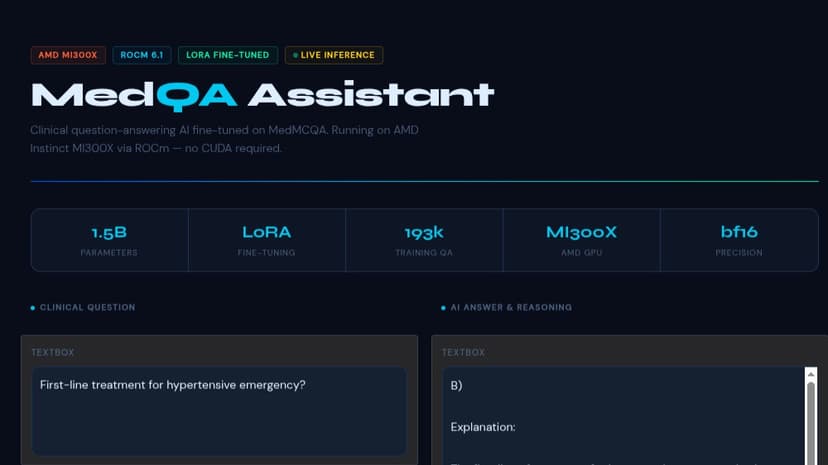
MedQA-Medical Q&A Assistant
MedQA is a medical question-answering AI built entirely on AMD hardware for the lablab.ai AMD Hackathon. We fine-tuned Qwen3-1.7B using LoRA on the MedMCQA dataset — 193,000 clinical multiple-choice questions from Indian medical entrance exams. Given a clinical MCQ with four options, the model selects the correct answer and provides a clinical explanation. This has real applications in medical education, exam prep, and clinical decision support. The entire pipeline runs on AMD Instinct MI300X via AMD Developer Cloud using ROCm 7.2 — no CUDA or NVIDIA hardware required. We used PyTorch with ROCm backend, HuggingFace Transformers, PEFT for LoRA, and TRL for training. Inference runs in bfloat16, natively supported on AMD GPUs. Key decisions: LoRA over full fine-tuning means only 0.15% of parameters are updated — fast and memory efficient. We switched from fp16 to bfloat16 after fp16 caused gradient norm explosion (nan values) on ROCm. bfloat16 trained stably throughout. The project has four components: train.py for LoRA fine-tuning, infer.py for CLI inference, eval.py for accuracy evaluation with per-subject breakdown, and app.py — a Gradio web app with a custom dark clinical UI. The LoRA adapter is open-sourced on HuggingFace Hub and the live demo runs on HuggingFace Spaces. Built by Harikrishna Sivanand Iyer and Srijan Sivaram A.
10 May 2026


