
🤓 Latest Submissions
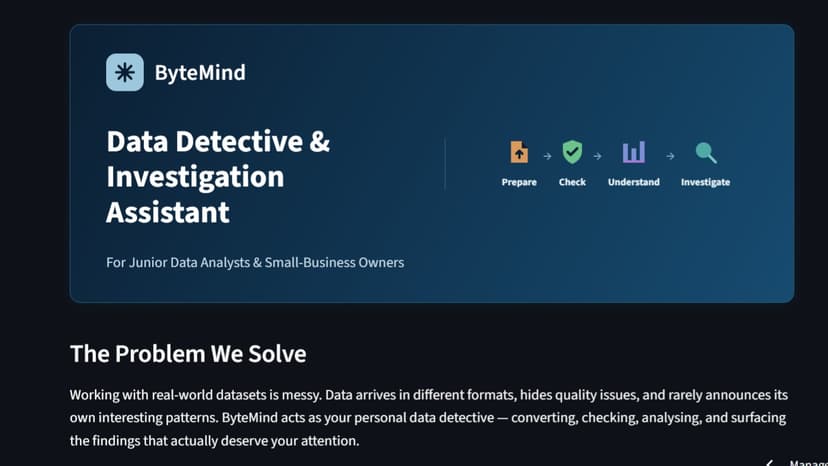
ByteMind-Data Detective & Investigation Assistant
Many beginners, junior analysts, and small businesses have data but struggle to understand what is actually happening inside it. Data may come from different sources and formats, contain missing values or duplicates, and require a lot of manual checking before meaningful analysis can even begin. Even after cleaning and analysing the data, users may still be unsure about which findings are worth investigating further. ByteMind was created to make this process simpler and more approachable. It works as a Data Detective and Investigation Assistant, guiding users through a simple workflow: Prepare → Check → Understand → Investigate. Users can upload CSV, Excel, or JSON files and convert between supported formats when needed. ByteMind then performs a Data Health check, identifying issues such as missing values, duplicate records, data types, high-cardinality columns, consistency problems, and potential outliers. It also provides a transparent data-quality score to help users quickly understand the condition of their dataset. Once the data is ready, ByteMind automatically performs exploratory analysis, including descriptive statistics, correlations, category comparisons, time-based trends, and top/bottom comparisons. Instead of stopping at charts and numbers, its Investigation Engine highlights interesting patterns and turns them into investigation leads. For example, it can identify a strong relationship between two variables and suggest why that relationship may be worth investigating, along with relevant follow-up questions and next steps. The target users are students, beginner data analysts, junior analysts, and small-business users who want useful analysis without having to manually perform every initial data-checking step. What makes ByteMind different is its focus on investigation rather than simply generating dashboards or statistics. It does not claim that a correlation proves causation. Instead, it presents what was observed and encourages the user to investigate further. The application is built with Python, Pandas, NumPy, Streamlit, Plotly, and openpyxl, with IBM Bob 2.0 used as the development partner during the project. The result is a lightweight, transparent, and practical tool that helps users move from a raw dataset to meaningful questions and potential areas of investigation more efficiently.
27 Sep 2026
