
🤝 Top Collaborators

🤓 Latest Submissions
Discharge Buddy
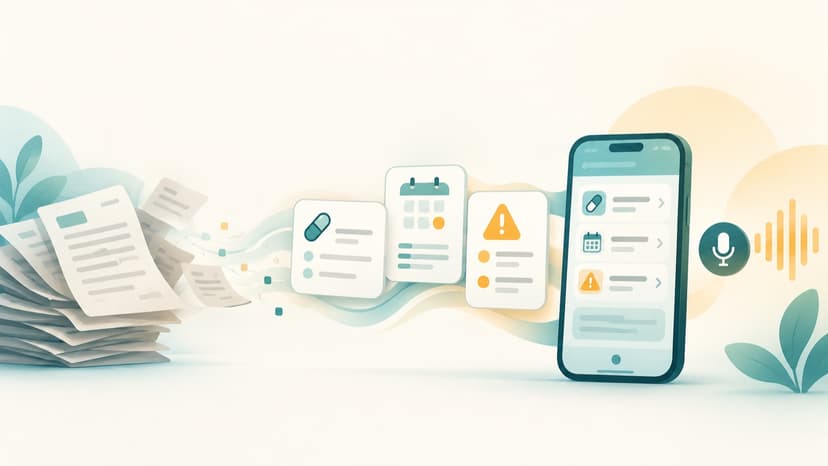
Every patient goes home. Not every patient goes home ready. Discharge instructions arrive as a stack of clinical prose at the exact moment a person is exhausted and overwhelmed. Medications get missed. Warning signs go unrecognized. Caregivers are handed responsibility with no tools. Nobody checks in until something goes wrong, and by then the patient is often readmitted. Discharge Buddy works in three moves. Ingest. A caregiver pastes or photographs the discharge summary. AI extracts the structure hiding inside it: each medication with its dose, frequency and purpose, every appointment, every warning sign paired with the action it requires, emergency contacts, and restrictions. The extracted data returns as an editable form, so a human reviews and corrects the AI before anything is saved. Understand. One care plan, two views, switched by a role toggle. Caregivers see full clinical detail, tap-to-dial emergency contacts, and check-in history. Patients see a calmer version: what to take and when, the next appointment only, and a simple list of things to watch for. A Read Aloud button speaks the plan at a slowed pace for anyone who can't read small type. Check in. The patient taps one button and talks. Live transcription streams their words onto the screen. When they stop, the app sends the transcript together with that patient's own discharge instructions and returns a verdict: On Track, Mild Concern, or Needs Attention, with plain-language flags. If something is urgent, a Call 911 panel appears. This isn't generic health advice. It's one person's words checked against one person's care plan. Incumbents sell B2B to health systems via hospital-configured SMS. Discharge Buddy is consumer-facing, self-serve, document-ingesting, and voice-first by design. Built with React, TypeScript, Supabase, and Speechmatics.
10 Aug 2026
CyberShield AI
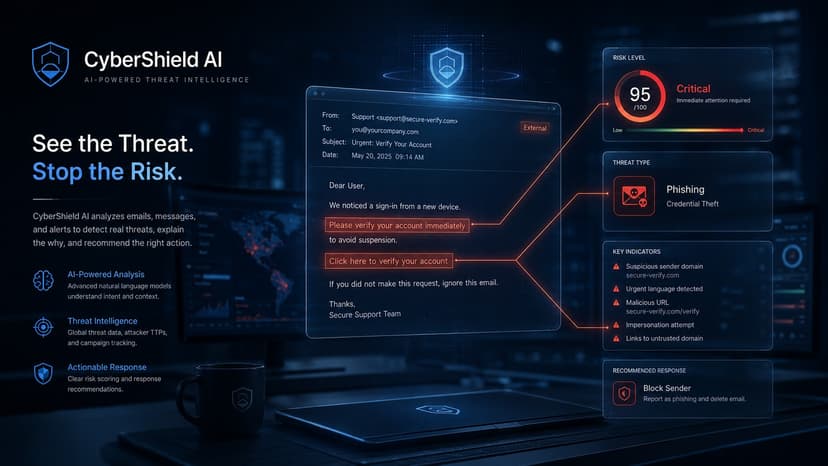
The problem Phishing is still the top entry point for cyberattacks, and modern phishing no longer looks like phishing. It is personalized, well written, and plausible. Worse, the tools meant to protect us do not explain themselves. A spam filter silently files a message away, so the user never learns which parts were dangerous, why, or what to do next. Security expertise does not scale to every inbox, and a binary label does not create it. The solution CyberShield AI is an explainable threat analysis workspace. The pipeline is: message input, AI classification, risk score and threat type, explainability layer, highlighted indicators, recommended response. Paste a suspicious message and a terminal panel streams the analysis live. The verdict appears with a risk ring and confidence bar. Then the key moment: the original message reappears with every suspicious fragment highlighted in place. Hover any highlight to see exactly why it was flagged, whether a look-alike domain, a credential request, or manufactured urgency. Concrete actions follow: quarantine, block sender, reset credentials, report. Use of Fireworks AI Fireworks is our entire inference backbone. DeepSeek V4 Flash is the primary analyst, chosen because our task is classification plus evidence extraction plus reasoning in one call. We use Fireworks structured JSON outputs to force every response into a strict schema, giving fine-tune-grade reliability without fine-tuning. A second model, GPT-OSS 120B, acts as an LLM judge: it reviews the draft verdict, corrects the risk score, and drops any indicator not present verbatim in the message. Use of AMD Every inference call runs on AMD MI300X GPUs via Fireworks. The MI300X memory capacity is what makes serving a 120B judge model affordable, which is what makes our two-model architecture possible. Because we built on open-weight models, our enterprise roadmap is private on-premise deployment on customer-owned AMD GPUs, so sensitive email never leaves their network.
13 Jul 2026

LUMEN - From topic to report
LUMEN is an end-to-end autonomous research agent built on a multi-agent AI pipeline. Given any research topic, LUMEN deploys five specialized AI agents in sequence — each with a distinct role — to produce a comprehensive, cited research report in minutes. The pipeline works as follows: a Planner Agent breaks the topic into focused research questions, a Search Agent finds credible sources using Tavily web search, an Extractor Agent pulls key facts and insights from each source, an Analyst Agent synthesizes findings and identifies research gaps, and finally a Writer Agent produces a clean, structured markdown report complete with an executive summary, key findings, evidence mapping, and citations. Built with CrewAI for agent orchestration, Qwen via Groq for language model inference, and Tavily for AI-optimized web search, LUMEN runs entirely on free-tier APIs with no hardware required. The Streamlit interface provides real-time agent progress tracking, showing users exactly which agent is working at any moment. Reports can be exported as Markdown, Word (.docx), or LaTeX, and published directly to Hugging Face Spaces. LUMEN demonstrates how agentic AI workflows can automate complex knowledge work — turning a single topic sentence into a publication-ready research document, fully autonomously.
10 May 2026


