
🤓 Latest Submissions
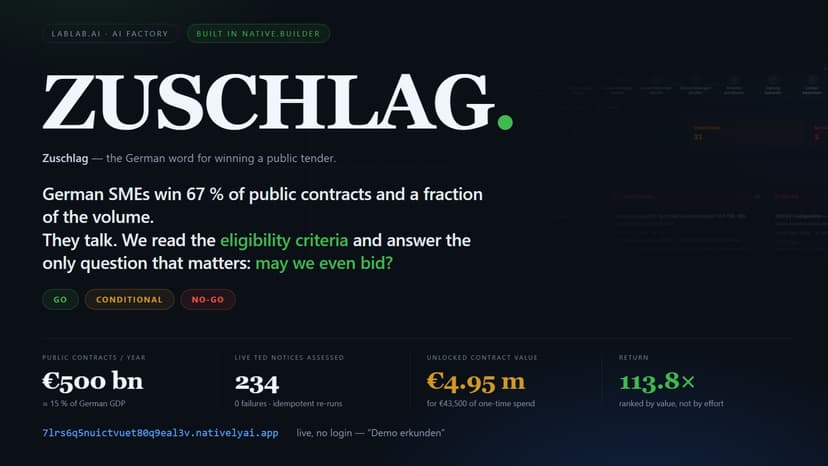
ZUSCHLAG
A company describes itself by voice. From that, the system builds a structured company profile, pulls live tender notices, and for each notice checks the company against the notice's eligibility criteria — not just the topic. Output per tender: GO / CONDITIONAL / NO-GO, naming the exact blocking criterion. All blockers are then aggregated into an unlock report: which one-time measures would open the most currently blocked contract volume. Commercial German tender search services exist — bidfix, tendigo, patterno, tendermeister, tendit. They are all alert feeds. Keyword in, hit list out by email. They don't solve the core problem: the owner gets 200 hits and doesn't know for a single one whether he is eligible. The work stays with him. Zuschlag differs on four points, none covered by a feed product: Eligibility checking instead of topic matching — criteria are read from the notice and checked individually against the profile, with a per-criterion met / missing / unclear result and a source quote. The unlock report — which one-time measure opens the most blocked volume, ranked by cost-benefit. No existing product tells an SME why it structurally loses. Backward schedule with a reality check — computed back from the submission deadline, including the buyer-questions cutoff, and honest when a required certificate takes longer than the remaining time. Bid kit instead of a link — proposal outline, evidence checklist, and draft questions to the contracting authority, derived from exactly those criteria marked unclear. arget user: owner-managed SMEs, 10–100 employees, in trades that could bid publicly but don't do it systematically. The buyer is the managing director. Willingness to pay is real because a single won contract exceeds an annual licence by orders of magnitude.
10 Aug 2026
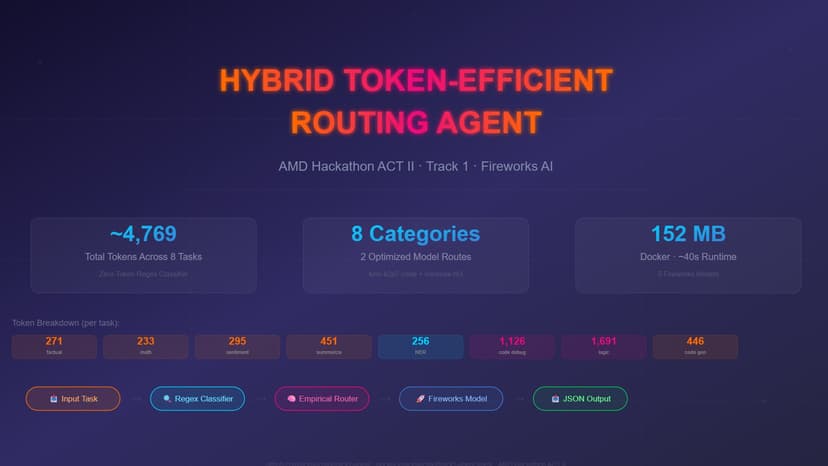
Token-Efficient Hybrid Router for Fireworks AI
Token-Efficient Hybrid Routing Agent for Fireworks AI is a lightweight, Docker-based AI pipeline that automatically classifies incoming tasks into one of eight categories — factual knowledge, mathematical reasoning, sentiment classification, text summarization, named entity recognition, code debugging, logical reasoning, and code generation — and routes each task to the cheapest capable Fireworks AI model. Instead of relying on a secondary LLM call for classification, the agent uses a zero-token regex-based classifier that analyzes prompt patterns without consuming any API tokens. An empirical routing table, built from real benchmark runs across all allowed models, maps each category to its most token-efficient provider: kimi-k2p7-code handles seven categories where it consistently delivers fewer prompt tokens, while minimax-m3 is reserved for NER tasks thanks to its clean JSON output at just 256 tokens. The agent applies category-specific system prompts, response-format constraints (JSON mode for sentiment and NER), and tight max-token caps to eliminate wasted generation. Across eight representative test tasks, the pipeline consumes approximately 4,769 total tokens and completes in under 40 seconds inside a 152 MB Docker image — making it both fast to deploy and aggressively cost-optimized for production AI orchestration.
13 Jul 2026

WarRoom band of agents runs your incident response
Six participants share one Band room. A Detector (non-LLM) watches metrics and raises the alert. The Commander opens the incident and delegates. The Diagnostician pulls live metrics, logs and deploys to pin the root cause. The Remediator proposes one fix and executes it — but only after approval. Comms posts plain-English stakeholder updates. A Bridge mirrors the room to an ops dashboard and relays the human's decision back into Band. Our core bet: Band is the only channel the agents have. No orchestrator, no message bus, no shared memory. Every handoff is a Band message with @mentions, and an agent acts only when mentioned — so the workflow emerges from who addresses whom, exactly like a real on-call channel. Humans and bots are first-class peers: two of the six participants are plain Python, indistinguishable room members alongside the reasoning agents. Even governance flows through the room — the human's Approve/Reject is injected back into Band as a message to the Remediator. The human gate is real, not cosmetic. We enforce it at the action layer: rollback, restart and scale are refused server-side until a human approves, and blocked attempts appear right on the timeline. A live dashboard shows service health flipping red to green, the Band conversation streaming in, the APPROVE button, and MTTR. A full incident — detect, diagnose, block, approve, remediate, resolve — runs end-to-end in well under a minute.
19 Jun 2026


