
🤓 Latest Submissions
optimus-router
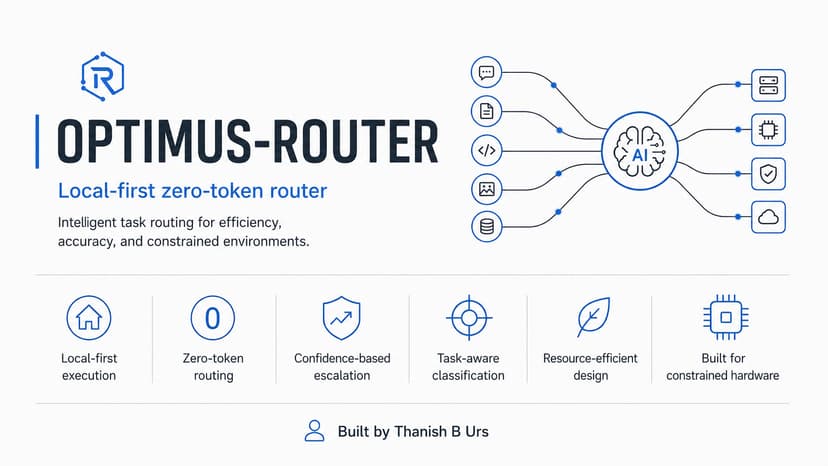
Optimus Router is a local-first AI inference system designed for environments where accuracy, runtime, memory usage, and external token costs must all be carefully controlled. It receives a JSON file containing task IDs and natural-language prompts. A fine-tuned MiniLM classifier first assigns each prompt to one of eight categories: factual knowledge, mathematical reasoning, sentiment classification, text summarisation, named entity recognition, code debugging, logical reasoning, or code generation. The router then selects the local model best suited to the category. DeepSeek-R1-Distill-Qwen-1.5B handles mathematics and logical reasoning, while Qwen3-4B-Instruct-2507 handles factual explanations, sentiment, summarisation, entity extraction, debugging, and code generation. Every category has specialized instructions and validation rules. The system checks calculations, logical constraints, summary limits, entity labels, code syntax, function names, and output structure. Invalid DeepSeek responses can be repaired locally or passed to Qwen for another attempt. Both models run through llama.cpp using quantized GGUF files. They are loaded sequentially rather than simultaneously, allowing the application to operate within limited CPU and memory resources. Runtime deadlines and per-request limits ensure that processing and final output remain within the ten-minute execution limit. Because only external model output tokens count toward the challenge score, Fireworks is disabled by default. Normal operation is entirely local and targets zero counted tokens. Fireworks can be explicitly enabled as a tightly limited emergency fallback. The completed answers are safely written to results.json, preserving every original task ID. Overall, Optimus Router combines lightweight classification, specialized local models, validation, and controlled fallback behavior to provide accurate answers efficiently and economically.
13 Jul 2026
BandAudit
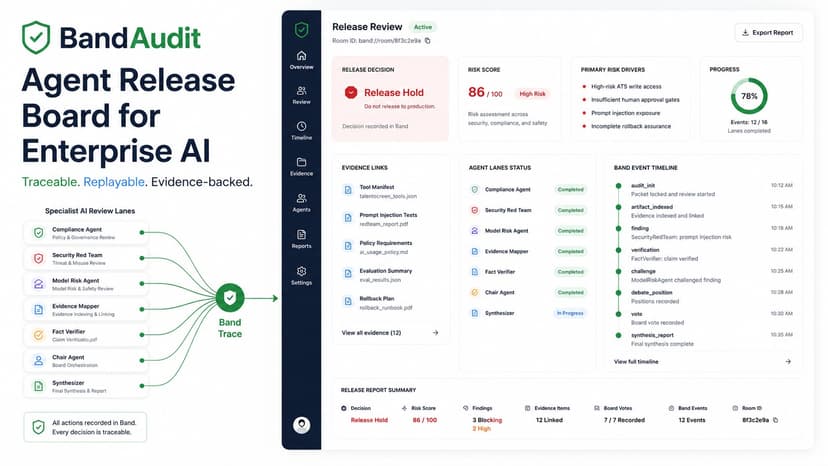
BandAudit is a multi-agent governance workflow for safe and traceable deployment of enterprise AI agents. It turns a release packet into a structured Agent Release Board review, not a single chatbot response. Our expert agents investigate ownership, controls, security risk, model behavior, evidence quality, rollout readiness and compliance concerns. All material actions are recorded as an event in a Band room creating a replayable source of truth for findings, debates, votes and final decisions. The system outputs an auditable release decision (approve, conditionally approve or hold). It also produces exportable reports for compliance, security, product, and leadership teams, making sure AI-agent release decisions are evidence-backed, provider-diverse, and enterprise-ready.
19 Jun 2026

QubicLink
QubicLink is a no-code identity verification and engagement automation platform built for the Qubic ecosystem. It solves a core problem highlighted in the hackathon kickoff: how to connect a user's social identity to their on-chain wallet without deploying smart contracts. Using EasyConnect and Make.com, QubicLink allows users to verify wallet ownership by placing a unique bid order on QX (e.g., 1337 QUBIC). This transaction acts as a secure cryptographic handshake between their wallet and Discord identity. Once verified, users can receive roles, trigger gamified actions, or become eligible for rewards like airdrops and community perks. The system is lightweight, fast to deploy, and entirely no-code—making it accessible to DAOs, launchpads, and Qubic-based projects looking to boost engagement, automate reputation, and build trust-driven communities without compromising on decentralization.
7 Dec 2025


