

🤓 Latest Submissions
CivicTwin - Proof-Carrying Rule Twin
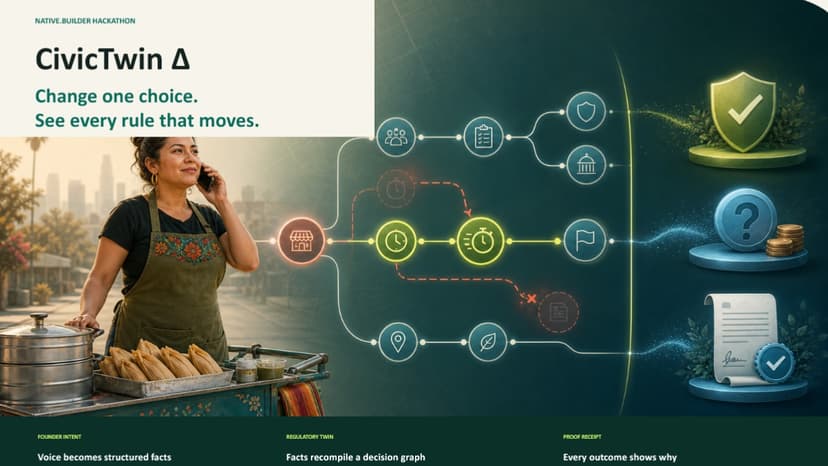
CivicTwin helps multilingual, first-time micro-entrepreneurs answer a question ordinary search and chat systems cannot: what exactly changes if I change one operating choice? The initial experience follows Sofia Reyes, an Oakland mobile-food founder. Her vehicle type, location, health status, and vending duration activate requirements across city, county, and state sources. CivicTwin converts her spoken intent into structured operating facts, compiles official evidence into typed rules, evaluates those rules with a deterministic constraint solver, and emits an inspectable dependency graph. The winning demo changes Sofia's vending duration from 60 minutes to 30 minutes. The model recompiles the graph and removes the restroom-agreement dependency. When the changed pushcart scenario lacks sufficient fee evidence, the answer remains UNKNOWN and an evidence gap is flagged instead of hallucinating a zero-dollar fee. Every decision opens a proof receipt containing the triggering fact, rule identifier, source URL and clause, retrieval date, confidence, and unresolved boundary. The product was built primarily in native.builder: its agents created and refined the React/TypeScript app structure, multi-route UX, stateful intake, counterfactual controls, trust surface, proof-receipt interface, and public deployment. Partner-ready adapters connect Speechmatics for multilingual transcription, Bright Data for official-source acquisition, and the AI/ML API for rule compilation and counterfactual auditing. Deterministic demo fallbacks are visibly labeled when credentials are not connected. CivicTwin is not a chatbot or a static report. It is a proof-carrying regulatory world model. The business wedge is Oakland mobile vending; the expansion unit is a versioned jurisdiction pack for founders, SBDCs, lenders, and city permitting teams. The goal is simple: turn fragmented rules into the next valid move, without hiding uncertainty.
10 Aug 2026
ProcureGuard AI
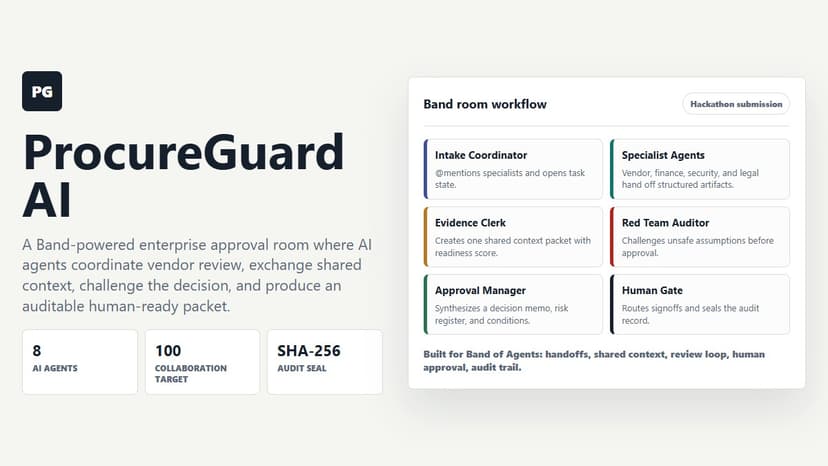
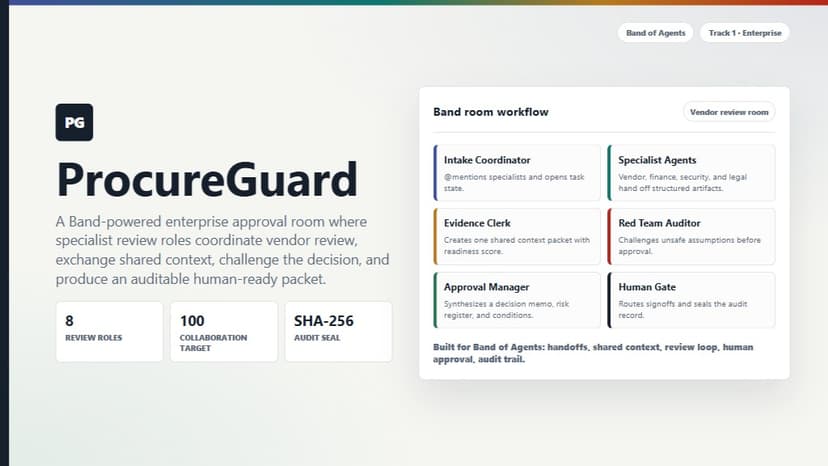
ProcureGuard AI turns enterprise vendor approval into a live, multi-agent decision room running on Band as the real coordination layer — not a simulator. Eight role-specific agents — Intake Coordinator, Vendor Research, Finance ROI, Security Compliance, Legal Policy, Evidence Clerk, Red Team Auditor, and Approval Manager — plus a Human Procurement Lead collaborate in one Band chat room through real @mention message routing, task events, and shared context. The flow is genuine agent-to-agent work, not a linear script. The Cordinator opens a real Band room and recruits its sibling agents. The four specialists review the request in parallel and hand off structured findings, each grounded in per-claim citations tied to specific fields of the request, so there are no hallucinated claims. The Evidence Clerk consolidates them into one shared context packet. A Red Team Auditor then challenges that packet and can issue a binding veto that deterministically forces escalation — so the system can overule its own unsafe approval. The Approval Manager synthesizes the trail into approve, conditional, reject, or escalate, and routes it to a human gate with the exact signoffs required. We verified this on the real Band platform: a live run produced a room on app.band.ai with 10 real Band messages and 7 task events, all carrying Band-issued IDs, read back through Band's own context API as proof. The agents are genuinely cross-framework — LangGraph, CrewAI, Pydantic AI, and Anthropic — all joining one Band room. Every run ends in a SHA-256 tamper-evident audit seal, a downloadable report, and an evidence bundle. It is a procurement decision court, not a report generator
19 Jun 2026


