
🤓 Latest Submissions
TradeGuard
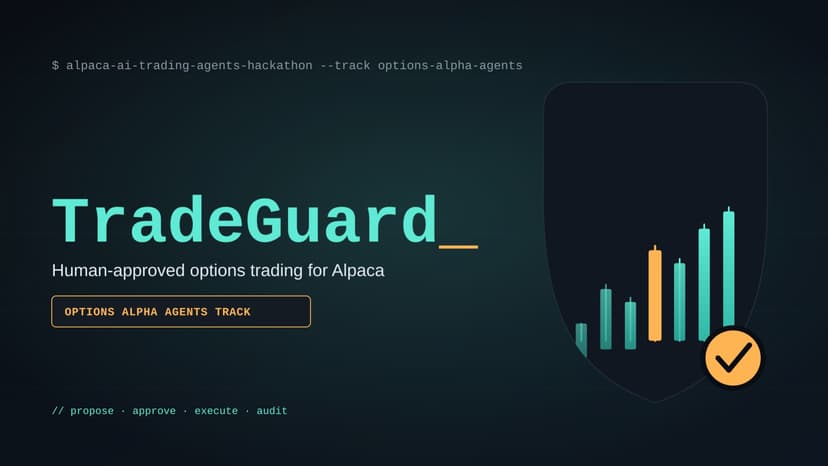
**TradeGuard** is a human-in-the-loop options-trading agent built for the Options Alpha Agents track. Rather than competing on autonomous complexity, TradeGuard focuses on the harder problem: making AI-assisted trading safe, auditable, and controllable. The workflow is deliberately strict. A Go backend reads real market context — quotes, news, and option chains — through a read-only MCP connection. An LLM (Fireworks AI, Kimi K3) then proposes at most one options contract per symbol per cycle: a long call or put to open a new position, sized within a hard position-size cap. Each proposal includes plain-language bull and bear reasoning. **Nothing executes automatically.** A human reviews the complete proposal in a Flutter app and chooses **Approve** or **Deny**. Only after approval does a separate Go executor, using the Alpaca Trading API directly and never through the LLM, place the paper order. Safety is enforced through independent layers. The LLM has no order-placement tools, while a denylist blocks tools named “order” or “delete.” Position-size limits are enforced both in the app and again by the executor. A kill switch is checked by both the agent and executor before action. Contract proposals are also validated against real, pre-filtered candidates before storage, preventing hallucinated symbols from reaching execution. Every outcome — approved, denied, executed, over-cap, or broker-rejected — is recorded in a permanent audit trail with its reason. The Flutter app provides three realtime views: **Queue, Portfolio, and Audit**, all synced live through PocketBase. The demo is fully end-to-end: a real MCP connection to an Alpaca paper account, live market data and option chains, LLM-generated reasoning, human approvals and denials, real paper orders, and complete audit logging.
4 Sep 2026
ClipCast — AI Clips & Pronunciation Guide
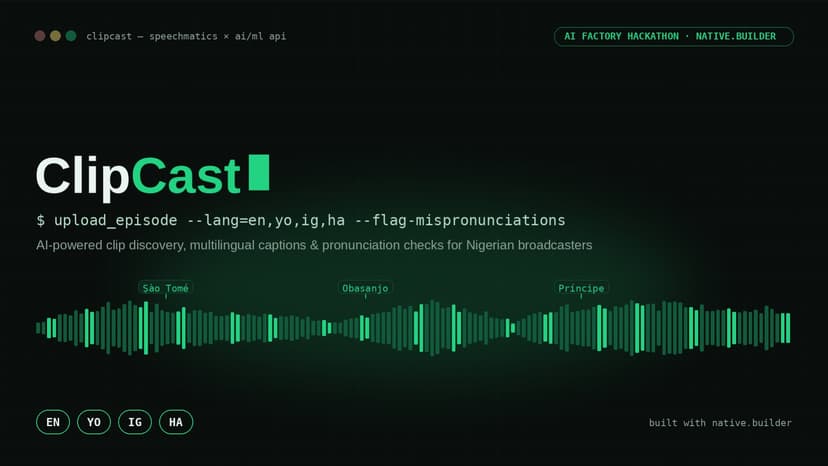
ClipCast helps Nigerian radio hosts, podcasters, and broadcast content creators turn long-form audio into ready-to-post social content, without hours of manual work. The problem: broadcasters record for hours but rarely have time to mine episodes for shareable clips. Generic AI tools also treat Nigerian and African names as an afterthought, mispronouncing them on air and in captions, and default to English-only captioning, leaving Yoruba, Igbo, and Hausa audiences out. How it works: upload an audio file or paste a direct URL. ClipCast transcribes it with Speechmatics, then analyzes the transcript with AI/ML API to generate 3-5 timestamped clip suggestions, each with a caption in English, Yoruba, Igbo, and Hausa. Separately, it builds a pronunciation report: names likely to be mispronounced, with a phonetic guide and an AI-scored mispronunciation confidence, so a host can prep before their next read. Approved clips can be exported as text or SRT, or downloaded as trimmed audio, and organized on an internal content calendar. Built entirely in native.builder, through iterative prompting rather than hand-written code. Every integration is real and working: Speechmatics for transcription, AI/ML API for structured analysis, and Supabase for auth, database, storage, and Edge Functions. Along the way, several silent data-pipeline bugs were caught by reviewing the actual generated source against the original spec, including flagged-name confidence scores and multilingual captions that were being generated correctly but never reaching the UI. Known limitation: the AI's language-origin classification for flagged names is strong on common first names but can default to "English" for internationally famous historical figures, likely because the model associates them with the English-language sources it was trained on rather than the name's actual etymology. This is a prompt-tuning refinement for a future iteration; the core pipeline works correctly end to end.
10 Aug 2026
PronounceAI
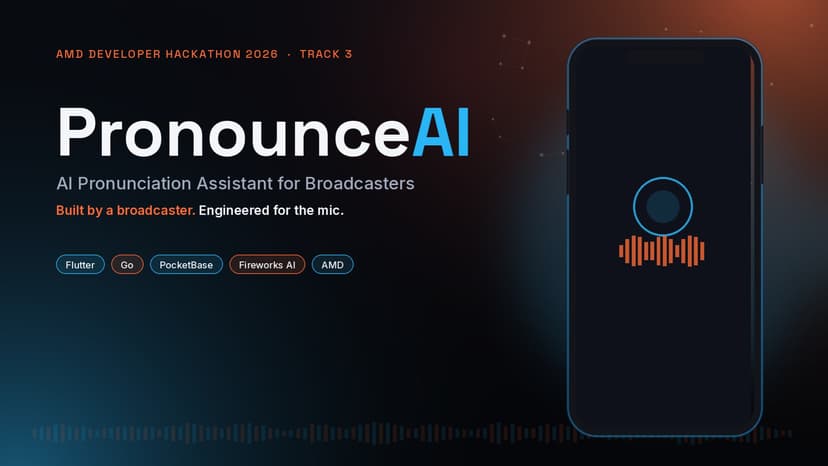
Pronounce AI is an AI-powered pronunciation assistant designed to help broadcasters, journalists, podcasters, and public speakers confidently pronounce unfamiliar names, places, organizations, and technical terms before going live. International news stories often contain words from different languages, forcing presenters to search multiple websites or videos for pronunciation guidance under tight deadlines. Pronounce AI streamlines this process by analyzing an entire news script in seconds and identifying words that may be difficult to pronounce. For each detected term, the application provides an easy-to-read phonetic pronunciation, English and native IPA transcriptions, language of origin, contextual meaning, presenter tips, confidence scores, and suggested on-air replacements where appropriate. The application is built with a Flutter frontend, a PocketBase/Go backend for lightweight data persistence. AI analysis is powered by Fireworks AI using DeepSeek V4 Flash as the primary model, with automatic fallback to nemotron-3-ultra-nvfp4 to ensure reliability if the primary model is unavailable. To improve speed and reduce AI inference costs, Pronounce AI implements intelligent caching. Previously analyzed scripts are stored in PocketBase and can be retrieved instantly without making another AI request, resulting in significantly faster responses and a better user experience. Our long-term vision extends beyond pronunciation assistance. We plan to evolve Pronounce AI into a comprehensive newsroom preparation platform with hybrid entity/word-level caching, pronunciation audio playback, multilingual support, collaborative newsroom dictionaries, and additional AI-powered tools that help broadcasters prepare accurate, confident, and professional news presentations.
13 Jul 2026


