

🤝 Top Collaborators




🤓 Latest Submissions
Necro — Code Archaeology
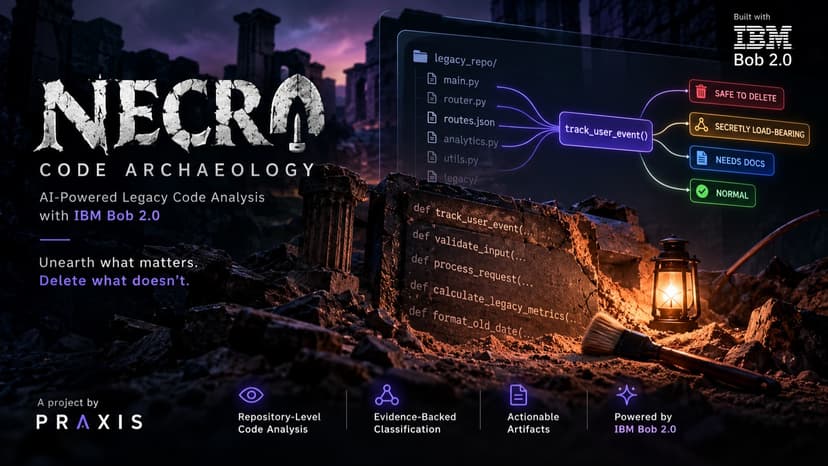
Legacy code is rarely removed because developers cannot confidently determine whether an apparently unused function is truly dead or quietly connected to production behavior. Traditional static analysis can identify direct references, but legacy systems often rely on dynamic dispatch, configuration files, string-based handlers, and indirect dependencies. Necro is an AI-powered code archaeology system built with IBM Bob 2.0 to investigate these ambiguous pieces of legacy code. Instead of simply detecting unused functions, Necro reasons across the repository and classifies suspicious modules into actionable categories: Safe to Delete, Secretly Load-Bearing, Undocumented but Valuable, and Normal — No Action. Each classification is accompanied by an evidence trail showing the repository locations and relationships that support the decision. For code confirmed to be removable, Necro can also provide a generated deletion artifact, turning analysis into an actionable engineering decision. Our demonstration uses a deliberately realistic legacy repository containing functions that appear unused through direct inspection but have hidden connections through routing and configuration. One example, track_user_event, has no direct import but is connected through dynamic dispatch and route configuration — demonstrating why naive dead-code detection can be dangerous. Necro's goal is to reduce the uncertainty surrounding legacy-code cleanup: instead of asking “Can I delete this?”, developers can ask “What evidence tells me whether I can safely touch it?”
27 Sep 2026

Neural Analytics
An AI-powered analytics platform that lets you upload CSV files and ask natural language questions. Supports multi-table querying with automatic JOINs, semantic schema search, and AI-generated insights with interactive visualizations. Drag-and-drop CSV upload — Upload up to 5 files (40 MB each) instantly Multi-table NL querying — Ask questions across multiple datasets with automatic JOINs Zero SQL knowledge required — LLM generates correct queries from plain English Semantic schema search — FAISS embeddings find relevant columns by semantic meaning Auto-fix on failure — LLM self-corrects failing queries in real-time Interactive visualizations — Auto-selects best chart type (bar, line, pie, histogram) AI summaries — 3-bullet findings generated from query results Data cleaning report — Shows nulls normalized, duplicates removed, type coercions
19 May 2026
AIRA - Autonomous Incident Response Agent
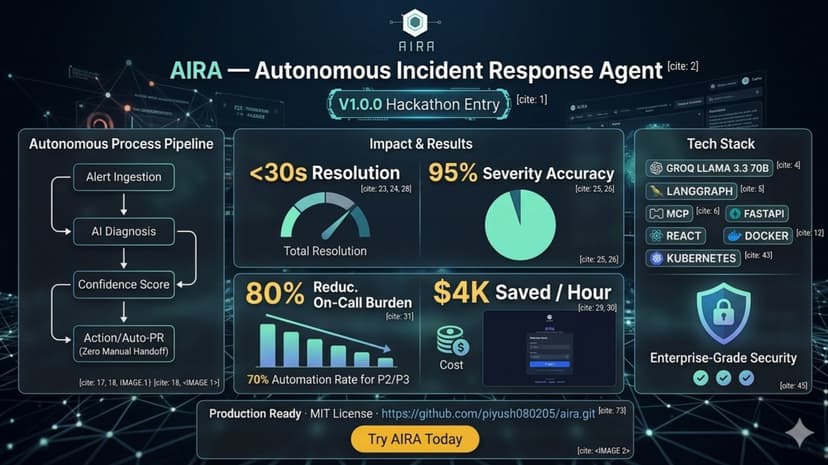
AIRA (Autonomous Incident Response Agent) is an AI-powered incident response automation platform that revolutionizes how teams handle production incidents. Built with FastAPI, React, and LangGraph, AIRA receives incidents from monitoring tools like Datadog or Prometheus and executes a sophisticated 5-phase workflow powered by Groq's Llama 3.3 70B LLM. The system automatically classifies incident severity (P0-P3) in under 5 seconds, fetches relevant code context via MCP servers, analyzes similar historical incidents using Redis-based similarity search, generates git-style patches with unit tests, and calculates a composite confidence score. Based on this score, AIRA either automatically creates GitHub pull requests (>85% confidence) or requests human approval via Slack. With enterprise-grade security features including blocked paths for critical files, complete audit trails, and mandatory human oversight for P0 incidents, AIRA achieves 80% faster resolution times while maintaining safety. The real-time WebSocket dashboard provides full transparency into agent decisions, and the system continuously learns from each incident to improve future responses. AIRA reduces incident resolution time from hours to seconds, saves $4,000/hour in downtime costs, and cuts on-call burden by 60%—all while maintaining 95% accuracy in severity classification.
17 May 2026


