
🤝 Top Collaborators

🤓 Latest Submissions

DocProof
Documentation rot is one of the most quietly expensive problems in software: READMEs claim Node 18 while package.json requires Node 20, .env.example is missing a required key, API docs describe endpoints that no longer match the code. Nobody notices until a new hire wastes a day debugging an environment that was "documented correctly." DocProof turns every documentation claim into a Documentation Contract — a structured object with a source, a claim, an expected value, an actual value, a pass/fail status, and evidence. Powered by IBM Bob 2.0's Agent Mode, a central orchestrator dispatches four specialized subagents in parallel (Runtime Requirements, Commands, Config/Env, API Docs), each independently verifying one area of the target repo against its documentation using Bob's Document Understanding to extract claims from README, docs, and specs. When a mismatch is found, DocProof doesn't just flag it — it generates a suggested fix, routes it through a human Approve/Reject step, and re-verifies automatically once approved, closing the loop: Problem → Evidence → Fix → Approval → Re-verify. The result is a live Documentation Trust Score that the team can watch improve in real time. On our demo repo, running the full pipeline caught 3 deliberately planted inconsistencies (Node version, Python version, a missing SECRET_KEY), generated fixes for all of them, and raised the Trust Score from 52.5 to 57.5 after a single approved fix cycle — with zero duplicate contracts and fully refreshed evidence on every corrected item. DocProof isn't a linter. It's a standing, provable guarantee that what your docs say is what your code actually does.
27 Sep 2026
TrustShield
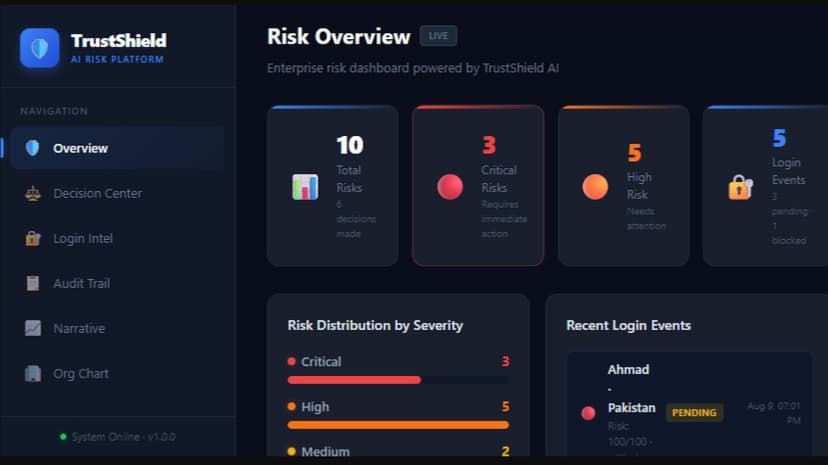
**TrustShield AI** is an explainable and accountable AI governance layer for cybersecurity. It addresses a critical gap in AI-powered security systems: they can detect threats and make decisions, but often fail to clearly explain why a decision was made, what evidence supports it, and when human oversight is required. Our MVP focuses on **suspicious login detection**. TrustShield analyzes signals such as unknown devices, suspicious IP reputation, failed login attempts, unusual locations, and unusual login times. It generates a risk score, confidence level, supporting evidence, and a human-readable explanation. The decision then passes through an **Accountability Engine** that determines whether AI can act autonomously: • Low Risk → Automatically Allow • Medium Risk → Analyst Review • High Risk → Human Approval Required • Low Confidence → Escalate to Human For high-risk events, AI cannot directly execute the recommended action. A security analyst can **Approve, Reject, or Escalate** the recommendation. Every decision is recorded in a complete audit trail, including the security event, AI analysis, evidence, explanation, accountability policy, human action, and final outcome. ### Core Workflow **DETECT → EXPLAIN → EVIDENCE → GOVERN → HUMAN CONTROL → AUDIT** What makes TrustShield different is that it focuses on **what happens after AI makes a cybersecurity decision**. Instead of simply saying "AI detected a threat," TrustShield shows why the AI made the decision, what evidence supports it, how confident it is, what policy governs the action, whether human approval is required, and what ultimately happened. TrustShield AI demonstrates a practical approach to making AI-powered cybersecurity more **explainable, auditable, accountable, controllable, and honest about uncertainty**. **TrustShield AI: The trust and accountability layer for AI-powered cybersecurity.**
10 Aug 2026

