
🤝 Top Collaborators


🤓 Latest Submissions
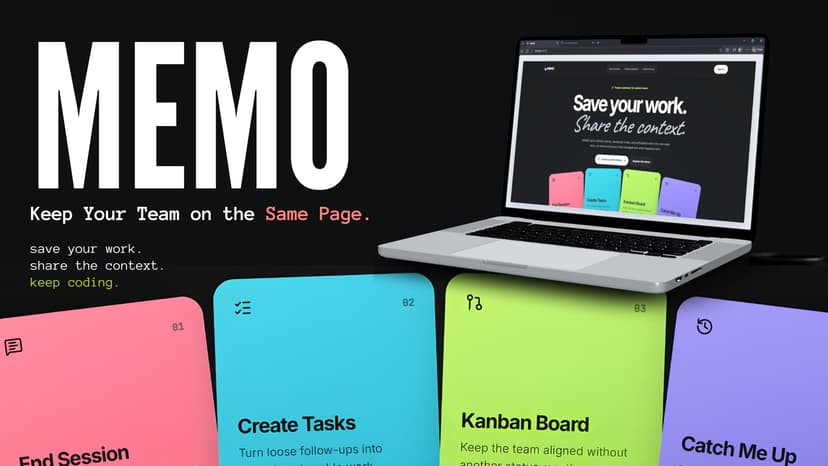
MEMO — Keep Your Team on the Same Page
Software teams rarely lose track of work because the information does not exist. They lose it because the information is scattered. A developer may know exactly where they stopped, while the rest of the team sees only commits, pull requests, issues, and task cards. When someone takes over a feature, returns after being away, or joins an unfamiliar project, they often have to reconstruct the context themselves: What changed? What is unfinished? What is blocked? What should happen next? MEMO — Keep Your Team on the Same Page is an AI-powered collaboration and project intelligence platform designed for software development teams. MEMO connects to GitHub and turns development activity—commits, pull requests, issues, changed files, branches, and contributor activity—into shared project context. Using IBM watsonx.ai, MEMO analyzes this context to understand the project's current state, identify potential missing work, suggest next steps, and recommend relevant team members based on their observable project activity. Instead of simply generating generic AI suggestions, MEMO connects recommendations to evidence from the repository and provides confidence levels so developers can understand why something was suggested. Team members can review, edit, dismiss, approve, or reassign suggestions before they become actionable tasks. MEMO also addresses one of the most common problems in collaborative development: losing context between coding sessions. With I'M DONE FOR TODAY, developers can turn their recent work, blockers, and next steps into a structured handoff. When another teammate returns, CATCH ME UP summarizes what changed, what needs attention, and what they should look at next. This creates a continuous workflow: GitHub activity → project understanding → potential missing work → actionable tasks → team handoff → faster context recovery. MEMO is more than another Kanban board or AI coding assistant. It acts as a shared memory layer for a development team, transforming the activity already happening in GitHub into context that can be understood and acted upon. This reduces manual context reconstruction, missed follow-up work, and handoff friction while keeping developers in control of decisions.
27 Sep 2026
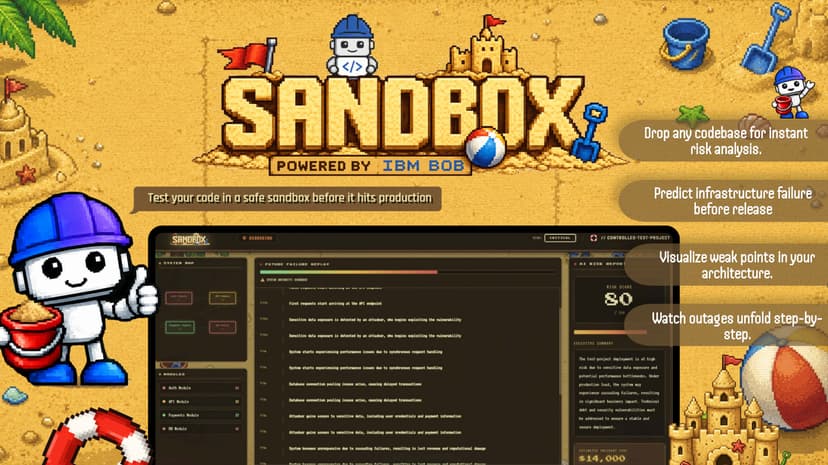
Sandbox — Castles Crumble. Fix Them First.
Most tools tell you your code has bugs. Sandbox shows you exactly how your system collapses under real-world production load — before a single user is affected. Sandbox is a retro pixel beach-themed deployment risk simulation engine powered by IBM WatsonX AI. Upload any project as a ZIP, and within seconds, Sandbox maps your system architecture, calculates a 0–100 risk score, and generates a cinematic Failure Replay — a step-by-step animated timeline showing when your auth service buckles, when your database connections max out, and when the cascade begins. Unlike static analyzers like SonarQube or Snyk, Sandbox doesn't just flag issues — it simulates the sequence of failure, gives you a live damage meter tracking system integrity, and delivers actionable AI recommendations to fix vulnerabilities before deployment. Built in just 12 hours using IBM Bob as an AI engineering partner — a 70% reduction from the estimated 40–50 hour build — Sandbox demonstrates how AI-assisted development enables developers to ship production-quality software faster and smarter. IBM Bob generated all 8 React components, architected the state management system, implemented the WatsonX integration, and solved complex hydration and animation challenges. Key features include an interactive React Flow system map with risk-colored nodes, physics-based particle effects on upload, Framer Motion animations throughout, and a full demo mode that works without any API keys. Sandbox is built for developers, DevOps teams, and QA engineers who need to move fast without breaking things — and for anyone who wants to see their system stress-tested before the world does. Drop your system. Watch it break. Ship it fixed.
17 May 2026


