
🤓 Latest Submissions
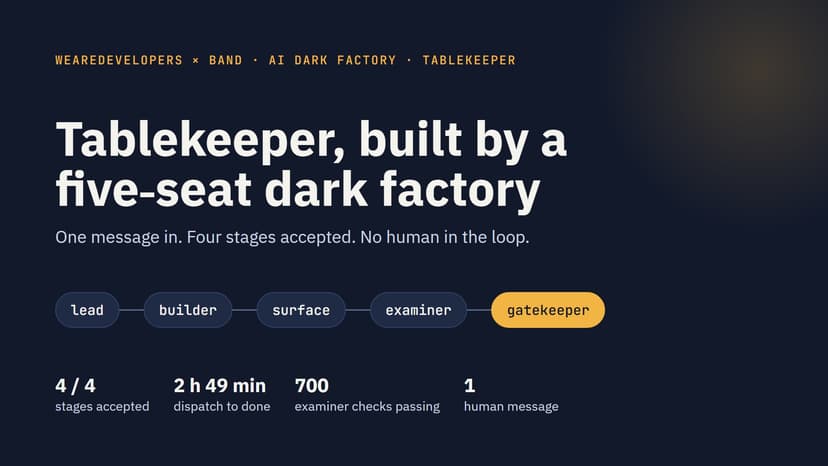
Tablekeeper by a Five-Seat Cloud Dark Factory
We built a software factory, not just an app. Five coding-agent seats (lead, builder, surface, examiner and gatekeeper) work in one BAND room. Each seat is its own Claude Code cloud session, connected to BAND through a small bridge on the Agent API. One dispatched message, the tablekeeper task with all four stages, was the only human input. Planning, building, review and repair all happened between the seats in the room. The key design decision is how acceptance is split. The builder never grades its own work. The examiner turns every normative sentence of the spec into a ledger and black-box checks without ever reading product code, because only part of each stage's checks ships (11% for stage 3). The gatekeeper cannot edit code. It rebuilds every delivery from a clean clone and runs the supplied checks, the examiner's checks, concurrency and retry bursts, upgrades from earlier stages and an offline start at 2 vCPU / 2 GiB, then answers ACCEPT or REJECT. Result: all four stages were accepted in their first review round, 2 h 49 min after one message, for about $45 of cloud credit. On a fresh public clone in the judges' isolated mode, every folder from stage-1 to stage-4 claims its stage (120/120, 25/25, 7/7, 6/6) without overshooting, and the examiner's own suites reach 700 passing checks. In the stage-4 review, the gatekeeper caught a flaky examiner check, proved the service correct, and the fix came back through the room. The mandates are generic (no endpoint, field or domain word) and are linted against both tracks' vocabularies. FACTORY.md explains how to stand the factory up, measures time and cost, and lists 14 things that broke while we built it, each with the factory change it led to.
6 Oct 2026

BandGuard
Think your application is secure? Let us break into it...actually break it for you - so you know the security vulnerabilities of your application before someone else does. Most teams rely on static analysis tools, vulnerability scanners, and occasional manual reviews. These approaches often miss vulnerabilities that emerge from how different parts of an application interact, especially in modern AI-powered systems. Security reviews are expensive, infrequent, and rarely simulate how a real attacker would think and adapt. Our solution - BandGuard is an AI-powered adversarial testing platform where multiple specialized security agents collaborate to actively investigate and challenge an application's security posture. Developers simply provide a GitHub repository, and BandGuard deploys an AI Red Team that attempts to discover vulnerabilities in a safe, controlled environment. Instead of performing a single automated scan, agents work together like a real security team—sharing findings, validating exploits, challenging assumptions, and coordinating investigations through Band. The system analyzes applications from multiple perspectives, including traditional software vulnerabilities, exposed secrets, authentication weaknesses, insecure configurations, and AI-specific threats such as prompt injection, tool abuse, and context manipulation. Each security agent has a specialized role: Recon Agent maps the application's architecture and attack surface. Vulnerability Analysis Agent searches for common security flaws. AI Security Agent evaluates LLM and agentic workflows for prompt injection and AI-specific risks. Secrets Agent identifies exposed credentials and sensitive configuration leaks. Exploit Validation Agent verifies findings and reduces false positives. Security Review Agent prioritizes and consolidates results. Remediation Agent generates actionable fixes and secure implementation guidance.
19 Jun 2026


