
🤓 Latest Submissions
Zero-Token Hybrid Routing Agent
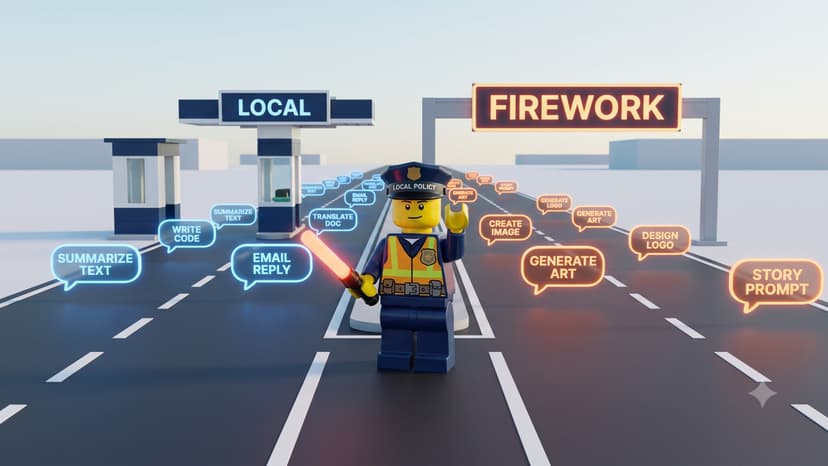
In the rapidly evolving landscape of enterprise AI, developers face a critical dilemma: cost versus accuracy. Routing every user query to a massive 70B+ parameter cloud model guarantees high accuracy but quickly destroys token budgets. Conversely, routing to smaller, cheaper models risks catastrophic failures on complex logic tasks. Furthermore, attempting to use LLM "self-reflection" to determine task difficulty introduces severe latency, burns unnecessary tokens, and often falls victim to small-model overconfidence. To solve this, we built the Hybrid Token-Efficient Routing Agent. Our solution introduces a Two-Stage Zero-Token Filter that categorizes query complexity locally in milliseconds, safely escalating only the most difficult prompts to premium Fireworks AI endpoints. Our architecture operates through a strict pipeline. Stage 1 is the Heuristic Trap Detector. We engineered a hyper-optimized Python regex engine designed to immediately intercept "falsely simple" logic traps—such as spatial reasoning, letter counting, riddles, and stealth coding requests—that typically fool small models. These are instantly flagged for escalation. Stage 2 serves as the Local SLM Brain. For prompts that pass the regex, a highly quantized GGUF model (Llama-3-8B) running via llama-cpp-python evaluates the input. Utilizing an aggressively optimized system prompt, it forces a strict single-token output (SIMPLE or COMPLEX). This categorization costs exactly zero API tokens and executes locally in under a second. Finally, in Stage 3, the Cloud Dispatch dynamically routes verified COMPLEX prompts to the heavy-duty Fireworks models, while SIMPLE tasks are mapped to the most cost-effective tier. By combining adversarial heuristic trapping with a rigid 1-token local classifier, our agent achieves a mathematically optimal balance of speed, cost, and accuracy.
13 Jul 2026


