

🤝 Top Collaborators


🤓 Latest Submissions
RepoMedicAI Repository Diagnostic&Debugging Agent
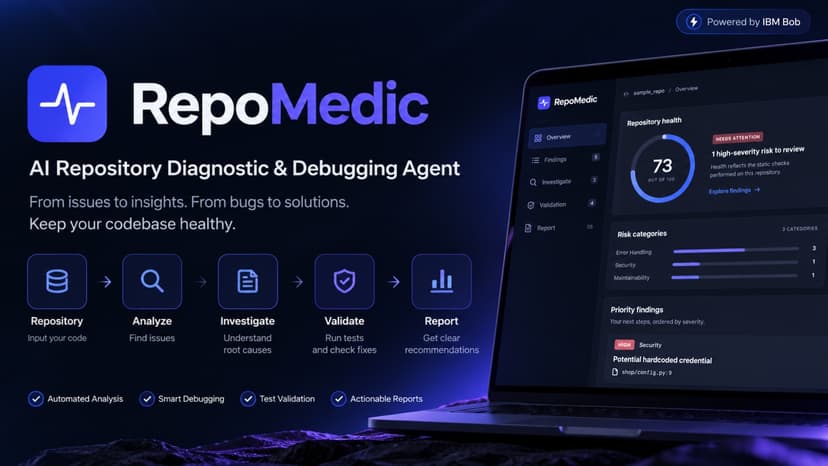
Developers often spend more time understanding a repository and locating the real cause of a problem than implementing the fix itself. This becomes especially difficult when onboarding to an unfamiliar codebase, debugging inherited software, or deciding which issues deserve attention first. Static analysis can identify suspicious patterns, but developers are often left to connect findings to relevant files, reason about likely root causes, determine a repair strategy, and decide how to validate the result. RepoMedic is an AI-assisted repository diagnostic and debugging agent designed to turn that fragmented process into one structured engineering workflow. A developer can load the built-in demo repository, provide a public GitHub repository URL, or upload a ZIP project. RepoMedic analyzes the repository, calculates a health score, identifies and prioritizes findings by severity and category, and provides a searchable triage view. From a selected finding or manually described issue, RepoMedic's investigation workflow identifies relevant files, produces a likely root-cause analysis with a confidence level, recommends a repair strategy, and proposes regression testing guidance. The developer can then move directly into validation and an engineering report that consolidates repository health, findings, investigation results, recommendations, and validation status. This creates a continuous workflow from repository intake to actionable engineering evidence rather than a collection of disconnected analysis tools. RepoMedic is designed with a deliberate security boundary. Imported GitHub and ZIP repositories are treated as untrusted and analyzed statically; their code is never executed. Runtime validation is restricted to the controlled built-in demo environment. GitHub imports are shallow and bounded, while ZIP ingestion includes protections against traversal, symlinks, collisions, and resource abuse. The working prototype demonstrates the complete workflow on a multi-file sample repository containing Python, JavaScript, HTML, and CSS. The demo produces 5 prioritized findings across 16 analyzed files, including a high-severity potential hardcoded credential. RepoMedic can investigate that finding, identify relevant files, provide credential-specific root-cause and repair guidance, recommend regression coverage, and execute the trusted demo's 12-test validation suite. RepoMedic targets developers, maintainers, reviewers, and engineers onboarding to unfamiliar repositories. Its goal is simple: reduce the manual effort between “something is wrong in this repository” and “here is where to investigate, why it may be happening, how to address it, and how to validate the result.”
27 Sep 2026
