AI/ML API

The AI/ML API offers a comprehensive suite of advanced AI functionalities designed to meet a variety of needs, including text completion, image inference, speech-to-text, and text-to-speech capabilities. The API is engineered for seamless integration, exceptional performance, and secure API key management, ensuring a smooth and reliable user experience.

Key Features

  • Inference: Effortlessly evaluate and deploy models for a range of tasks including text generation, image analysis, and more. This feature allows users to leverage the power of advanced AI to draw meaningful inferences from various data types.
  • API Key Management: Securely generate, manage, and monitor API keys to ensure the safety and integrity of interactions with the API. This feature provides robust security measures to protect data and operations.
  • Broad Model Selection: Gain access to a diverse array of models tailored to various AI applications, allowing selection of the most appropriate model for specific tasks. This extensive model library supports a wide range of functionalities to address different AI challenges.

Start building with AI/ML API

To start using the AI/ML API, follow the detailed Quickstart guide which provides step-by-step instructions to set up the development environment and initiate the first API call. This guide is designed to help users quickly familiarize themselves with the API's capabilities and start leveraging its powerful features.

Authentication

API Key Management

To use the AI/ML API, an API key is required. This key is essential for authenticating requests to the API. API keys can be easily generated and managed through the account dashboard, ensuring secure access to the API services.

Sending Your First Request

After setting up the environment and obtaining an API key, proceed to send the first request. The API documentation provides detailed instructions and examples to help craft requests and understand responses, enabling full utilization of the AI/ML API's functionalities.

Authorization: Bearer YOUR_API_KEY

curl --location --globoff 'api.aimlapi.com/chat/completions' \
--header 'Content-Type: application/json' \
--header 'Authorization: Bearer YOUR_API_KEY' \
--data '{
    "model": "gpt-3.5-turbo",
    "messages": [
        {
            "role": "user",
            "content": "What's API?"
        },
    ],
    "max_tokens": 512,
    "stream": false,
    
}'

👉 Read the documentation to find out more: https://docs.aimlapi.com/

AI/ML API top builders

Explore the top contributors showcasing the highest number of AI/ML API app submissions within our community.

AI/ML API AI technology page Hackathon projects

Discover innovative solutions crafted with AI/ML API, developed by our community members during our engaging hackathons.

CodeForge AI — Autonomous Code Generation

CodeForge AI — Autonomous Code Generation

CodeForge AI — From Prompt to Secure, Intelligent Code CodeForge AI is an AI-powered autonomous developer agent that transforms natural-language requirements into functional, optimized, and understandable code. Developed by team Prompt to Product for the Vultr Agent Rush Hackathon, it combines intelligent code generation, secure execution, automated debugging, and performance analysis into one platform. The Problem AI coding assistants can generate code quickly, but developers still face challenges verifying correctness, identifying bugs, analyzing algorithm efficiency, and safely executing unfamiliar code. Running untrusted AI-generated code without isolation can create serious security risks. Our Solution CodeForge AI bridges the gap between AI-generated code and reliable software development through an intelligent workflow that generates, tests, analyzes, and improves code. Key Features AI Code Generation: Converts natural-language instructions and pseudocode into structured code in Python, C++, and JavaScript. Secure Sandbox Execution: Uses Docker-based isolation to support controlled execution of generated Python code. Autonomous Error Repair: Analyzes execution failures and attempts to correct generated code automatically. Performance Analysis: Estimates time and space complexity and identifies potential algorithmic inefficiencies. Step-by-Step Explanation: Explains generated algorithms, program logic, and illustrative execution traces. Interactive Dashboard: Provides a modern web interface for code generation, inspection, testing, and debugging. Technology Stack CodeForge AI uses React, Vite, JavaScript, Python, FastAPI, Docker, and REST APIs. Its architecture is designed to integrate Vultr Serverless Inference for AI-powered generation and repair, with deployment on Vultr cloud infrastructure.

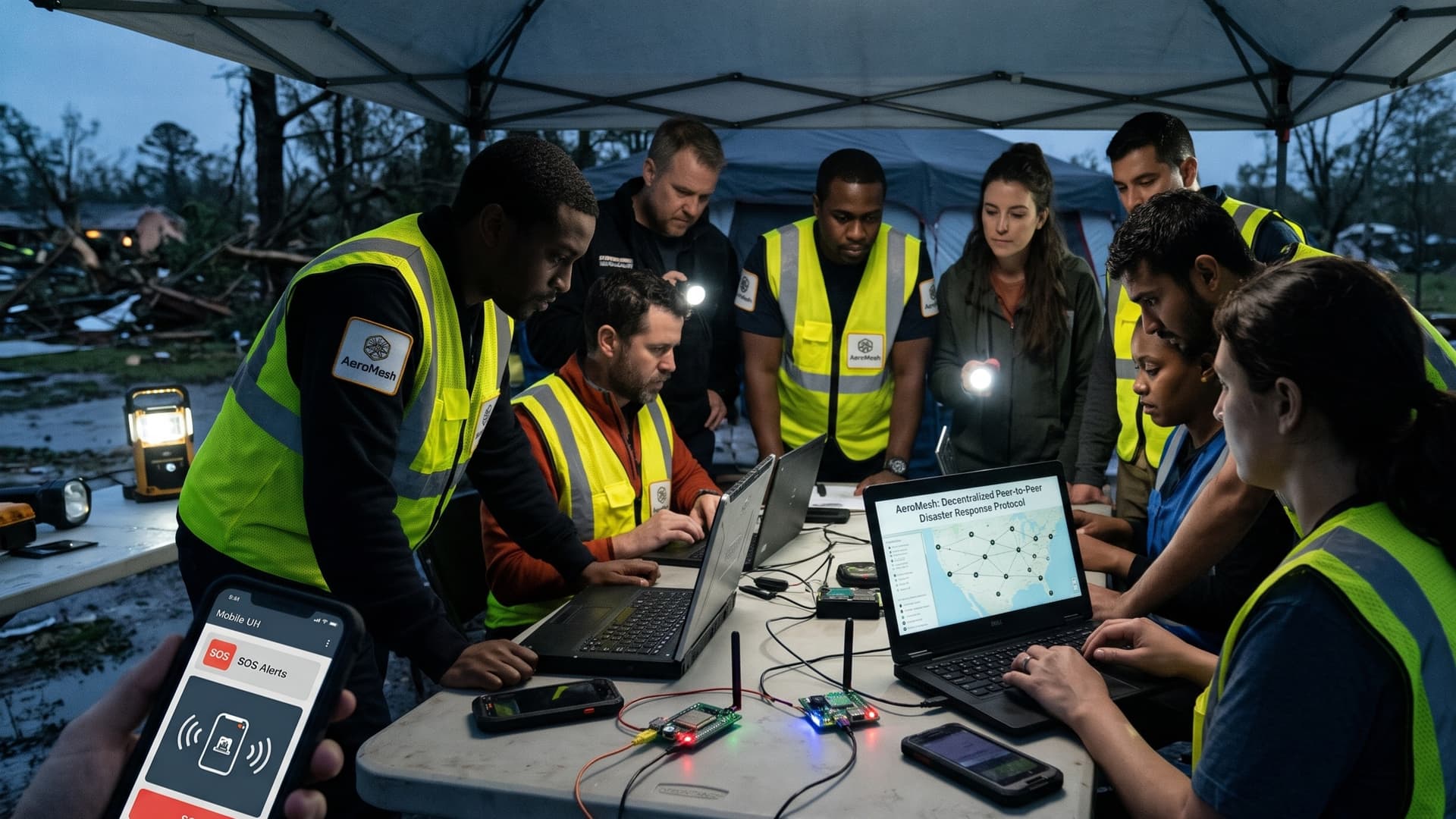
AeroMesh: Decentralized Disaster Response Mesh

AeroMesh: Decentralized Disaster Response Mesh

AeroMesh is an open, decentralized communication framework built for zero-connectivity environments during catastrophic natural disasters, power grid failures, and complete telecommunication blackouts. Traditional disaster relief depends heavily on cellular towers and cloud infrastructure, which are often the first assets knocked offline. When these networks collapse, first responders and stranded citizens are isolated, causing critical rescue delays. AeroMesh solves this by turning consumer devices—smartphones, laptops, and single-board edge microcontrollers—into autonomous, cooperative relay nodes. Operating as a Delay-Tolerant Mobile Ad-Hoc Network (DTN/MANET), the protocol uses local interfaces like Wi-Fi Direct and Bluetooth Low Energy (BLE) to form dynamic, self-healing peer-to-peer topologies without requiring central gateways or towers. At its core, AeroMesh runs an opportunistic store-and-forward epidemic routing protocol. Devices discover nearby peers, exchange cryptographic signatures, and propagate emergency packets across network partitions. To prevent data conflicts across disconnected clusters, the system implements Conflict-Free Replicated Data Types (CRDTs), mathematically guaranteeing eventual consistency for casualty lists, supply inventories, and incident maps upon reconnection. Security relies on on-device asymmetric key pairs, enabling zero-trust verification of packet authenticity without a central Certificate Authority. Field teams access live data through an embedded, browser-based offline dashboard served directly from edge nodes, ensuring reliable coordination when every other network fails.