Arc

Arc is a purpose-built, EVM-compatible Layer-1 blockchain advancing the frontier of stablecoin finance and tokenization. It features USDC as native gas, deterministic settlement finality, opt-in privacy, and a stable transaction fee architecture. Optimized for stablecoin-native use cases, such as global payments, FX, and capital markets, Arc serves as a foundational settlement layer for programmable money on the internet.

General
CompanyCircle Internet Group
WebsiteArc Network
Documentationhttps://www.arc.network/litepaper
TypeLayer-1 Blockchain
LaunchPublic Testnet Fall 2025, Mainnet Beta 2026
ConsensusMalachite (Byzantine Fault Tolerant)
CompatibilityEVM-Compatible

Core Architecture

Malachite Consensus Engine

  • High-performance Byzantine Fault Tolerant (BFT) consensus
  • Built on Tendermint algorithm with Rust implementation
  • Sub-second deterministic finality (under 350ms with 20 validators)
  • Performance up to 10,000 TPS with 4 validators
  • No probabilistic confirmations or chain reorganizations

USDC as Native Gas Token

  • Transaction fees paid directly in USDC stablecoin
  • Predictable, dollar-denominated costs for enterprises
  • Eliminates volatile crypto token exposure for gas payments
  • Enhanced EIP-1559 fee mechanism with weighted moving averages
  • Stable transaction fee architecture optimized for business use

EVM Compatibility

  • Full Ethereum Virtual Machine compatibility
  • Seamless migration of existing Ethereum applications
  • Support for existing developer tools and frameworks
  • Native integration with Solidity smart contracts

Key Features

Deterministic Settlement Finality

  • Transactions achieve irreversible finality in under 1 second
  • No risk of chain reorganizations or reversals
  • Guaranteed final settlement for enterprise applications
  • Superior to probabilistic finality models

Built-in FX Engine

  • Institutional-grade Request-for-Quote (RFQ) system
  • 24/7 on-chain foreign exchange and settlement
  • Payment-versus-Payment (PvP) atomic swaps
  • Support for multiple stablecoin pairs (USDC, EURC, etc.)
  • Perpetual futures markets for stablecoin trading

Opt-in Privacy Controls

  • Confidential transfers hiding transaction amounts
  • Addresses remain visible for compliance
  • View keys for selective disclosure to regulators/auditors
  • Trusted Execution Environment (TEE) implementation
  • Future support for MPC, FHE, and Zero-Knowledge proofs

MEV Mitigation

  • Classification of constructive vs. harmful MEV
  • Encrypted mempools to prevent front-running
  • Batch transaction processing
  • Multi-proposer mechanisms for fair ordering
  • Protection against sandwich attacks and value extraction

Enterprise Integration

Circle Platform Integration

  • Native support for Circle Payments Network (CPN)
  • Full integration with USDC, EURC, and USYC tokens
  • Circle Mint, Wallets, and Contracts compatibility
  • Cross-Chain Transfer Protocol (CCTP) support
  • Gateway interoperability service integration

Real-World Asset Tokenization

  • Support for tokenized equities, bonds, and securities
  • Private credit and institutional fund tokenization
  • Partnership with licensed asset issuers and custodians
  • Regulated real-world asset (RWA) framework
  • Compliance-ready tokenization infrastructure

Institutional Validator Network

  • Permissioned Proof-of-Authority consensus initially
  • Hand-selected institutional validators
  • Geographic distribution of validator nodes
  • High compliance and regulatory standards
  • Future transition to broader validator participation

Use Cases

Global Payments & Remittances

  • Cross-border payments with instant settlement
  • Reduced intermediary costs and complexity
  • 24/7 operation independent of banking hours
  • Multi-currency stablecoin support

Capital Markets & Trading

  • Institutional trading settlement
  • Tokenized securities and derivatives
  • Automated delivery-versus-payment (DvP)
  • Real-time collateral management

Foreign Exchange

  • On-chain FX trading and settlement
  • Stablecoin pair perpetual futures
  • Institutional-grade price discovery
  • Automated currency conversion

Treasury Management

  • AI-powered treasury optimization
  • Yield-bearing stablecoin integration (USYC)
  • Programmable finance workflows
  • Automated compliance reporting

Technical Specifications

  • Throughput: 3,000-10,000 TPS depending on validator count
  • Finality: Sub-second (100-350ms) deterministic settlement
  • Consensus: Malachite BFT based on Tendermint
  • Virtual Machine: Ethereum Virtual Machine (EVM) compatible
  • Gas Token: USDC native gas payments
  • Privacy: Opt-in confidential transfers with compliance features
  • Interoperability: Cross-chain bridges and CCTP integration

Development Timeline

  • Private Testnet: August 2025 (launched)
  • Public Testnet: Fall 2025
  • Mainnet Beta: 2026
  • Full Production: TBD with community and regulatory readiness

Arc represents Circle's vision for a stablecoin-native financial infrastructure that bridges traditional finance with programmable blockchain technology, designed specifically for enterprise adoption and regulatory compliance.

Arc top builders

Explore the top contributors showcasing the highest number of Arc app submissions within our community.

Arc AI technology page Hackathon projects

Discover innovative solutions crafted with Arc, developed by our community members during our engaging hackathons.

Ask The Ledger

Ask The Ledger

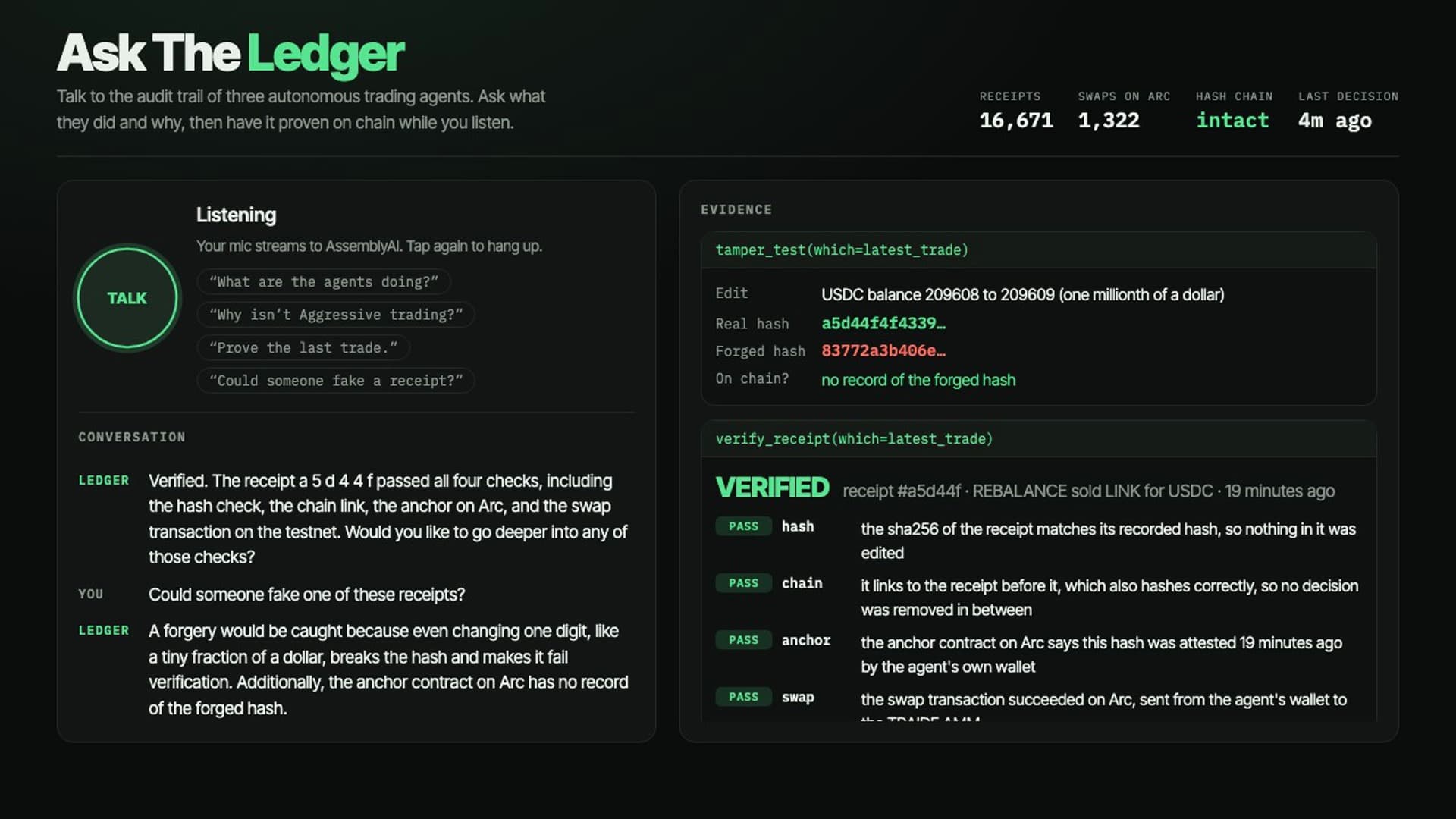
Autonomous agents that move money are only trustworthy if someone checks their work. Three trading agents on Arc testnet already write every decision as a hash-chained receipt and anchor every trade on chain. The ledger is public and honest, and it is 35 MB of JSON nobody reads. Ask The Ledger turns that audit trail into a conversation. Tap talk and ask: what are the agents doing, why isn't Aggressive trading, prove the last trade, could someone fake a receipt. It is a stored agent on the AssemblyAI Voice Agent API with six HTTP tools. AssemblyAI handles speech recognition, the model, turn taking and the voice over one WebSocket, and calls the tools server-side mid-conversation. Keyterms bias transcription toward agent names, LINK, USDC and Arc. The tools do real work. verify_receipt recomputes the sha256 of the receipt, checks the link to the previous receipt, calls the anchor contract on Arc to confirm the agent's own wallet attested it, and re-reads the swap. tamper_test changes one digit of a real receipt, shows the hash break, and confirms the anchor has no record of the forgery. Every fact the agent speaks comes from a tool result, and the page shows the same evidence it read. It is honest by design: when the agents are holding, it says so and reads the reason they logged. Arc testnet only, no real funds. Business value: any team running agents with financial authority, from trading desks to treasury and payment agents, needs an audit surface non-engineers can use. A compliance lead can ask a question and get a verified answer in seconds instead of filing a ticket.

Code2Edge: Deployment with Proof

Code2Edge: Deployment with Proof

Porting a PyTorch model to a microcontroller sounds like a model problem, but it's really a pipeline problem. A keyword-spotting model needs audio resampled, windowed, FFT'd, run through a Mel filterbank, log-compressed, and normalized before it ever reaches the network — and the constants controlling each step (window size, FFT convention, epsilon values) are usually scattered across config files nobody rereads. Get one of them wrong in the C rewrite and the device still boots fine; it just quietly predicts the wrong thing, with no black-box "pass/fail" test telling you why. Code2Edge solves this with stage-wise differential parity instead of black-box testing. The same audio corpus runs through both the Python reference pipeline and the generated C pipeline, and every intermediate tensor is compared — max/mean absolute error, cosine similarity, and eventually prediction agreement. If a stage drifts past tolerance, the system flags exactly which stage and offers a deterministic hint (e.g., "shape mismatch at framing — check hop length"), so debugging starts from evidence instead of guesswork. Bob drives this as an orchestrator, not a black-box code generator. An MCP server gives it five hardware-aware tools (profiling the model, inspecting the pipeline, checking the target, running parity tests, benchmarking) plus workflow tools for starting runs and gating steps. Bob follows a fixed sequence: analyze the repo, produce an Edge Readiness Report, pause for a human APPROVE/REJECT, generate code, run a host parity gate (with a 3-attempt repair loop before escalating to a human), build for the MCU, run a device parity gate, benchmark on real silicon, and open a pull request. The target users are embedded/ML engineers who need confidence that a ported pipeline behaves identically to its source model — not just that it compiles. The project is grounded in a real trained workload: a 119,372-parameter DS-CNN for 12-class keyword spotting (96.65% test accuracy), deployed to an STM32U585 (Cortex-M33) on an Arduino UNO Q. What makes this different is the discipline around honesty: every reported number is explicitly labeled real (measured from an artifact) or mock (a placeholder for an unavailable dependency), and the two are never mixed. Host-side parity is fully real and passing across 500 samples and 4 pipeline stages. Physical benchmarking is real and passing on actual silicon (50/50 correct inferences). Device-side parity is real but currently limited to a single fixture rather than the full corpus — an openly disclosed gap, with a hardware-validation guide checked in to finish the job.

PraxisGuard

PraxisGuard

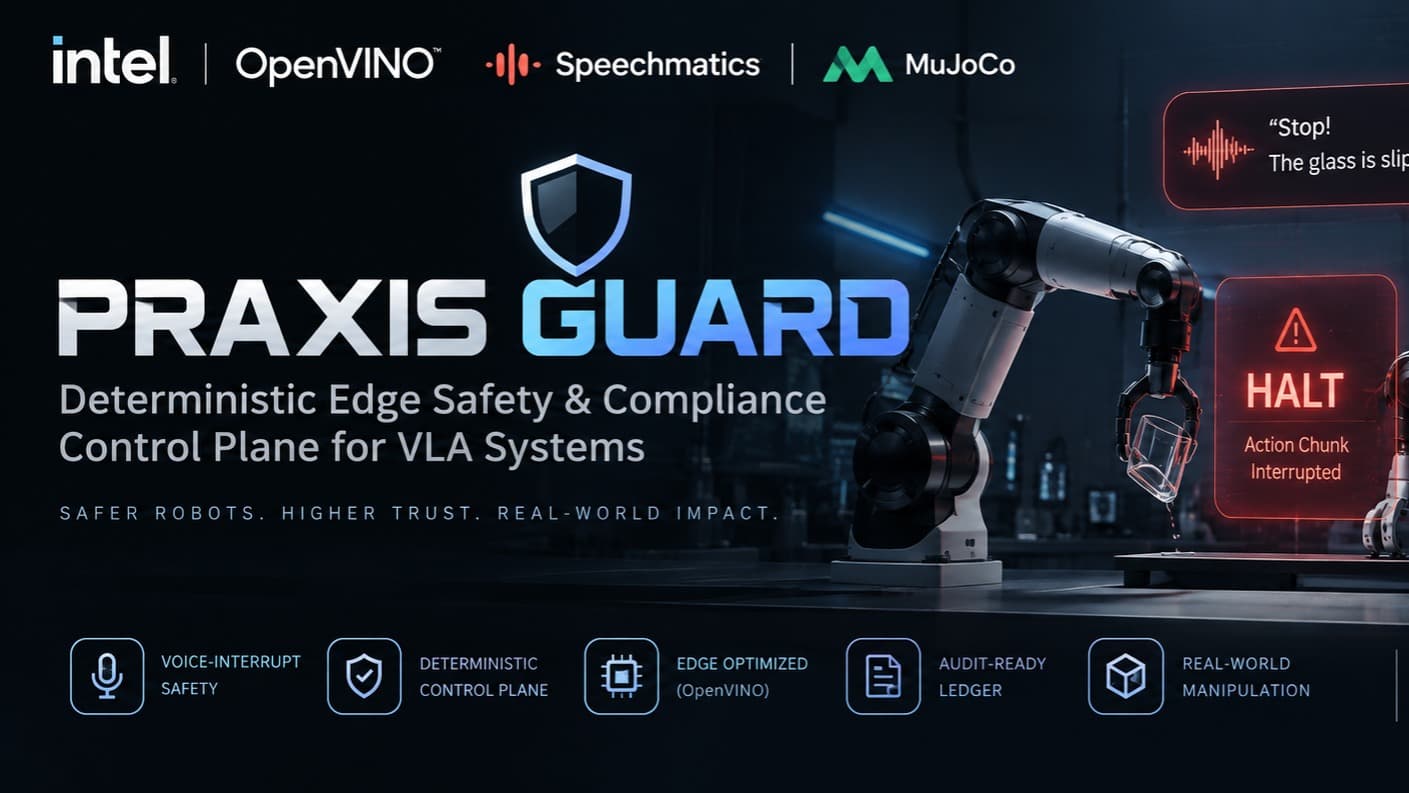
Modern Vision-Language-Action (VLA) manipulation policies (ACT, SmolVLA, Pi0.5) predict motor trajectories in chunks—typically 50 steps at 100 Hz. While action chunking stabilizes bimanual coordination, it creates a 500 ms open-loop blind spot: once dispatched, policies cannot react to dynamic workspace hazards mid-execution. Solution: Praxis Guard Praxis Guard decouples trajectory generation from deterministic safety authority: Streaming Acoustic Hazard Detection: Interfaces with Speechmatics real-time streaming ASR over WebSockets to capture spoken interventions. Negation-Aware Arbiter: Implements a priority-ordered taxonomy (HALT > CLARIFY > REDIRECT > MODIFY) with syntactic awareness—suppressing idioms like "don't stop now" while immediately acting on true hazards. Instant Action Flush: Bypasses model inference cadence, invalidates the active trajectory chunk, and commands an immediate zero-velocity hold in <1 ms. Edge Acceleration via OpenVINO: Runs a baseline policy compiled to OpenVINO IR (FP16) at 0.058 ms p50 latency, preserving compute headroom for safety monitoring on Intel Core Ultra silicon. Cryptographic Tamper-Evidence: Chains every safety event with SHA-256 signatures to an append-only ledger, making post-incident modifications provably invalid. Business Value & Applications Deployment in Regulated Environments: Provides the deterministic, fail-safe supervisory layer required by ISO and OSHA standards for learned robotics. Forensic Liability Protection: Guarantees unforgeable audit trails for industrial reconstruction and insurance certification. Human-in-the-Loop Workspaces: Enables hands-free spoken safety intervention across warehouse logistics and dynamic assembly lines.

Fresno LUX: A Living City

Fresno LUX: A Living City

Fresno LUX is a prototype for a living intelligence layer across an entire city. Fresno already contains enormous amounts of intelligence: residents know where problems exist, nonprofits know where help is needed, businesses know where opportunities exist, educators understand gaps in learning, researchers generate knowledge, and government maintains critical infrastructure and data. The problem is that much of this intelligence is fragmented across disconnected systems. Fresno LUX connects those pieces. The platform creates a shared city graph where people, organizations, resources, needs, projects, observations, experiments, and outcomes become connected nodes. Instead of simply collecting data, LUX continuously asks: What is happening? What do we know? What is missing? What can we test? What changed? A community problem can become an observable signal. That signal can become an experiment. The experiment produces evidence. Evidence changes the system's understanding. That updated understanding informs the next action. Observe → Connect → Understand → Act → Measure → Learn → Converge. The goal is to move Fresno from disconnected information toward collective intelligence—a system where knowledge can travel across boundaries and successful solutions can be discovered, tested, measured, and replicated. LUX is designed to make the invisible connections visible: the relationship between a neighborhood and its resources, between a student and educational opportunity, between a business and workforce capacity, between environmental conditions and community health, and between an idea and measurable real-world impact. This hackathon prototype demonstrates the beginning of a Living Fresno Graph: a city that can observe itself, learn from evidence, and coordinate toward better outcomes.