AudioCraft

Welcome to the ultimate destination for groundbreaking audio technology. Crafted meticulously by Meta, AudioCraft is a cutting-edge library for deep learning-powered audio generation and research.

General
AuthorMeta
Repositoryhttps://github.com/facebookresearch/audiocraft
TypeThe library for audio processing and generation

What is AudioCraft?

AudioCraft is a next-gen library revolutionizing the audio industry with its array of features. It's not just an audio library, it's the future of audio.

Key Features:

  • Advanced Audio Generation Models: With models like AudioGen and MusicGen, prepare to experience unparalleled audio quality.
  • EnCodec: An innovative audio compressor and tokenizer that is setting a new standard in audio processing.

Capabilities:

  • Generative Audio Needs: A comprehensive code base for all generative audio needs - be it music, sound effects, or compression after training on raw audio signals.
  • Simplified Model Design: The model design, especially for MusicGen and AudioGen, is simplified compared to previous generative models. With a single autoregressive Language Model (LM) that operates on compressed discrete music representation, or tokens, AudioCraft efficiently captures long-term dependencies in audio for high-quality generation.
  • EnCodec: A unique neural audio codec that converts audio signals to discrete tokens and vice-versa. It acts as the bridge between the raw waveform and the autoregressive language model.
  • Text-to-sound Generation: With AudioGen, you can convert text into environmental sounds.
  • Text-to-music Generation: MusicGen brings texts to life by crafting diverse, enchanting melodies based on the provided textual cues.

AI Tutorials


AudioCraft Resources

A curated list of libraries and technologies to help you build great projects with AudioCraft.

  • Installation Guide: Get started with AudioCraft using the detailed guide on GitHub.
  • Models Overview:
    • MusicGen - A top-tier controllable text-to-music model.
    • AudioGen - A groundbreaking text-to-sound model.
    • EnCodec - A high fidelity neural audio codec.
    • Multi Band Diffusion - An EnCodec compatible decoder using diffusion.
  • API Documentation: Delve deeper into the features, functionalities, and integrations with the detailed API Documentation.
  • Meta Intro Article: Understand the technology, its creation, and its capabilities with this Meta Intro Article.

AudioCraft top builders

Explore the top contributors showcasing the highest number of AudioCraft app submissions within our community.

AudioCraft AI technology page Hackathon projects

Discover innovative solutions crafted with AudioCraft, developed by our community members during our engaging hackathons.

ProcureVoice

ProcureVoice

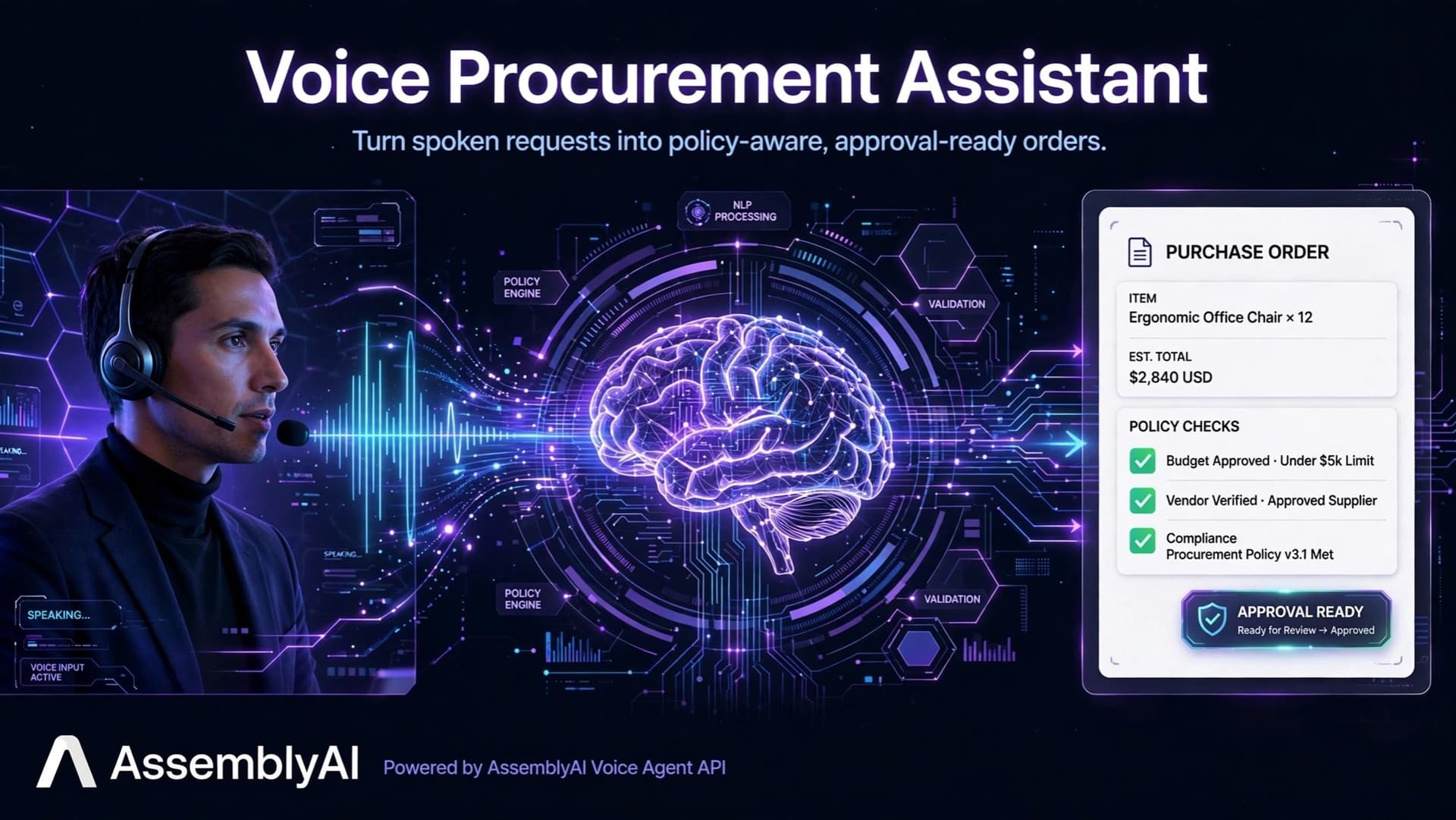
ProcureVoice turns a spoken sentence into an approval-ready procurement request. An employee says: "I need three monitors at ₦100,000 each from Techmart, approved vendor, normal request." ProcureVoice listens, detects what's missing, asks follow-up questions, checks company procurement policy, calculates the total spend, and creates a structured purchase request with a unique ID β€” all in a natural voice conversation, without a form. Built on the AssemblyAI Voice Agent API, ProcureVoice runs a single WebSocket carrying real-time speech recognition, LLM reasoning, text-to-speech, turn detection, and JSON-schema tool calling. Two backend tools β€” check_purchase_policy and create_purchase_request β€” execute against a Node.js server that evaluates spend thresholds, vendor status, category rules, and urgency. The result is a request that arrives ready for human approval, routed to the right level: manager, finance, or executive. The agent never approves purchases. It prepares and routes them. That boundary is deliberate: it makes ProcureVoice deployable in enterprises where autonomous spend decisions are unacceptable. Voice is the natural interface for procurement because procurement begins as conversation. Forcing employees to translate that conversation into a form is the source of most friction in the process. ProcureVoice removes the translation step. Stack: AssemblyAI Voice Agent API, WebSocket, Node.js, Express 5, Web Audio API, AudioWorklet, vanilla JS. No frameworks, no bundler, no database β€” deployed on Render, built entirely from a phone in Termux.

 BugForge

BugForge

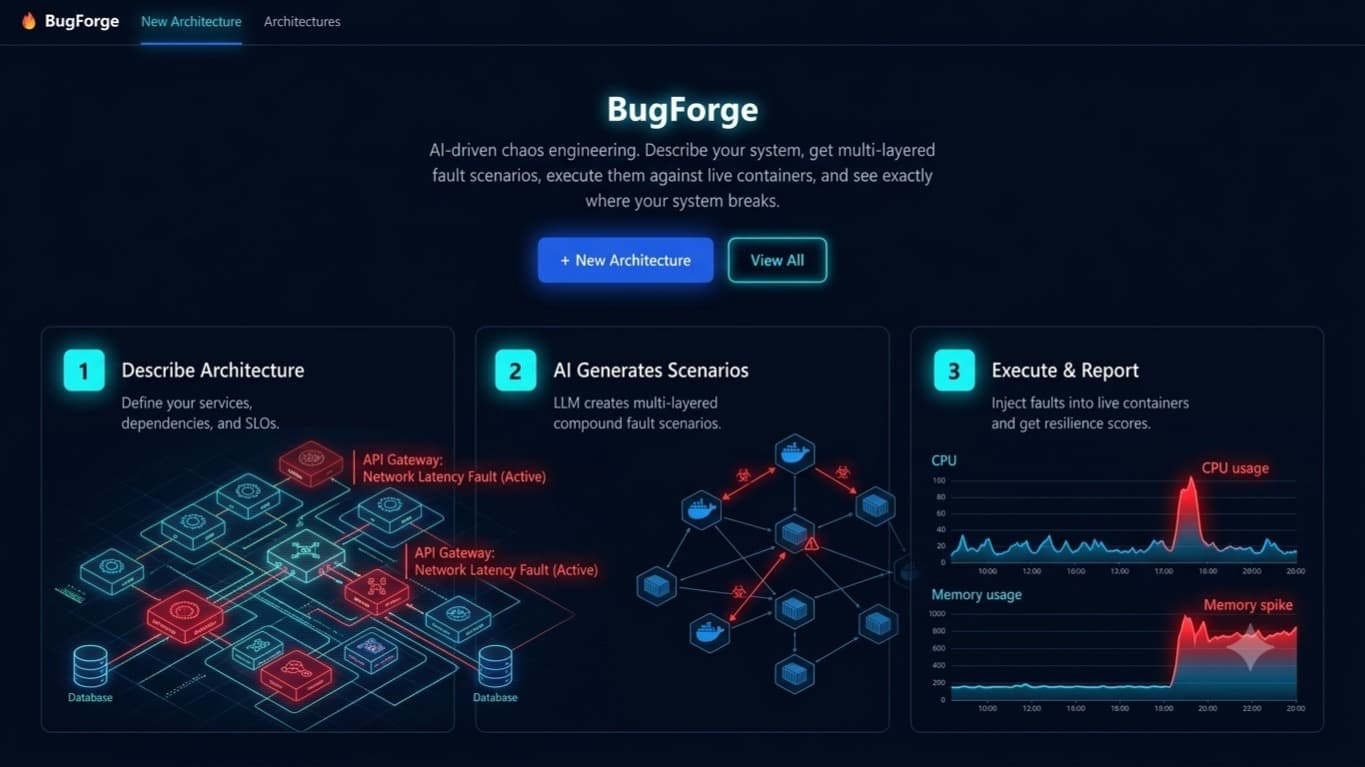
BugForge β€” AI-Driven Chaos Engineering Platform The Problem Modern systems fail in compound, unpredictable ways β€” not just one thing at a time. Yet engineers practicing chaos testing almost always test simple, single-fault scenarios: kill one container, inject one latency. They rarely combine multiple simultaneous failures. The result is a false sense of resilience β€” systems that pass every individual chaos test but collapse when two or three failure modes hit at once. Traditional chaos tools also lack structure: no scenario review before execution, no automatic fault revert, and no standardized reporting. The Solution BugForge uses an LLM (OpenAI GPT-4o or IBM watsonx Granite) to generate compound, multi-layered fault scenarios that human engineers rarely think to combine β€” like "inject 300ms latency on the API while the database is frozen while the worker is under 90% CPU stress." These are the scenarios that expose real weaknesses: missing retry logic, absent circuit breakers, connection pool exhaustion. A human-in-the-loop approval step ensures no fault is ever injected without explicit sign-off. Once approved, BugForge executes faults directly against live Docker containers using 6 fault types β€” container kill, process freeze, network partition, CPU stress, memory stress, and latency injection β€” all automatically reverted after each step. Real-time container logs and CPU/memory metrics are streamed during execution. A structured report then shows per-step pass/fail results, peak resource charts, and an optional LLM-written resilience score from 1 to 10. Target Users Site reliability engineers, platform engineers, and backend developers operating microservice systems on Docker or Docker Compose environments. What Makes It Unique AI-generated compound scenarios β€” the LLM designs failure combinations humans would not think to test Human-in-the-loop approval β€” no fault touches a container without engineer sign-off End-to-end in one platform β€” design, approve, execute, observe, and report in a single tool The entire workflow β€” from describing a system to reading the final resilience report β€” takes minutes, not days.