AutoGen

AutoGen is an advanced open-source framework developed by Chi Wang designed to simplify the creation of multi-agent systems powered by large language models (LLMs). The platform allows developers to build conversational AI agents that can interact with each other, humans, and various tools in a coordinated manner. AutoGen is highly modular and supports a wide range of applications, making it an essential tool for developers looking to implement complex, automated workflows with minimal manual intervention.

General
AuthorChi Wang
Release DateSeptember 2023
Websitehttps://microsoft.github.io/autogen/
Repositoryhttps://github.com/microsoft/autogen
Documentationhttps://microsoft.github.io/autogen/docs/Getting-Started
Discordhttps://discord.com/invite/pAbnFJrkgZ
Technology TypeAI/ML Framework

Key Features

  • Multi-Agent Framework: Facilitates the design of agents with specialized roles, enabling them to communicate and collaborate efficiently.

  • Enhanced LLM Inference: Provides advanced APIs for improving LLM performance, reducing inference costs.

  • Customizable Workflows: Supports complex, dynamic workflows by allowing agents to interact through conversational patterns, enabling seamless automation.

  • Tool Integration: Agents can be configured to use external tools, adding flexibility and enhancing their problem-solving capabilities.

  • Human-in-the-Loop: Integrates human feedback into the workflow, allowing for oversight and intervention when necessary.

Start Building with AutoGen

AutoGen simplifies the development of complex AI applications by providing a robust framework for creating multi-agent systems. With its modular design, developers can quickly build and customize AI workflows that combine LLMs, human intelligence, and various tools to tackle intricate tasks. Whether you are looking to automate customer support, enhance software development processes, or optimize supply chains, AutoGen offers the flexibility and power needed to create sophisticated AI-driven solutions. Explore the community-built use cases and applications to see the full potential of what AutoGen can do.

πŸ‘‰ Start building with AutoGen

πŸ‘‰ Examples

AutoGen top builders

Explore the top contributors showcasing the highest number of AutoGen app submissions within our community.

AutoGen AI technology page Hackathon projects

Discover innovative solutions crafted with AutoGen, developed by our community members during our engaging hackathons.

AdvancedLeads AI β€” Multi-Agent Lead Scoring

AdvancedLeads AI β€” Multi-Agent Lead Scoring

B2B lead qualification is usually a single model's judgment call, and single-model judgment is unreliable: it's confident, opaque, and hard to audit. AdvancedLeadsGeneration-AI replaces that with a structured debate between agents, then a scored reconciliation against historical deal data. The system runs three roles. An advocate agent argues why a lead is a strong fit, citing signals from the lead's profile and company data. A risk agent argues the opposite β€” surfacing counter-evidence, red flags, and gaps in the data. A reconciliation layer then scores both arguments against historical won/lost deal patterns and produces a final lead score with the reasoning attached, so a sales team can see not just the score but why it was given. The key design decision was separating advocacy from risk assessment. A single prompt asking a model to "evaluate this lead" tends to collapse into one perspective. Forcing two agents to argue opposing positions, then having a third layer judge between them, produces more balanced output and surfaces concerns a single-pass evaluation would miss. We built it on IBM Granite models via IBM Watsonx.ai, with a FastAPI backend exposing the workflow as public-facing REST APIs and a Next.js frontend. The project won the IBM Granite Hackathon on lablab.ai (Team PolyEns, February 2025). The architecture and API contracts are documented publicly in the repository so the debate-and-reconcile pattern can be reused for other scoring workflows β€” vendor evaluation, candidate screening, or any decision where a single model's opinion isn't enough.

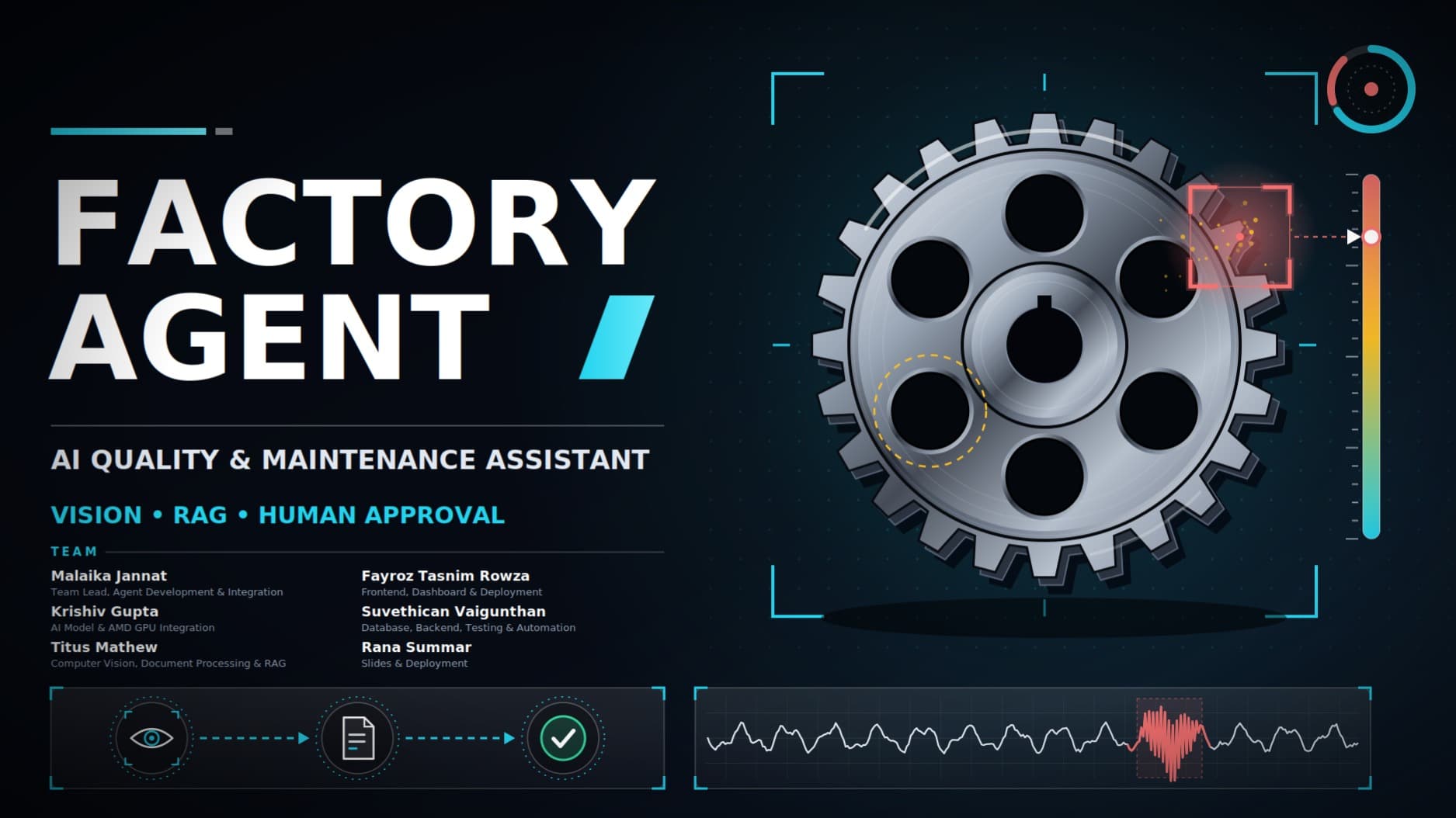
Factory Agent: AI Quality & Maintenance Assistant

Factory Agent: AI Quality & Maintenance Assistant

Factory Agent is an end-to-end AI quality inspection and industrial maintenance assistant designed for modern manufacturing environments. It addresses costly equipment downtime and the safety risks of unverified AI recommendations through multimodal defect detection, retrieval-augmented generation (RAG), evidence-grounded diagnosis, and human-in-the-loop governance. The system accepts machine-part photographs, sensor telemetry reports in CSV, JSON, or TXT formats, and technical inspection documents in TXT or PDF formats, including OCR-based text extraction. For visual inspection, Factory Agent combines an advisory local CNN with AMD Token Factory vision models, including Qwen3.8-Flash-Next and Gemma-4-31B-IT. It evaluates individual model predictions rather than averaging confidence scores, flagging low-confidence results and disagreements as UNVERIFIED for expert review. Its RAG pipeline retrieves relevant maintenance procedures from technical manuals. Primary and fallback language models, MiMo-V2.6-Flash and DeepSeek-V4-Flash, generate diagnostic explanations and repair recommendations grounded in retrieved evidence. The system validates recommendations against source manual text and provides citations identifying relevant manuals and pages where available. A human-in-the-loop interface enables plant managers to review predictions, examine supporting evidence, and approve or reject proposed maintenance actions. Only approved cases proceed to Evolus automation workflows for maintenance work-order generation. Built with Next.js, React, TypeScript, FastAPI, PyTorch, and Docker, Factory Agent supports cloud integrations and an offline mock mode for demonstrations and development without API keys. By combining automation, traceable evidence, and human oversight, Factory Agent aims to make industrial AI safer, more transparent, auditable, and practical.