BERT

The BERT paper by Jacob Devlin was released not long after the publication of the first GPT model. It achieved significant improvements on many important NLP benchmarks, such as GLUE. Since then, their ideas have influenced many state-of-the-art models in language understanding. Bidirectional Encoder Representations from Transformers (BERT) is a natural language processing technique (NLP) that was proposed in 2018. (NLP is the field of artificial intelligence aiming for computers to read, analyze, interpret and derive meaning from text and spoken words. This practice combines linguistics, statistics, and Machine Learning to assist computers in ‘understanding’ human language.) BERT is based on the idea of pretraining a transformer model on a large corpus of text and then fine-tuning it for specific NLP tasks. The transformer model is a deep learning model that is designed to handle sequential data, such as text. The bidirectional transformer architecture stacks encoders from the original transformer on top of each other. This allows the model to better capture the context of the text.

General
Relese date2018
AuthorGoogle
Repositoryhttps://github.com/google-research/bert
Typemasked-language models

Libraries


BERT top builders

Explore the top contributors showcasing the highest number of BERT app submissions within our community.

BERT AI technology page Hackathon projects

Discover innovative solutions crafted with BERT, developed by our community members during our engaging hackathons.

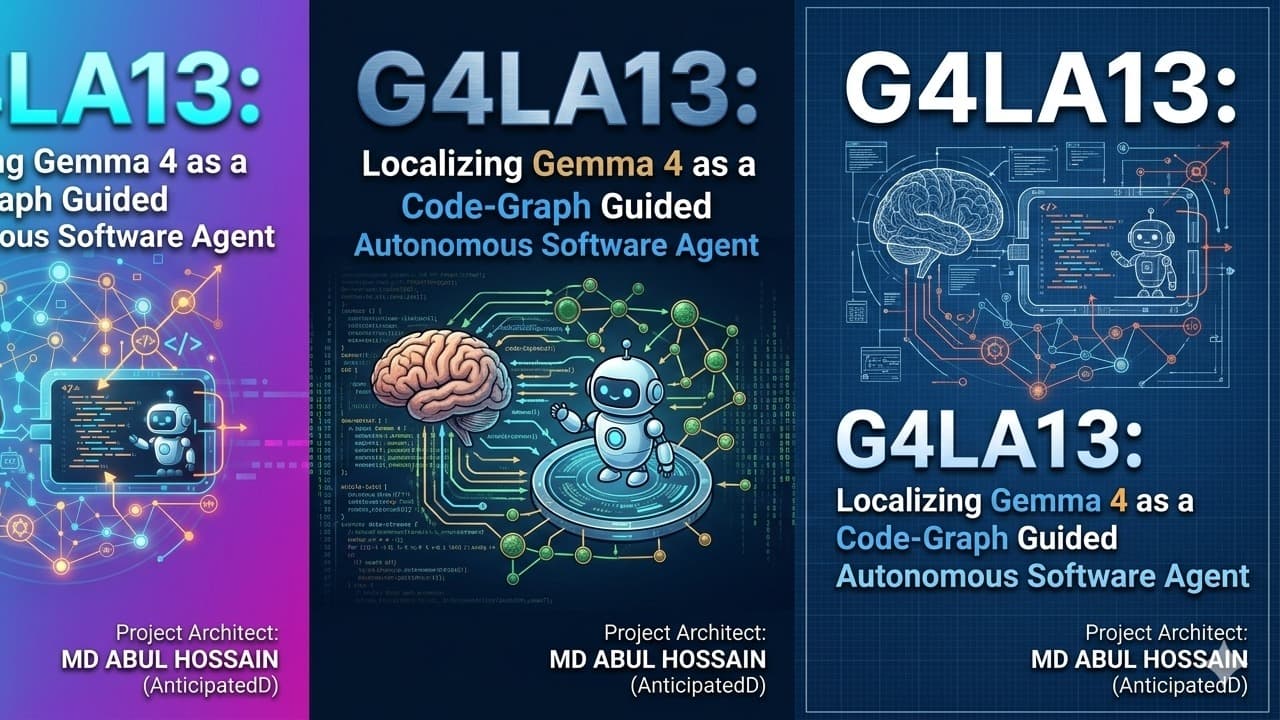
AnticipatedD/G4LA13_Gala4_Localizing_Code-Graph

AnticipatedD/G4LA13_Gala4_Localizing_Code-Graph

AnticipatedD/G4LA13_Gala4_Localizing_Code-Graph is a resilient Band Agentic Mesh designed for the Pocketful track. It demonstrates how autonomous agents can collaborate to build a four‑stage wallet and payments service with auditability and reproducibility. The factory runs three agent seats — Architect, Builder, and Reviewer — each with a clear mandate. The Architect inspects requests and produces ordered plans with acceptance criteria. The Builder implements endpoints stage by stage, containerizing services and enforcing balances, validation, and conservation of funds. The Reviewer runs harness tests, validates outputs, and rejects failures with clear logs. Recovery is built in: failures trigger mandate updates and retries until all tests pass. - Stage‑1 establishes authentication, balances, and payments. - Stage‑2 integrates a UI layer with Playwright tests. - Stage‑3 adds time‑aware balances, statements, and operator corrections. - Stage‑4 completes the system with refunds and correction batches. Technologies include Python, Docker, Band SDK, Band Desktop, Band Agent API, Band WebSocket API, Playwright, and GitHub Actions. This structured progression shows originality, resilience, and research‑grade ambition. 🛠 Technologies Used (Expanded) - Python 3.12 Core language for backend service implementation. - Docker Containerizes each stage (stage-1 through stage-4) for reproducibility. - Band SDK Connects agents to Band infrastructure. Provides adapters. - Band Desktop (formerly Jam). The coordination surface where Architect, Builder, and Reviewer agents collaborate. - Band Agent API (/api/v1/agent). Used by agents to validate identity, recruit peers, join chats, send messages, and post events. - Band WebSocket API (Phoenix Channels). - Playwright Automates browser tests for Stage‑2 UI integration. - GitHub Actions CI/CD pipeline for automated builds and harness runs.

MindBridge: AI Mental Health Support

MindBridge: AI Mental Health Support

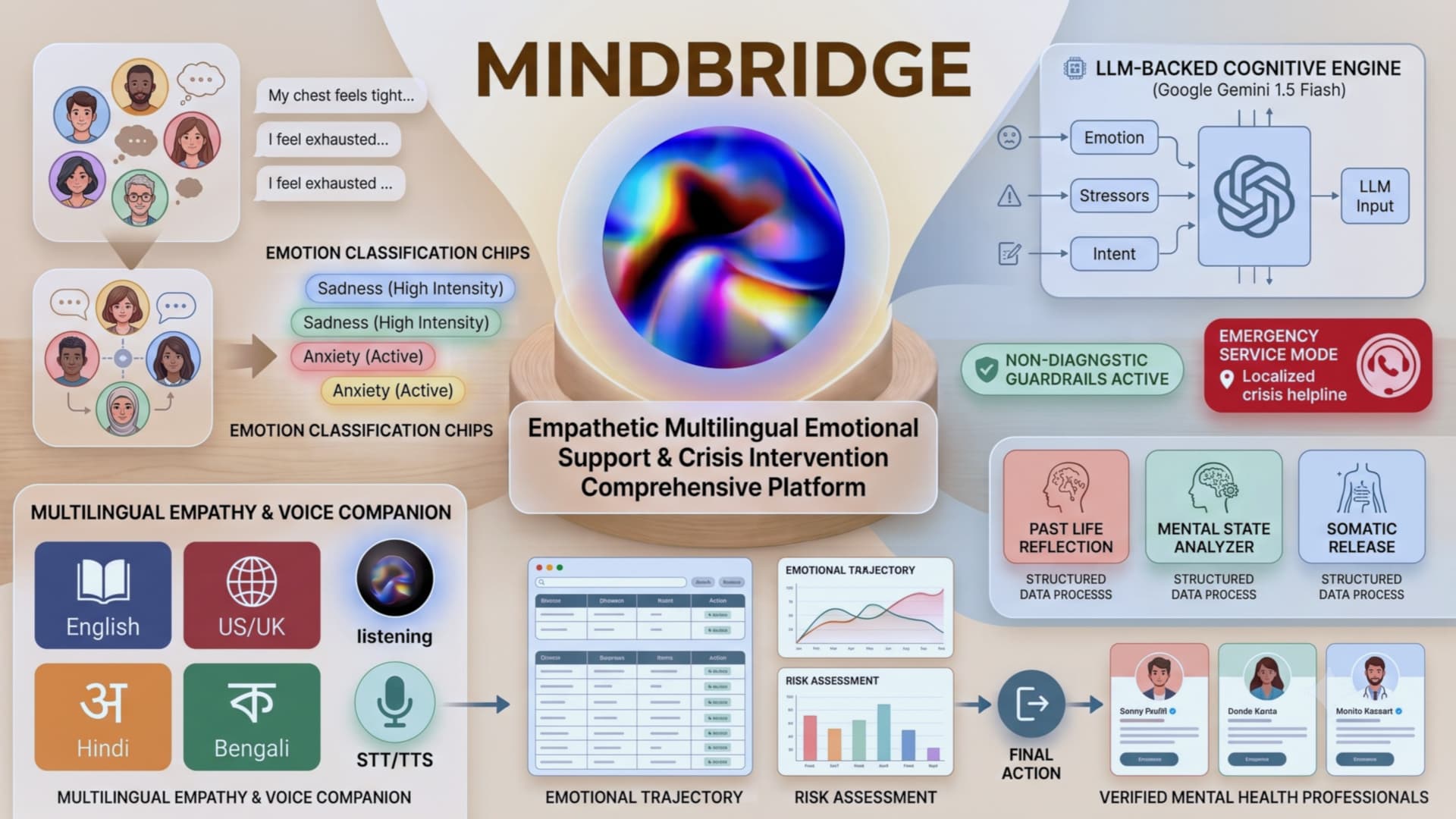
Problem And Solution Statement: Many people deal with stress or feeling down, but they are not sure what it means or how to get help. It can feel awkward to talk to someone about it because of what others might think or because it costs too much or seems too far away. During a really bad moment, it gets even harder to know where to turn. MindBridge tries to help with that by giving a simple way to check in on how you are doing. The screening part asks about twenty questions and then gives a summary of things like mood or sleep without saying it is a real diagnosis. I think that part matters because it just points people toward what might help next instead of acting like a doctor. Users can type or talk to it in English, Hindi, or Bengali, and the chatbot answers in a normal way. It also shows breathing exercises or other small steps for handling daily stress. If someone leaves some questions blank, the result just says it is not complete, which makes sense so the summary does not get messed up. One thing that stands out is how it handles bigger worries. When someone mentions thoughts about hurting themselves or other serious stuff the system switches to emergency mode and shows numbers or places to go right away. People can reach that without finishing anything else or signing up first. It also lets users look up nearby therapists using their location or a city name and it tries to show which ones are checked out properly. The idea seems aimed at students or anyone who wants an easy first step. It combines the chat part with finding help and safety checks all in one place, but I am not totally sure how well that works in practice. Some parts feel like they could still be confusing if the person is already overwhelmed. It keeps saying it is not meant to replace actual professionals, which is probably good to repeat.

Fresno LUX: A Living City

Fresno LUX: A Living City

Fresno LUX is a prototype for a living intelligence layer across an entire city. Fresno already contains enormous amounts of intelligence: residents know where problems exist, nonprofits know where help is needed, businesses know where opportunities exist, educators understand gaps in learning, researchers generate knowledge, and government maintains critical infrastructure and data. The problem is that much of this intelligence is fragmented across disconnected systems. Fresno LUX connects those pieces. The platform creates a shared city graph where people, organizations, resources, needs, projects, observations, experiments, and outcomes become connected nodes. Instead of simply collecting data, LUX continuously asks: What is happening? What do we know? What is missing? What can we test? What changed? A community problem can become an observable signal. That signal can become an experiment. The experiment produces evidence. Evidence changes the system's understanding. That updated understanding informs the next action. Observe → Connect → Understand → Act → Measure → Learn → Converge. The goal is to move Fresno from disconnected information toward collective intelligence—a system where knowledge can travel across boundaries and successful solutions can be discovered, tested, measured, and replicated. LUX is designed to make the invisible connections visible: the relationship between a neighborhood and its resources, between a student and educational opportunity, between a business and workforce capacity, between environmental conditions and community health, and between an idea and measurable real-world impact. This hackathon prototype demonstrates the beginning of a Living Fresno Graph: a city that can observe itself, learn from evidence, and coordinate toward better outcomes.

AegisLayer: Enterprise Privacy Middleware

AegisLayer: Enterprise Privacy Middleware

AegisLayer is a zero-trust enterprise privacy middleware designed to solve the critical data security bottleneck preventing enterprises from adopting Large Language Models. When employees send prompts to cloud AI providers, sensitive PII and proprietary secrets are often leaked. AegisLayer intercepts these prompts at the network boundary and sanitizes them in real-time before they ever leave the corporate network. Our solution employs a highly optimized dual-engine architecture: 1. CPU Regex Engine: A deterministic pass that instantaneously identifies and redacts structured data like IPv4 addresses, credit card numbers, phone numbers, and API keys. 2. AMD ROCm-Accelerated NER Engine: An advanced Named Entity Recognition pipeline powered by PyTorch and HuggingFace Transformers. Optimized specifically for AMD Instinct GPUs via ROCm, this engine identifies unstructured entities (Persons, Organizations, Locations) with sub-100ms latency. As entities are detected, AegisLayer maps them to opaque, entropy-free tokens (e.g., [PERSON_1]) and stores the mapping in an ephemeral, in-memory vault. The sanitized prompt is then safely forwarded to the external LLM provider. Once the AI generates a response, AegisLayer automatically de-tokenizes the text, restoring the original values seamlessly. The vault is immediately wiped after each round-trip, guaranteeing zero persistent storage of sensitive data. AegisLayer ensures maximum data privacy, regulatory compliance, and architectural resilience without introducing any friction to the end-user experience.