Bright Data Scraping Browser

The Bright Data Scraping Browser is a cloud-hosted, managed browser environment that developers control using Playwright, Puppeteer, or Selenium. Unlike a self-hosted headless browser, all proxy routing, CAPTCHA solving, browser fingerprinting, and retry logic are handled automatically by Bright Data's infrastructure, so scripts focus on data extraction rather than unblocking.

General
DeveloperBright Data
TypeManaged Cloud Browser API
ProtocolsPlaywright, Puppeteer, Selenium
Documentationdocs.brightdata.com/browser
Python Boilerplatebrightdata/bright-data-browser-api-python-playwright-project

Core Features

  • Playwright, Puppeteer, and Selenium compatible: connect your existing scripts to the managed browser via a CDP (Chrome DevTools Protocol) endpoint, no SDK change required.
  • Built-in proxy rotation: each session is automatically routed through Bright Data's residential or datacenter proxy network.
  • CAPTCHA auto-solving: CAPTCHAs are solved in the background without script-level intervention.
  • Browser fingerprint management: browser signatures are rotated and normalised to avoid detection.
  • JavaScript rendering: full JS execution before data extraction, suitable for SPAs and dynamically loaded content.
  • Auto-scaling infrastructure: browser instances scale with your request volume; no pool management required.

Tools and Resources


Ecosystem and Integrations

  • Works alongside Bright Data proxy zones for granular proxy type selection per browser session.
  • Output can feed directly into structured data pipelines, databases, or AI training corpora.
  • Combined with the Web Unlocker for layered unblocking on particularly difficult targets.
  • The MCP Server exposes browser automation capabilities to AI agents without requiring direct Playwright scripting.

Connect your Playwright or Puppeteer scripts to the managed browser at brightdata.com/products/scraping-browser or follow the quickstart documentation.

Bright Data Scraping Browser top builders

Explore the top contributors showcasing the highest number of Bright Data Scraping Browser app submissions within our community.

Bright Data Bright Data Scraping Browser AI technology Hackathon projects

Discover innovative solutions crafted with Bright Data Scraping Browser, developed by our community members during our engaging hackathons.

AI Educational Tablekeeping system

AI Educational Tablekeeping system

TableKeeper is a smart and modern restaurant table management platform designed to simplify the way restaurants handle reservations, table availability, customer information, and seating operations. In many restaurants, managing tables manually can become difficult, especially during busy hours. Staff members often have to handle phone reservations, walk-in customers, waiting lists, table availability, and customer requests at the same time. This can lead to confusion, long waiting times, double bookings, inefficient table usage, and a poor customer experience. TableKeeper addresses these challenges by bringing the complete table management process into one simple and organized digital platform. The primary goal of TableKeeper is to make restaurant operations more efficient while creating a smooth and convenient experience for customers. Restaurants can use the platform to maintain a real-time view of their tables and their current status. Tables can be identified as available, reserved, occupied, or waiting to be cleaned, allowing staff to understand the restaurant's seating situation at a glance. This reduces the need for manual tracking and helps staff make faster decisions during busy periods. One of the key features of TableKeeper is digital reservation management. Customers can check available tables and select a suitable date and time for their visit. Once a reservation is created, the restaurant can view and manage the booking through its dashboard. This helps reduce the chances of double bookings and makes it easier for staff to organize upcoming reservations. The system can also maintain important booking information such as customer name, contact details, reservation time, number of guests, and special requests. TableKeeper also focuses on improving table utilization. Restaurants often lose valuable time and revenue when tables remain unused because their availability is not properly tracked.

Fresno LUX: A Living City

Fresno LUX: A Living City

Fresno LUX is a prototype for a living intelligence layer across an entire city. Fresno already contains enormous amounts of intelligence: residents know where problems exist, nonprofits know where help is needed, businesses know where opportunities exist, educators understand gaps in learning, researchers generate knowledge, and government maintains critical infrastructure and data. The problem is that much of this intelligence is fragmented across disconnected systems. Fresno LUX connects those pieces. The platform creates a shared city graph where people, organizations, resources, needs, projects, observations, experiments, and outcomes become connected nodes. Instead of simply collecting data, LUX continuously asks: What is happening? What do we know? What is missing? What can we test? What changed? A community problem can become an observable signal. That signal can become an experiment. The experiment produces evidence. Evidence changes the system's understanding. That updated understanding informs the next action. Observe → Connect → Understand → Act → Measure → Learn → Converge. The goal is to move Fresno from disconnected information toward collective intelligence—a system where knowledge can travel across boundaries and successful solutions can be discovered, tested, measured, and replicated. LUX is designed to make the invisible connections visible: the relationship between a neighborhood and its resources, between a student and educational opportunity, between a business and workforce capacity, between environmental conditions and community health, and between an idea and measurable real-world impact. This hackathon prototype demonstrates the beginning of a Living Fresno Graph: a city that can observe itself, learn from evidence, and coordinate toward better outcomes.

GrantForge AI

GrantForge AI

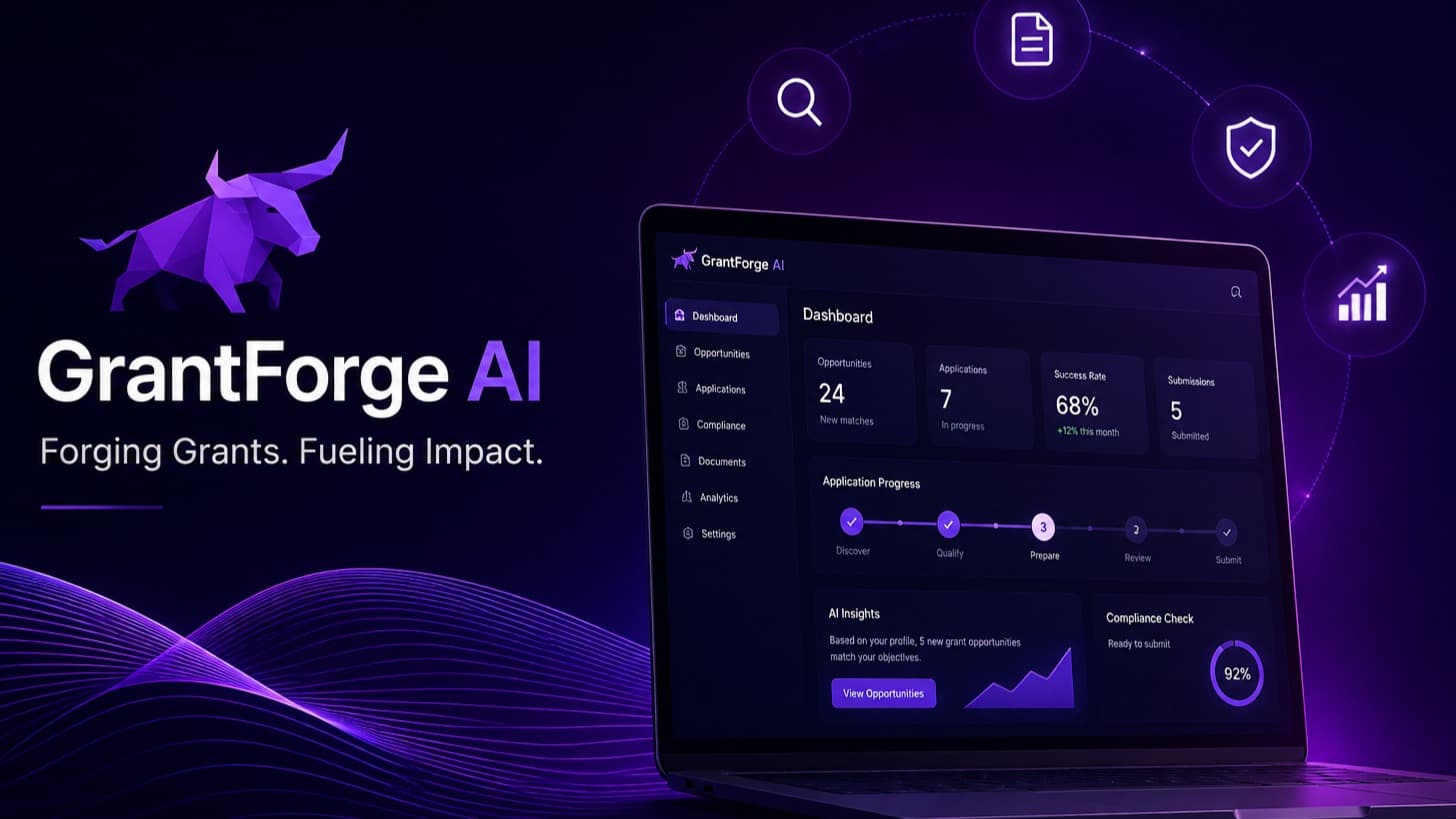
GrantForge AI turns the complex NSF SBIR/STTR grant process into a guided, AI-powered workflow: Describe → Discover → Analyze → Draft → Review. Founders can describe their project by text or voice and receive ranked NSF solicitation matches scored 0–100, with plain-English explanations of why each opportunity fits. GrantForge then extracts evaluation criteria from dense solicitation documents into a structured, actionable rubric so founders know exactly what reviewers are looking for. The platform generates an editable technical narrative, milestone timeline, and budget, then performs a compliance review by scoring the proposal against each evaluation criterion from 1–5 and identifying specific weak spots. Founders can revise and re-score their proposal until it is submission-ready. GrantForge AI includes four core modules: Grant Discovery, Rubric Analyzer, Proposal Authoring, and Compliance Review. The product is fully functional end-to-end, including authentication, persistent user workspaces, live NSF data, AI-powered analysis, and PDF case-file export. Our demo follows a deep-tech founder developing a low-power AI chip for medical devices. Instead of spending weeks searching NSF documents and guessing what reviewers want, the founder can move from an initial idea to matched opportunities, an extracted rubric, a generated proposal draft, and a compliance scorecard in roughly 10 minutes. GrantForge AI targets the $200M+ annual NSF SBIR/STTR funding pool, with future plans to expand to DOE, NIH, and DOD funding opportunities. GrantForge AI helps founders spend less time navigating grants and more time building the technologies they are trying to fund.

FundFlow AI — Scholarship Funding Intelligence

FundFlow AI — Scholarship Funding Intelligence

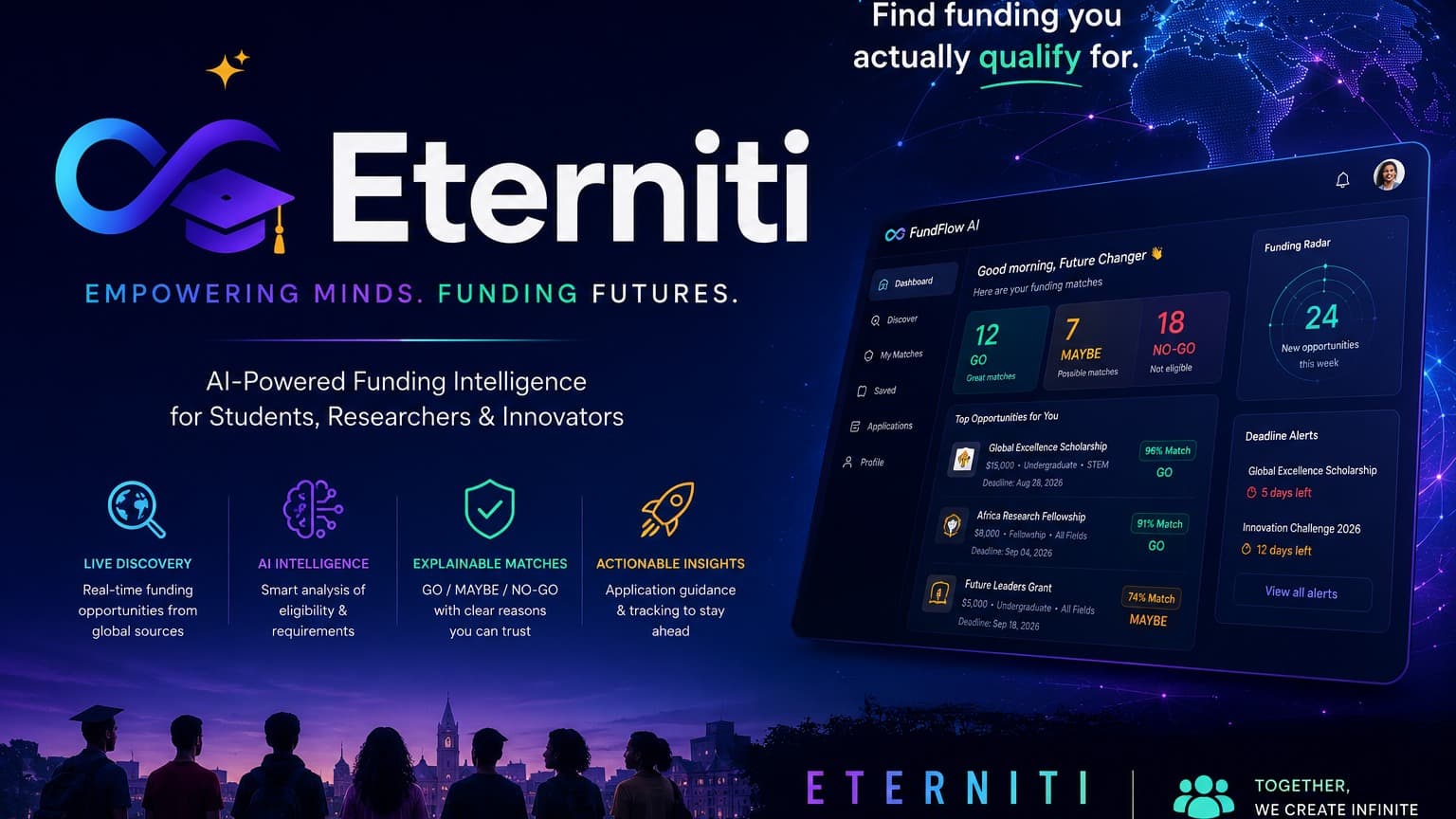
Students searching for scholarships and grants often face hundreds of opportunities without knowing which ones they actually qualify for. Eligibility requirements such as nationality, GPA, study level, field of study, and required documents are frequently buried in lengthy application pages, forcing students to manually evaluate opportunities one at a time. FundFlow AI solves this problem by turning funding discovery into an eligibility intelligence workflow. A student creates a funding profile, and FundFlow AI uses Bright Data to retrieve live scholarship and funding pages from the web. AI/ML API then extracts structured eligibility requirements from the retrieved content and evaluates them against the student's profile. Instead of presenting a black-box recommendation, FundFlow produces an explainable GO, MAYBE, or NO-GO decision. GO indicates that no known mandatory requirement has been failed, MAYBE identifies missing or uncertain information, and NO-GO identifies clear eligibility failures. The platform also explains why a student qualifies, highlights potential issues, identifies required documents, and provides a plain-language recommendation. The MVP was built end-to-end with native.builder, using Supabase for the database and Edge Functions powering the discovery, extraction, and matching pipeline. Bright Data provides live web retrieval, while AI/ML API powers structured extraction and eligibility reasoning. FundFlow AI is positioned Africa-first, beginning with students such as our Nigerian undergraduate demo profile, while the architecture supports students searching for funding opportunities globally.