Google DeepMind

Google DeepMind is a world-renowned artificial intelligence research laboratory, formed from the merger of DeepMind and Google's AI division. It stands at the forefront of AI innovation, responsible for groundbreaking advancements, including the development of the Gemini series of multimodal AI models and the Gemma open-model family. DeepMind's mission is to solve intelligence to advance science and benefit humanity.

General
AuthorGoogle DeepMind
Release Date2010 (DeepMind founding)
Websitehttps://deepmind.google/
Technology TypeAI Research Organization

Key Research Areas and Achievements

  • Reinforcement Learning: Pioneering work in reinforcement learning, including AlphaGo, which defeated world champions in Go.
  • Large Language Models: Development of advanced LLMs, contributing to the Gemini and Gemma model families.
  • Scientific Discovery: Application of AI to accelerate scientific research, such as AlphaFold for protein structure prediction.
  • Safety and Ethics: Dedicated research into AI safety, ethics, and responsible deployment.

Start Exploring Google DeepMind

Google DeepMind's research underpins many of the most advanced AI systems in the world. As the organization behind foundational models like Gemini and Gemma, its work is crucial for understanding the future of AI. Developers and researchers can delve into their publications and open-source contributions to gain insights into cutting-edge AI development.

👉 DeepMind Research Publications 👉 About Google DeepMind

Deepmind top builders

Explore the top contributors showcasing the highest number of Deepmind app submissions within our community.

Google Deepmind AI technology Hackathon projects

Discover innovative solutions crafted with Deepmind, developed by our community members during our engaging hackathons.

TEP Copilot: reasoning, not reciting

TEP Copilot: reasoning, not reciting

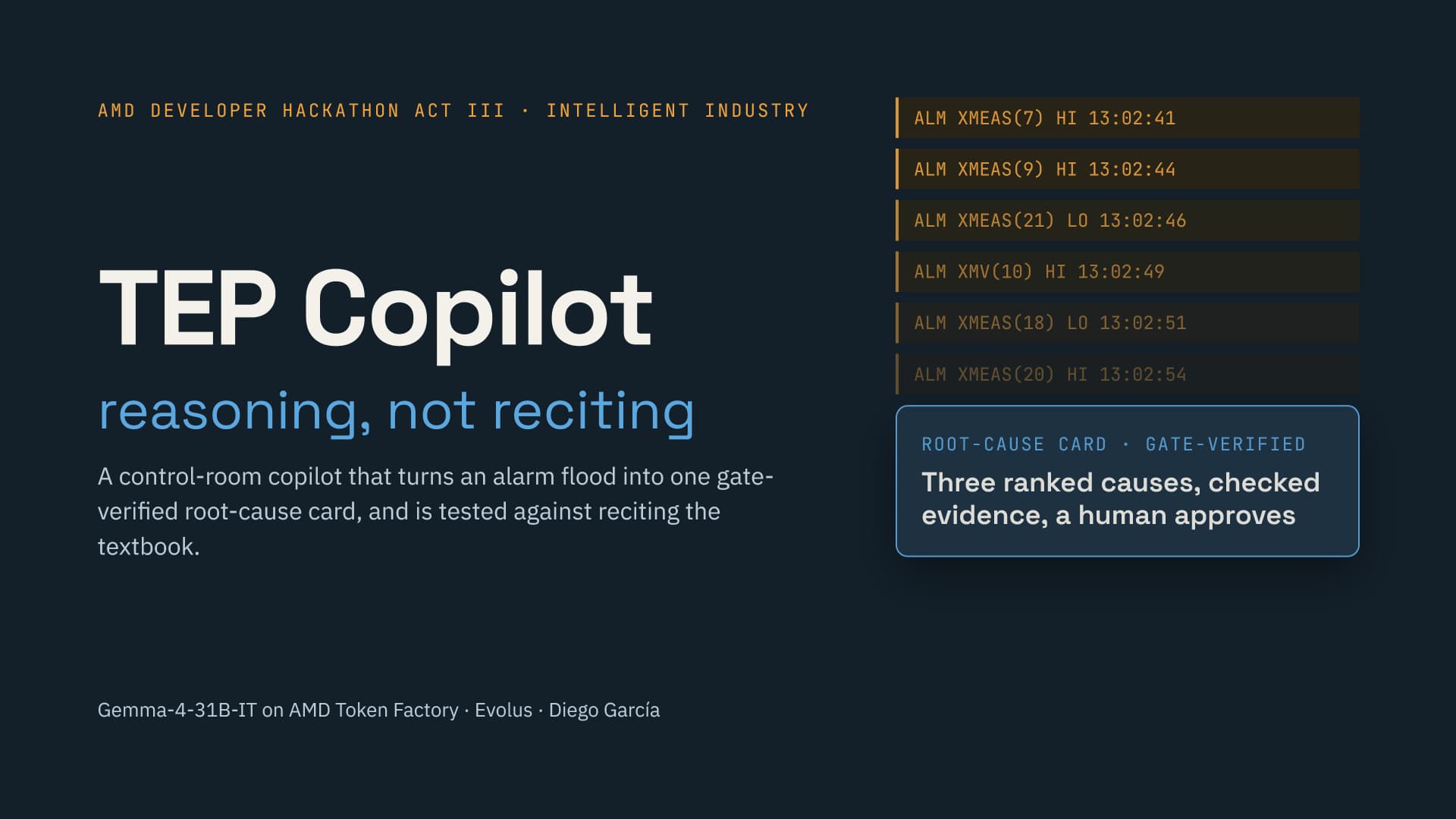
In a plant upset, operators drown in alarms: at Milford Haven in 1994, two operators faced 275 alarms in under 11 minutes. Plants now want AI copilots in that room, but an AI that sounds right and is wrong is one more alarm. TEP Copilot turns an alarm flood into one root-cause card the operator can check. Statistics detect the fault (PCA T²); Gemma-4-31B-IT on AMD Token Factory proposes three ranked causes with sensor evidence; a deterministic gate strikes every claim the data does not support and flags control verbs; a human approves. The model has no write access to the process. After approval, an Evolus agent with a Knowledge Library drafts the work order and shift handover, and an Evolus AI Tool translates it. Does it reason or recite? TEP has been public since 1993, so we tested it as an experiment: 2 public datasets, 2 models, 3 disguise levels, thinking off/on, k=5 samples, comparisons within each fault. - A disguised twin renames every tag and unit: Gemma top-1 stays at 45/100 on the original plant and 44/100 fully disguised. - Two models: Qwen3.8-27B names the top cause more often, but the gate rejects more of its evidence (31% vs 22%, 9 of 12 faults). - Thinking on raises the evidence the gate rejects from 22% to 36% (9 of 12 faults). - The card arrives before the alarm flood in 4 of 4 flooding faults. - FaultExplainer protocol: Gemma 8/11, between GPT-4o (7/11) and o1-preview (9/11). For refinery and chemical-plant control rooms; estimated inference cost $0.00015 per incident. Every result is recomputed by a script from pinned runs; the demo replays them offline.

ShelfReady: Trust Layer for Product Data

ShelfReady: Trust Layer for Product Data

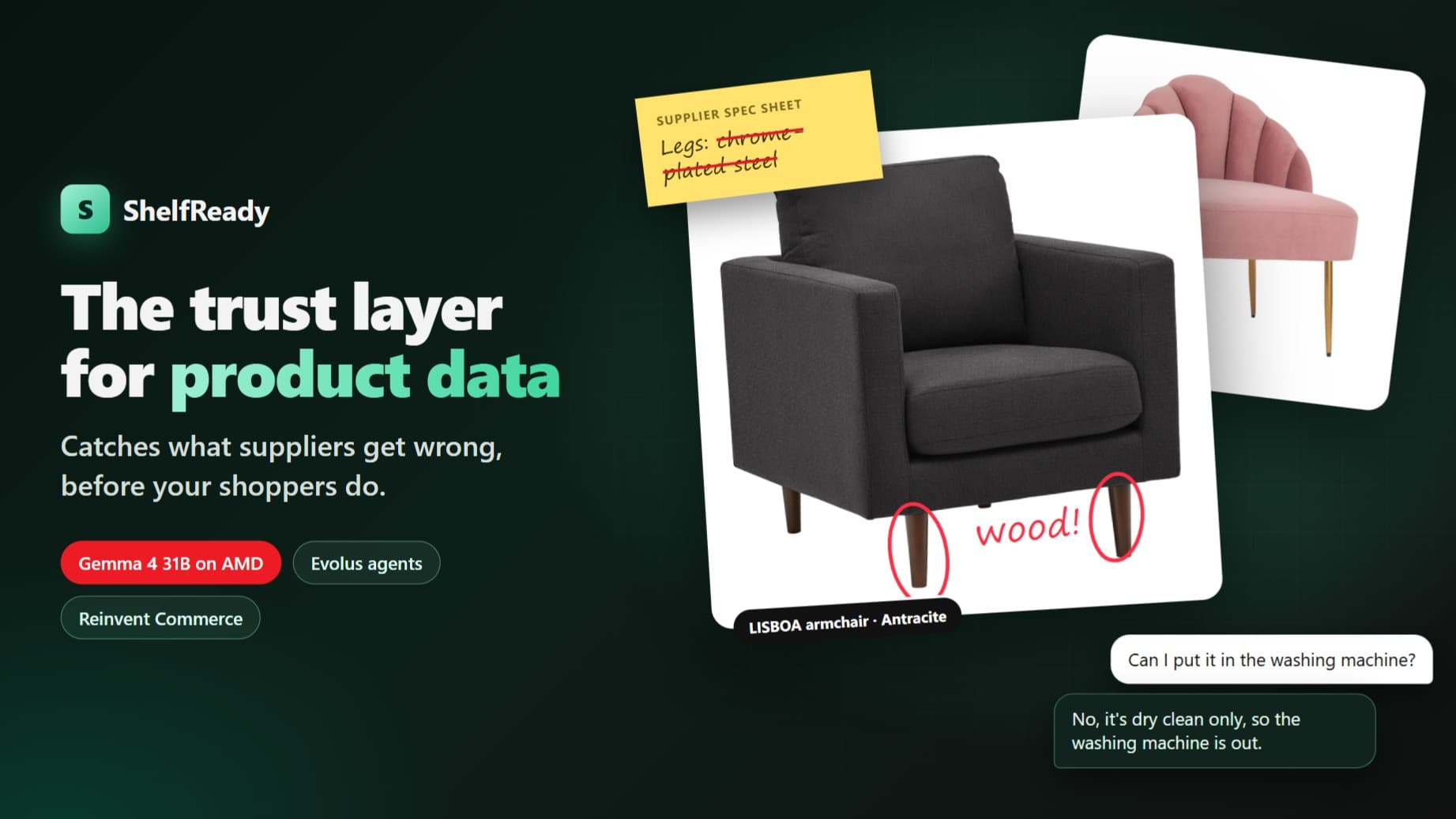
Online shops copy product data from supplier emails: a spec sheet PDF, some photos, a care label, a dimension drawing. These often contradict each other. A wrong width, colour or washing instruction on a product page turns into a return: 60.4% of German online shoppers have returned items because the description or photos did not match (KPMG/EHI 2025). Since December 2024 the EU General Product Safety Regulation also requires manufacturer details, an EU responsible person and safety warnings in the shopper's language on every offer. ShelfReady is the trust layer between supplier data and the shop. Gemma 4 31B, running on AMD, extracts the spec and reads every photo, label and drawing, drawing boxes on what it sees. Seventeen checks in plain Python then compare the supplier's claims with its own evidence and with EU listing rules. What the evidence settles (a width the supplier's own drawing shows) collapses into one line; everything else goes to a person with the spec sheet and the photo side by side and the contradiction highlighted. Open facts are held back instead of guessed. The listing, safety warnings and alt text for every photo are written from verified facts only, translated into seven languages and checked in code (numbers, units, names, glossary). A publish gate blocks anything with an open legal item. Evolus agents, on the same Gemma 4 31B, write the emails that ask suppliers the open questions and answer shoppers on the shop page from the verified facts only. Measured, not claimed: on 25 supplier submissions with 59 planted defects, ShelfReady found 57 (recall 0.966, precision 0.983) with no false alarm on clean products. On 250 real Amazon Berkeley Objects listings it audited 900 photos; a person confirmed 29 of 30 photo findings. Video narration voice: ElevenLabs.

Turno

Turno

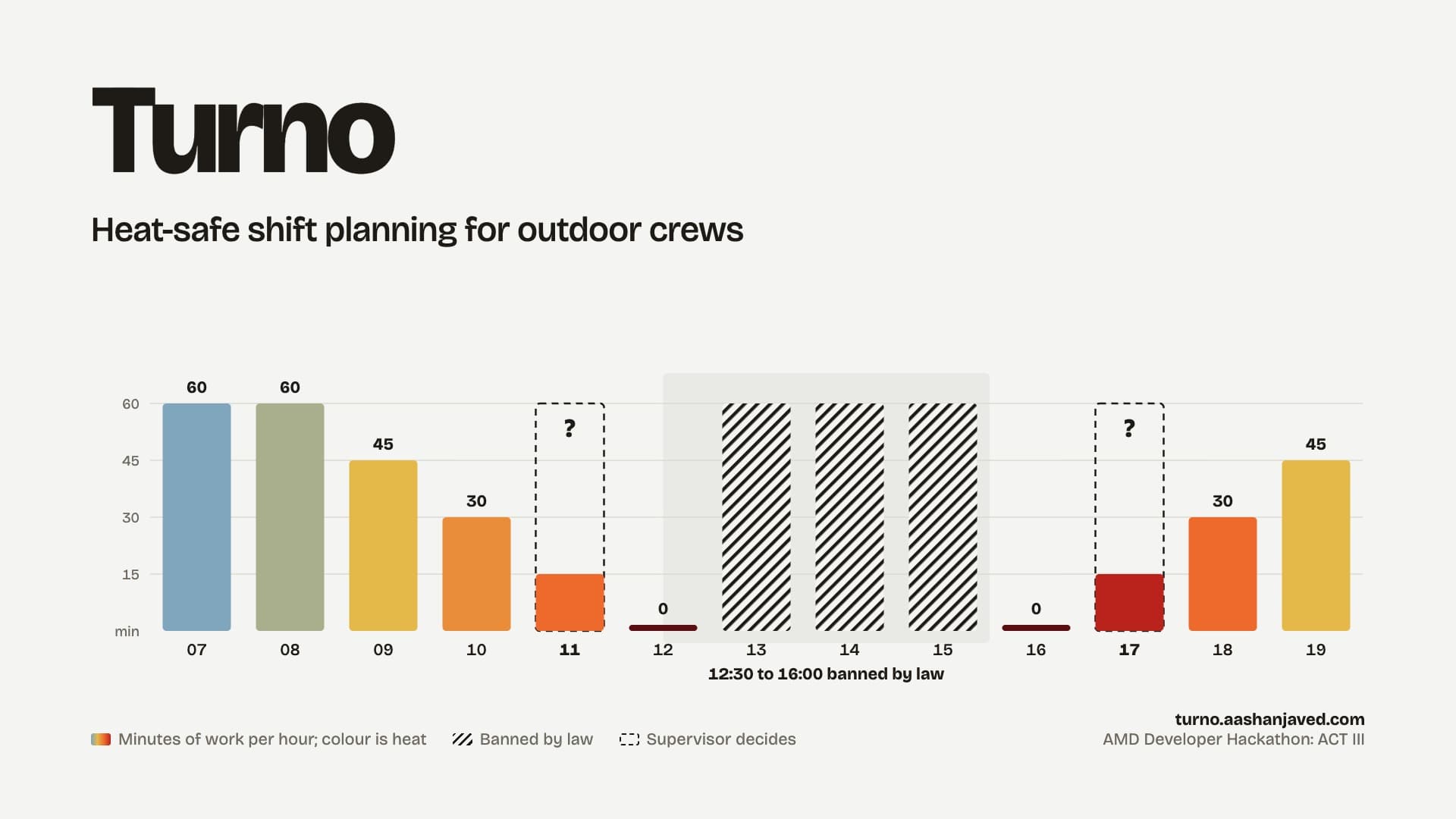
Italian regions ban outdoor work from 12:30 to 16:00 on days rated ALTO for heat risk. A supervisor still has to plan the other hours, prove the ban was kept, and brief the crew. On ERA5 (June to August 2026, five sites), 59 to 66% of heat-restricted working hours fall outside the ban window. Turno plans those hours. How it works. ECMWF's 10-member open-data ensemble gives WBGT for every member and hour (Liljegren, thermofeel). Fixed NIOSH limits set 60, 45, 30, 15 or 0 minutes of work per hour, planned on the hottest member. Hours where members are 30 minutes of work apart go to the supervisor with the reason. The supervisor confirms the Worklimate rating; until then the ban is assumed. Output: a day strip, a bilingual crew briefing, a compliance log. On AMD. AMD Token Factory (AMD Radeon Cloud) runs the ordinance reader: MinerU2.5-Pro reads each region's signed PDF and DeepSeek-V4-Flash proposes every rule field with a verbatim quote. Code accepts a field only if the quote is in the document and contains the value. DeepSeek-V4-Flash also explains each hand-off. Off AMD: Gemma 4 writes the crew briefing through Google's Gemini API, and the forecast is ECMWF open data. No GPU instance was available, so the planned Aurora run on an MI300X did not happen. Pre-registered results: settings chosen on June dates; July and August (10 dates, 5 sites) untouched. One day ahead, a single ECMWF forecast over-planned work in 6.6% of heat-restricted hours; Turno in 1.1%, handing 3.0 to 17.0% of working hours to the supervisor. The reader accepted 0 wrong fields across two runs, and a live Lombardia re-read verified 7 of 7. Limits. Truth is ERA5 (0.25 degrees); there is no thermometer on site. ECMWF open data is 3-hourly. The number check proves every number came from the plan; it does not prove each sentence is right. Not tried with a real crew; no substitute for the employer's risk assessment. Live app: turno.aashanjaved.com. Code (MIT): github.com/Aashan47/turno