Gemma

Gemma is a lightweight, open large language model (LLM) from Google, optimized for efficient AI applications. As part of the Google Gemma family, it uses a transformer-based architecture tailored for responsible and accessible AI usage. Developed as a foundational model, Gemma serves various basic language processing needs, including chatbots, content summarization, and multilingual support.

General
Relese dateFebruary 2024​
AuthorGoogle DeepMind in collaboration with Google AI teams
Website[Google AI Gemma]https://ai.google.dev/gemma
RepositoryGoogle AI Developer Resources​
TypeOpen-source AI, transformer-based LLM

Key Features

  • Efficient Deployment: Available in parameter sizes like 2.5B and 7B, Gemma balances capability with efficiency, enabling deployments on both edge devices and cloud infrastructure​.

  • Flexible Tuning Options: Offers pre-trained and instruction-tuned variants, allowing developers to optimize for specific use cases or deploy as-is.

  • Decoder-Only Transformer Architecture: Uses a streamlined decoder-only design, enabling Gemma 1 to process up to 8192 tokens in one pass for better handling of long-form text​.

  • Safety and Accessibility Tools: Integrates responsible AI features, promoting transparency and safety in AI outputs​.

Applications:

  • Chatbot Development: Optimized for conversational tasks, Gemma provides foundational capabilities for chatbot applications.

  • Summarization and Paraphrasing: Its pre-trained model structure makes it suitable for summarizing content across languages and contexts.

  • Multilingual Processing: Supports multilingual inputs, making it adaptable for global applications and translation services​.

Get started building with Gemma:

Developers can quickly integrate Gemma into applications by accessing its model weights on Google AI Studio and Kaggle. The model’s lightweight design ensures that it can run efficiently on most hardware configurations, including mobile and edge devices. For optimal performance, utilize frameworks such as Keras or JAX to customize and deploy Gemma for your specific use case. Get started today by exploring the tools and resources available on the Google AI Gemma platform​.

Gemma top builders

Explore the top contributors showcasing the highest number of Gemma app submissions within our community.

Google Gemma AI technology Hackathon projects

Discover innovative solutions crafted with Gemma, developed by our community members during our engaging hackathons.

Chern Calibration Copilot: Quantum Kernel Agent

Chern Calibration Copilot: Quantum Kernel Agent

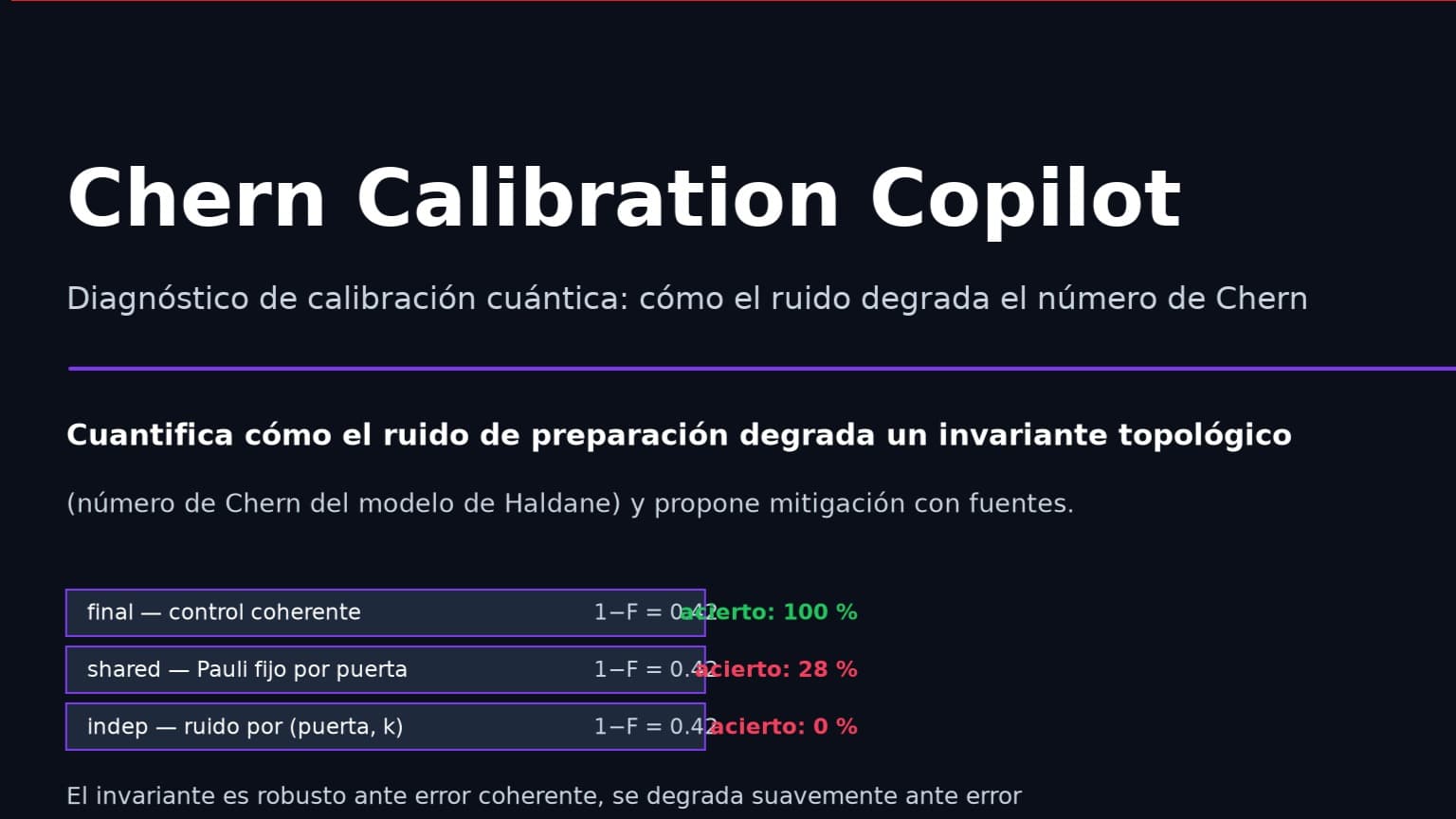
### Problema Los dispositivos cuánticos actuales operan con fidelidades del 95–99 %, pero no existe una respuesta cuantitativa sobre cuánta infidelidad de preparación tolera un invariante topológico (número de Chern) antes de dejar de ser un entero exacto. No hay herramienta que traduzca resultados de simulación cuántica en planes de calibración accionables con fuentes trazables. ### Solución: Chern Calibration Copilot Un copiloto de calibración cuántica con dos componentes integrados: ### Simulador base — 5 tareas avanzadas implementadas (36 tests nuevos) | Tarea | Módulo | Tests | Qué hace | |-------|--------|-------|----------| | 1. Chern espacio real | `simulador/espacio_real/` | 5 | Hamiltoniano 2L²×2L², Chern FHS en red finita | | 2. QAOA MaxCut | `simulador/qaoa/` | 7 | Ansatz p capas, optimización autograd PyTorch | | 3. Evolución temporal | `simulador/evolucion_temporal/` | 6 | Trotter, M(t) cruza M_c, diagnóstico dinámico | | 4. Lindblad | `simulador/lindblad/` | 6 | Matriz densidad 2^(2n), operadores salto, canal depolarizante | | 5. Surface code d=3 | `simulador/surface_code/` | 6 | Estabilizadores X/Z, decodador, tasa error lógico | **Total: 36 tests nuevos + 41 base = 77 tests pasando (77/0)** | `shared` (Pauli fijo) | 0.42 | 28 % | | `indep` (incoherente) | 0.42 | 0 % | **Hallazgo**: El invariante es exactamente robusto ante error coherente, se degrada suavemente ante error en posiciones fijas, y se destruye ante ruido incoherente. **La estructura del error importa más que su magnitud.**

Aviation Safety Evidence Engine

Aviation Safety Evidence Engine

Aviation Safety Evidence Engine Aviation investigators synthesize long, conflicting PDFs where untraceable AI summaries fail. Our dashboard lets analysts click a component on an aircraft schematic to build a bounded evidence pack and generate a verified briefing: documented findings, unknowns, and next checks. Unanalyzed parts stay gray so safety is never implied. Tech Stack & Split Evolus prepares data via REST (Document to data: 52.8 credits/32.3s; Summary: 11.72 credits/5.2s), creating an unmerged overview labeled "generated, not verified." Gemma 4 31B IT (AMD Developer Cloud) provides open-weight reasoning suitable for private deployment, while deterministic code verifies every claim. The 7-Part Harness Code governs what reaches the screen: (1) Bounded packs with leakage guards and contradiction searches; (2) Strict prompts requiring passage IDs and verbatim quotes; (3) Injected JSON schemas with one repair retry; (4) A deterministic substring verifier that flags—never hides—failed quotes as "needs review"; (5) Provenance pulled strictly from stored metadata; (6) No model calls on empty packs; and (7) Full audit logs for a replay-only demo. Results & Limits Tested on an Alaska Airlines 737 gear collapse (NTSB DCA23FA417, cause withheld) across 0–44 passages (up to 15.7k tokens). Showing the schema raised first-try parsing from 0/3 to 3/3, and the verifier passed 13/16 citations. Runs identified the fracture mechanism but missed the root cause (overhaul grinding heat damage). Built with Python, FastAPI, Pydantic, SQLite FTS, pypdf, and Docker, it ensures quote traceability, not interpretive accuracy.

PrintLoop

PrintLoop

PrintLoop is an AI assistant for FDM 3D printing, built for the AMD Developer Hackathon: ACT III (Track 1, Intelligent Industry). When a print fails, operators usually guess the cause, tweak slicer settings and retry, wasting filament and machine time. Existing tools detect failures or correct the printer in real time, but none turn a visible defect into a lasting, verified change to the slicer preset. In Mode 2, the operator uploads the printed .3mf project and a few photos of the part. A fine-tuned Gemma 4 E4B names the defects, and Gemma 4 26B judges severity and picks a fix from candidates supplied by a fixed knowledge base, so it cannot invent parameters. If the two models disagree, the operator decides. A validator limits the change (at most two parameters, fixed steps, material limits), the project is re-sliced headlessly with the slicer that created it, and a G-code pre-flight check confirms the change actually shows up before anything is printed. The operator approves, rejects or edits the fix. The loop stops at a good part or after three attempts, and every step is logged. Mode 1 watches the printer camera, raises an alert only when a defect persists across several frames, and proposes a pause that only a person can send. Status: Mode 2 works end to end with a web UI. The right fix was chosen in 7 of 8 test cases with deliberately induced defects, and the fine-tuned detector scores 93.8% on its test split, up from 18.3% before fine-tuning. Built to serve the models with vLLM on ROCm on an AMD MI300X, with llama.cpp as a local fallback. I changed the last sentence to “built to serve” rather than “served on” the MI300X. The repo hasn’t run the models there yet, and the friction log says the droplet couldn’t be created.