Imagen

Discover Imagen, an awe-inspiring text-to-image diffusion model that brilliantly merges photorealistic image synthesis with an unparalleled language comprehension mechanism. Born out of rigorous research by Google's Brain Team, Imagen harnesses the exceptional capabilities of large transformer language models for text understanding, while tapping into the prowess of diffusion models to generate high-definition images.

Unearthing Imagen's Key Insights and Features

  • Imagen showcases the extraordinary potential of generic large language models (like T5) when pretrained on text-only data, proving their effectiveness at encoding language for image creation.
  • By fine-tuning the language model in Imagen, both sample fidelity and image-text alignment receive a boost, yielding more significant improvements than scaling up the image diffusion model.
  • Imagen sets new benchmarks, achieving a stunning Fréchet Inception Distance (FID) score of 7.27 on the COCO dataset—despite never having trained on the COCO dataset.
  • Human evaluators have determined that Imagen's image-text alignment capabilities are on par with the COCO dataset, signaling its exceptional performance.

Embrace Imagen, the pinnacle of text-to-image technology, and explore a new frontier of AI-driven image generation capabilities.

Kickstart your development with a imagen

Imagen top builders

Explore the top contributors showcasing the highest number of Imagen app submissions within our community.

Google Imagen AI technology Hackathon projects

Discover innovative solutions crafted with Imagen, developed by our community members during our engaging hackathons.

Factory Agent: AI Quality & Maintenance Assistant

Factory Agent: AI Quality & Maintenance Assistant

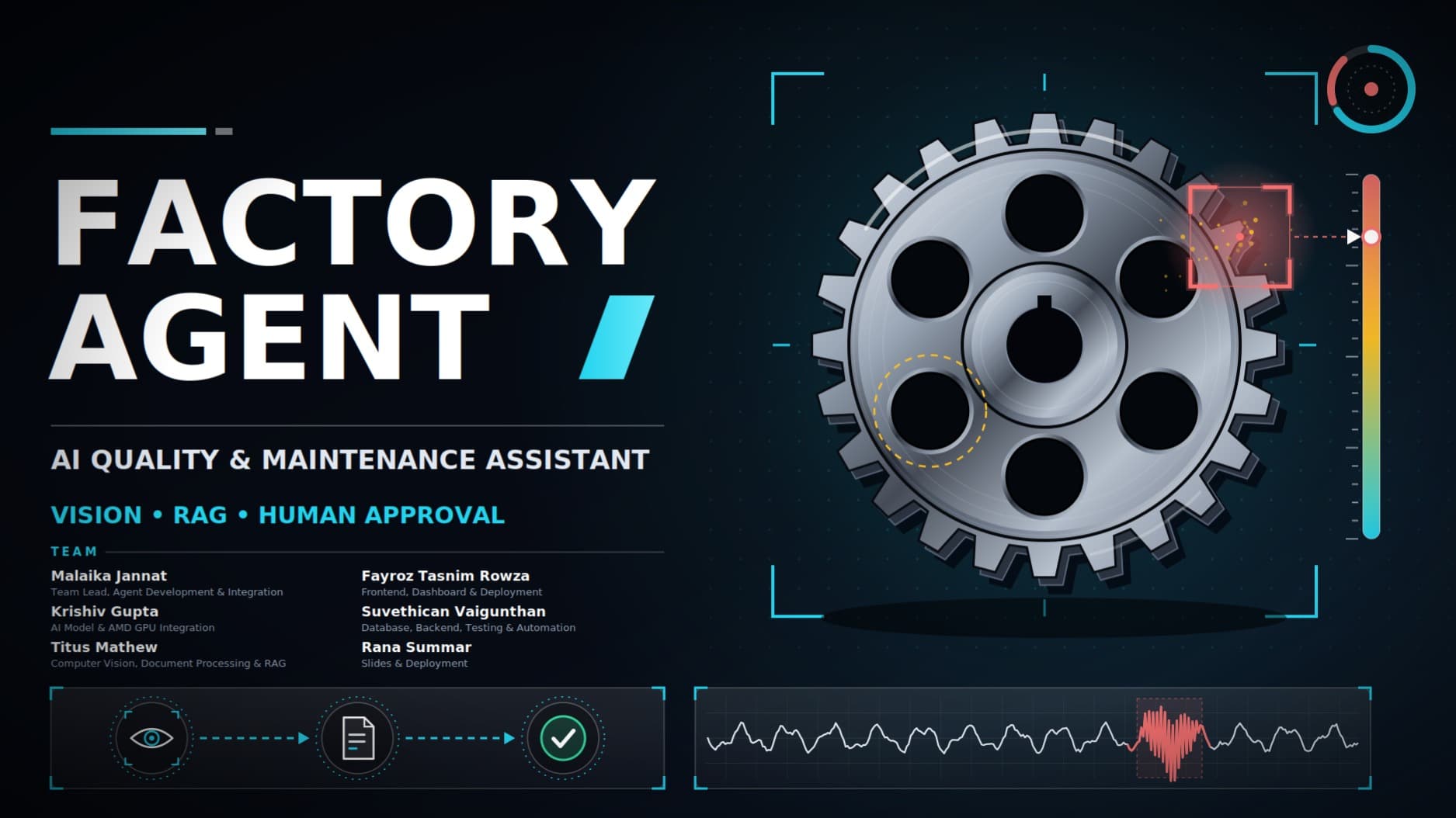
Factory Agent is an end-to-end AI quality inspection and industrial maintenance assistant designed for modern manufacturing environments. It addresses costly equipment downtime and the safety risks of unverified AI recommendations through multimodal defect detection, retrieval-augmented generation (RAG), evidence-grounded diagnosis, and human-in-the-loop governance. The system accepts machine-part photographs, sensor telemetry reports in CSV, JSON, or TXT formats, and technical inspection documents in TXT or PDF formats, including OCR-based text extraction. For visual inspection, Factory Agent combines an advisory local CNN with AMD Token Factory vision models, including Qwen3.8-Flash-Next and Gemma-4-31B-IT. It evaluates individual model predictions rather than averaging confidence scores, flagging low-confidence results and disagreements as UNVERIFIED for expert review. Its RAG pipeline retrieves relevant maintenance procedures from technical manuals. Primary and fallback language models, MiMo-V2.6-Flash and DeepSeek-V4-Flash, generate diagnostic explanations and repair recommendations grounded in retrieved evidence. The system validates recommendations against source manual text and provides citations identifying relevant manuals and pages where available. A human-in-the-loop interface enables plant managers to review predictions, examine supporting evidence, and approve or reject proposed maintenance actions. Only approved cases proceed to Evolus automation workflows for maintenance work-order generation. Built with Next.js, React, TypeScript, FastAPI, PyTorch, and Docker, Factory Agent supports cloud integrations and an offline mock mode for demonstrations and development without API keys. By combining automation, traceable evidence, and human oversight, Factory Agent aims to make industrial AI safer, more transparent, auditable, and practical.

Fresno LUX: A Living City

Fresno LUX: A Living City

Fresno LUX is a prototype for a living intelligence layer across an entire city. Fresno already contains enormous amounts of intelligence: residents know where problems exist, nonprofits know where help is needed, businesses know where opportunities exist, educators understand gaps in learning, researchers generate knowledge, and government maintains critical infrastructure and data. The problem is that much of this intelligence is fragmented across disconnected systems. Fresno LUX connects those pieces. The platform creates a shared city graph where people, organizations, resources, needs, projects, observations, experiments, and outcomes become connected nodes. Instead of simply collecting data, LUX continuously asks: What is happening? What do we know? What is missing? What can we test? What changed? A community problem can become an observable signal. That signal can become an experiment. The experiment produces evidence. Evidence changes the system's understanding. That updated understanding informs the next action. Observe → Connect → Understand → Act → Measure → Learn → Converge. The goal is to move Fresno from disconnected information toward collective intelligence—a system where knowledge can travel across boundaries and successful solutions can be discovered, tested, measured, and replicated. LUX is designed to make the invisible connections visible: the relationship between a neighborhood and its resources, between a student and educational opportunity, between a business and workforce capacity, between environmental conditions and community health, and between an idea and measurable real-world impact. This hackathon prototype demonstrates the beginning of a Living Fresno Graph: a city that can observe itself, learn from evidence, and coordinate toward better outcomes.

Social Sandbox: The Reaction Simulator

Social Sandbox: The Reaction Simulator

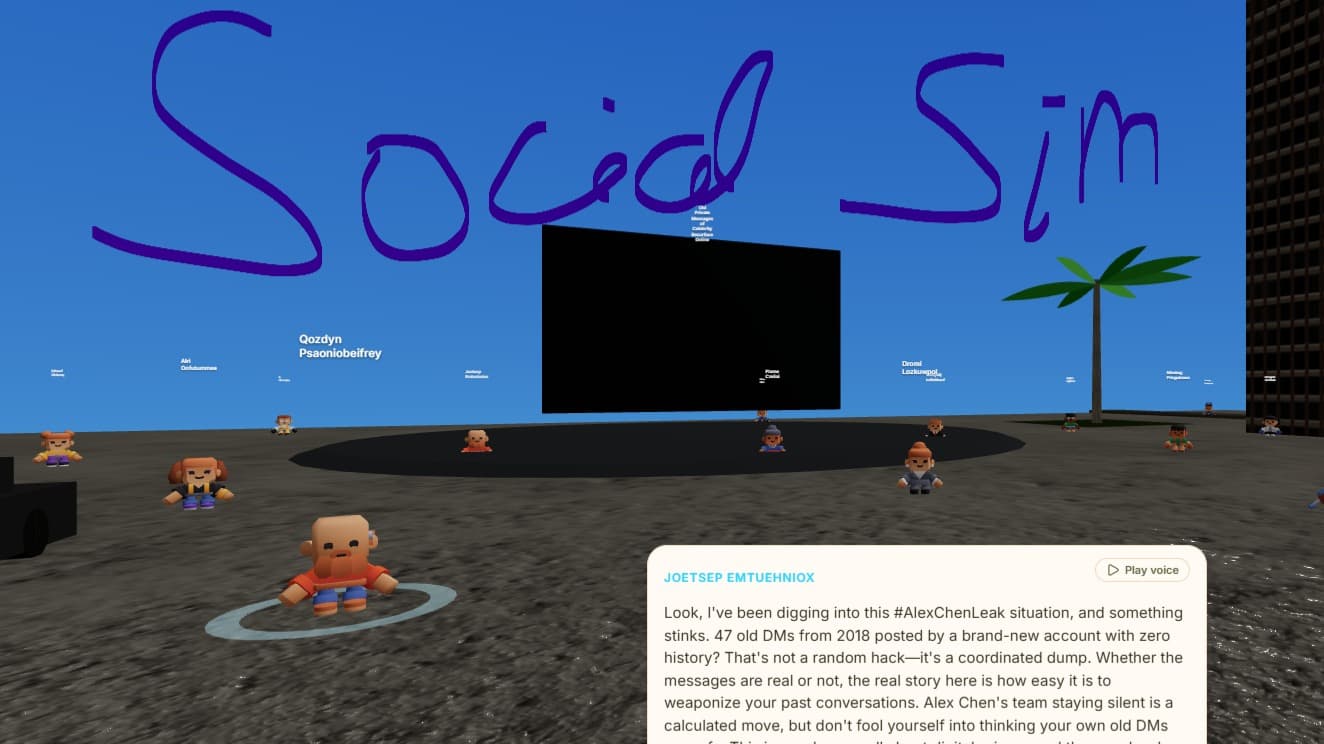
Social Sandbox is a multi-agent simulator of digital and real-world reactions. When a user inputs an event, a synthetic society of hundreds of agents, modeled on authentic platform demographics, react. First movers post, reactions breed reactions, the story crosses from one platform to another, mutating in tone, the news picks it up as a second ignition, and reputations rise or collapse. Underneath is a mechanistic model of society. We wanted to move past the LLM prompting into a real overview of how society interacts online. We built this as we saw how easy it is to build bots which interact almost flawlessly with real people on social media, but nothing that repurposes that technology towards helping humans. Every agent holds reputational capital that is specific to a field or platform (drawn from Bourdieu's theory of cultural capital) and a signed trust score per audience segment. The LLMs only voice the agents who actually react, turning each agent's computed emotion, stance, and arousal into a real post in that platform's grammar. Reaction spread follows established models as the design is grounded in named social theory. Each agent has their own personality, their own risk tolerance, tech literacy, and beliefs. The buyers are individual creators, PR and comms teams, brand-risk and crisis units, political campaigns, corporate marketing, and agencies. "Test-drive your announcement before you post it" is a pitch every one of them understands, and synthetic-audience testing is a fast-growing category. While PR firms and marketing agencies may prefer the dashboard-style visualization, we also target the wider creator economy. We use a 3D rendered visualization of a world where creators can interact with the bots directly, questioning them on their opinions and allowing for a deeper understanding of different perspectives outside of their own echo chamber. The design gamifies the experience to ensure creators remain an engaging and memorable experience.

TruthLensX

TruthLensX

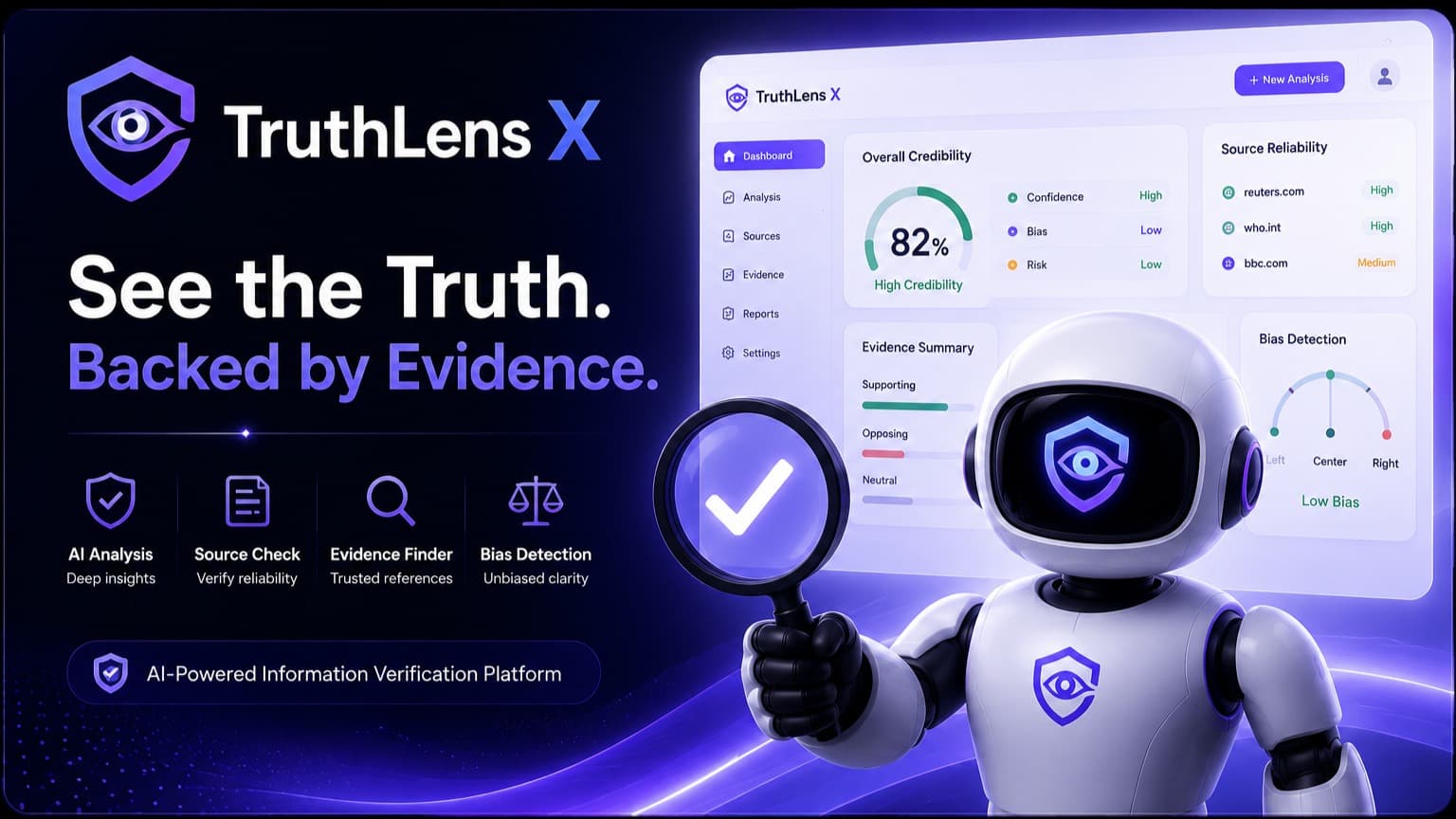
TruthLens X is an intelligent fact-verification and misinformation detection platform built to help people navigate today's rapidly growing information ecosystem. Every day, millions of users encounter news articles, social media posts, viral messages, and screenshots without knowing whether the information is accurate, biased, misleading, or completely false. TruthLens X addresses this challenge by providing a simple and transparent way to verify information. Users can paste text, upload screenshots, submit articles, or analyze online content through a modern and intuitive interface. The platform uses advanced artificial intelligence to extract claims, evaluate source credibility, identify bias, analyze supporting and opposing evidence, and generate detailed verification reports. Unlike traditional fact-checking tools that simply label content as true or false, TruthLens X focuses on transparency. It explains why a claim is considered trustworthy or misleading by presenting credibility scores, confidence ratings, source analysis, evidence-based reasoning, and simplified explanations that anyone can understand. The platform is designed for students, researchers, journalists, educators, organizations, and everyday internet users who want to make informed decisions before consuming or sharing information. With a clean user experience and evidence-first approach, TruthLens X promotes digital literacy, critical thinking, and responsible information sharing. Our vision is to create a future where people can instantly verify information, reduce the spread of misinformation, and build greater trust in the digital world. TruthLens X — See the Truth. Backed by Evidence.