Model Garden

Embark on your machine learning journey with a centralized platform to explore, uncover, and interact with an array of models from Google and its partners.

General
Release date2023
AuthorGoogle
TypeAI Model Repository

Start building with Model Garden on Vertex AI

We have collected the best Model Garden resources to help you get started with Google's Model Garden on Vertex AI today.

Kickstart your development with a Model Garden-based boilerplate. Boilerplates are a great way to headstart when building your next project with Model Garden on Vertex AI.

Model Garden top builders

Explore the top contributors showcasing the highest number of Model Garden app submissions within our community.

Google Model Garden AI technology Hackathon projects

Discover innovative solutions crafted with Model Garden, developed by our community members during our engaging hackathons.

IncidentProof — From Incident to Proof

IncidentProof — From Incident to Proof

IncidentProof is an AI-powered, evidence-driven incident response system that helps engineers investigate software failures, identify root causes, safely validate fixes, and generate proof that an incident has actually been resolved. The Problem Production incidents often require engineers to switch between Kubernetes, monitoring dashboards, logs, runbooks, and code. This makes investigation slow and fragmented. Even after finding a possible root cause, engineers still need to reproduce the failure, develop a fix, test it, and verify that the expected behavior has been restored. A fix that looks correct is not necessarily a proven fix. The Solution IncidentProof turns incident response into a structured, verifiable workflow: INCIDENT → INVESTIGATE → ROOT CAUSE → BLAST RADIUS → REPRODUCE → GENERATE FIX → SAFETY GATE → REGRESSION TEST → VERIFY → PROOF REPORT → DRAFT PR → HUMAN APPROVAL The system combines AI-assisted investigation with deterministic execution, safety controls, automated regression testing, and evidence-backed reporting. How It Works Investigation & Root Cause: IncidentProof gathers structured evidence from supported operational sources such as Kubernetes, Prometheus, IBM Cloud Logs, and runbooks. It evaluates possible causes and preserves evidence references so findings can be reviewed and audited. Blast Radius: The system analyzes affected services and dependencies to understand the potential impact of an incident rather than focusing only on the immediately failing component. Reproduction: The Incident Reproduction Engine runs controlled scenarios using explicit command arguments and strict timeouts. This allows the reported failure to be reproduced and recorded as evidence. Fix Generation: Once the failure is confirmed, IncidentProof generates a targeted fix proposal with controlled verification requirements. Safety Gate: Proposed actions pass through safety checks before execution. Potentially destructive commands are explicitly blocked, and controlled subprocess execution avoids unrestricted shell behavior. Claude Code hooks provide an additional safety and audit layer. Regression & Verification: IncidentProof automatically generates regression tests around the failure and verifies that the proposed fix restores the expected behavior. Proof Report: Instead of simply stating that an issue was fixed, the system generates a structured report containing the incident, root cause, evidence references, reproduction results, safety checks, regression testing, and verification results. Human Approval: Code changes remain draft-oriented and subject to human review. IncidentProof is designed to assist engineers, not silently modify production systems. IBM Bob & Technical Implementation IncidentProof was developed using IBM Bob IDE together with Claude Code, Python, and the Model Context Protocol (MCP). The project includes an MCP server, investigation tools, structured resources, Claude Code commands, subagents, safety hooks, evidence storage, reproduction and verification engines, regression-test generation, and proof-report generation. The demonstration uses a generic simulated "service-memory-failure" affecting an "example-service". The complete workflow can run locally without production credentials or access to a real Kubernetes cluster. The project includes an automated test suite with 104 passing tests, covering the core investigation, reproduction, safety, verification, evidence, regression, reporting, and MCP components. Impact IncidentProof reduces the manual effort required to move from an incident to a validated resolution while preserving the evidence behind each important decision. Its core principle is simple: Don't just fix the incident. Prove the fix. IncidentProof turns incident response from guesswork into a verifiable evidence chain—from incident investigation and root-cause analysis to tested fixes and proof of resolution.

Fresno LUX: A Living City

Fresno LUX: A Living City

Fresno LUX is a prototype for a living intelligence layer across an entire city. Fresno already contains enormous amounts of intelligence: residents know where problems exist, nonprofits know where help is needed, businesses know where opportunities exist, educators understand gaps in learning, researchers generate knowledge, and government maintains critical infrastructure and data. The problem is that much of this intelligence is fragmented across disconnected systems. Fresno LUX connects those pieces. The platform creates a shared city graph where people, organizations, resources, needs, projects, observations, experiments, and outcomes become connected nodes. Instead of simply collecting data, LUX continuously asks: What is happening? What do we know? What is missing? What can we test? What changed? A community problem can become an observable signal. That signal can become an experiment. The experiment produces evidence. Evidence changes the system's understanding. That updated understanding informs the next action. Observe → Connect → Understand → Act → Measure → Learn → Converge. The goal is to move Fresno from disconnected information toward collective intelligence—a system where knowledge can travel across boundaries and successful solutions can be discovered, tested, measured, and replicated. LUX is designed to make the invisible connections visible: the relationship between a neighborhood and its resources, between a student and educational opportunity, between a business and workforce capacity, between environmental conditions and community health, and between an idea and measurable real-world impact. This hackathon prototype demonstrates the beginning of a Living Fresno Graph: a city that can observe itself, learn from evidence, and coordinate toward better outcomes.

AI Lightweight Framework to Protect SDN

AI Lightweight Framework to Protect SDN

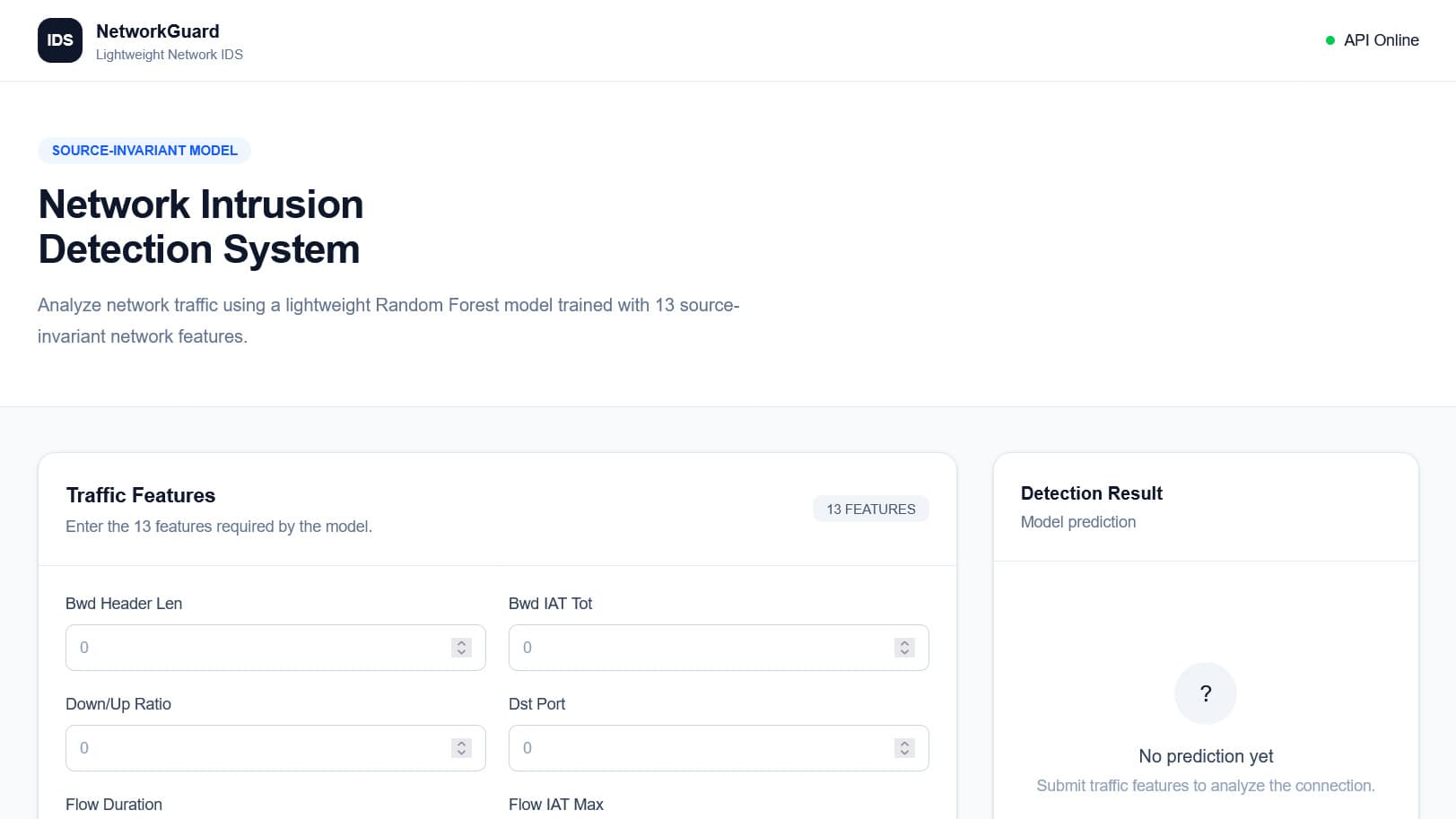
The current development of fifth-generation (5G) networks requires infrastructure such as Software-Defined Networking (SDN) to support high data rates, low latency, and flexible network management. However, the centralized control mechanism of SDN makes the controller a potential target for cyberattacks, particularly Distributed Denial-of-Service (DDoS) attacks. Previous studies have relied on complex deep learning, ensemble, or reinforcement learning models to improve detection accuracy. Although these approaches can enhance detection performance, they may introduce additional computational overhead to the controller, which is itself under attack. This study proposes a lightweight Random Forest-based framework for detecting DDoS attacks against SDN controllers in a 5G environment, with an emphasis on computational efficiency alongside detection accuracy. The study utilizes the InSDN dataset and applies data balancing, feature selection, and benchmarking across five feature-count configurations. The final model uses 13 source-invariant features, representing an 80.88% reduction in the number of features, and achieves an accuracy and weighted F1-score of 0.999623, with an inference time of 0.089986 seconds. The model is subsequently integrated into a FastAPI-based backend service and a Next.js-based web interface to support end-to-end DDoS detection. These results demonstrate that a simple machine learning approach can achieve a balance between effective attack detection and computational resource requirements.

VidTone Agent

VidTone Agent

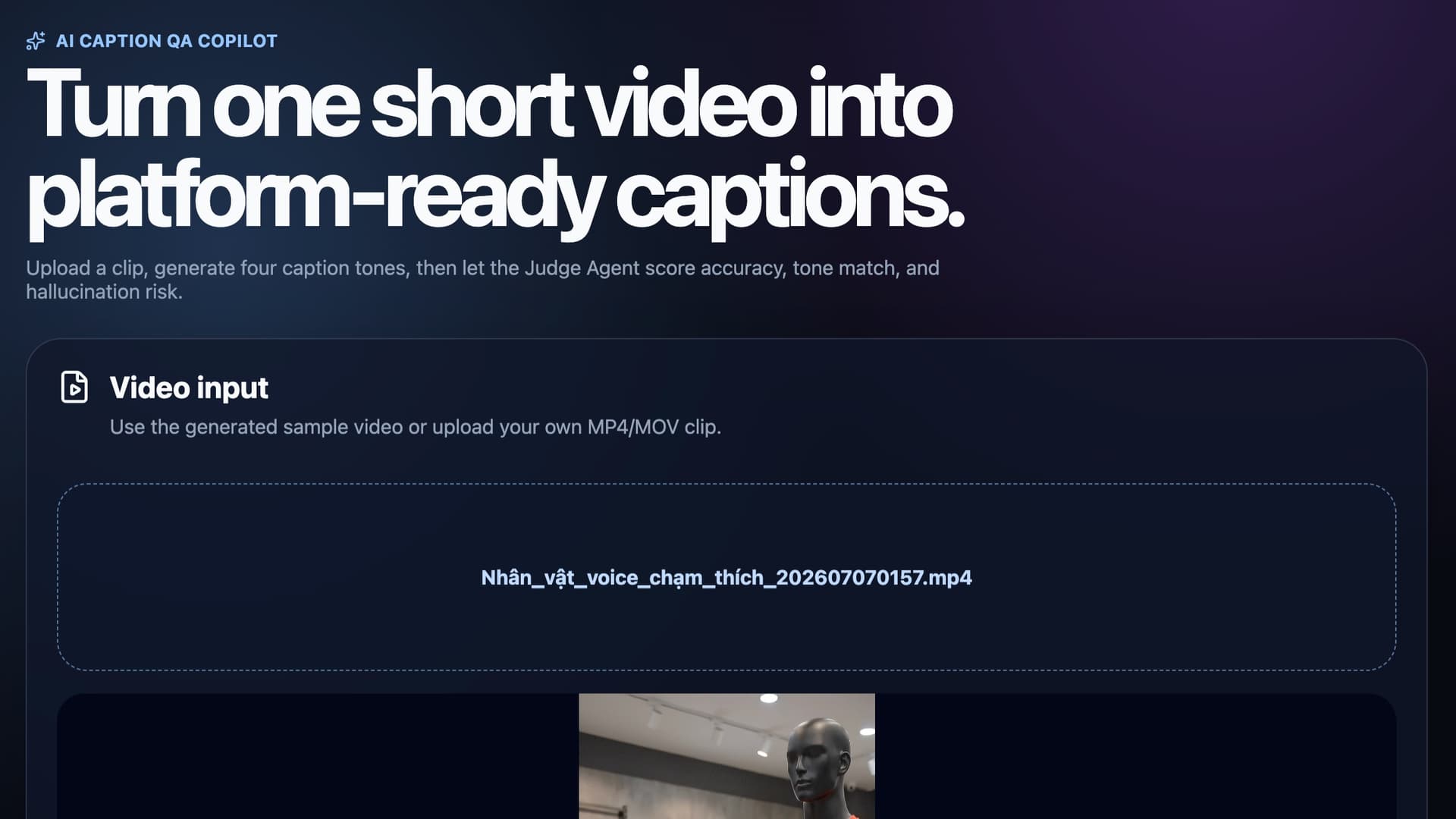
VidTone Agent is a Caption QA Copilot for short-video teams, built for AMD Developer Hackathon Act-II Track 2: Video Captioning. It turns a short video clip into four platform-ready caption styles: formal, sarcastic, humorous-tech, and humorous-non-tech. Most captioning tools stop after generation. VidTone Agent adds a second QA layer: a Judge Agent scores every caption for accuracy, tone match, and hallucination risk. If a caption is weak, the system can revise it using the judge’s notes, then export the final result as JSON or CSV. The core workflow is Generate → Judge → Revise → Export. The app runs in real mode with Fireworks AI. The verified model is accounts/fireworks/models/gpt-oss-120b, and users can override the model from the Web UI or CLI if their Fireworks account exposes other models. The product also supports batch processing for Track 2 judging: a folder of video clips can be processed into one aggregate CSV, JSON, and manifest. For longer videos, VidTone Agent can optionally split the video into shorter segments, process each segment, and export segment-level results. This keeps the main Track 2 short-video flow stable while making the tool more useful for real-world video teams. The stack includes Python 3.11, FastAPI, React, Vite, TypeScript, Bun, OpenCV, Docker, and Fireworks AI. The app ships as a Docker-ready web product with a FastAPI backend, React UI, CLI workflow, mock mode for local demos, and real Fireworks mode for final scoring.

DUAL-BROKER SOTA ENGINE

DUAL-BROKER SOTA ENGINE

Dual-Broker SOTA Engine is an automated trading system capturing real-time arbitrage between TradFi and Web3 prediction markets (Polymarket). The project proves that combining robust web scraping with low-latency LLM intelligence creates a secure, enterprise-grade engine. **Bright Data: Bypassing the Web's Toughest Blocks** Arbitrage demands real-time data from highly protected platforms like Yahoo Finance and Polymarket, where stale data leads to losses. The engine implements a resilient 3-tier extraction fallback powered by Bright Data: - **Bright Data Scraping Browser (CDP):** Renders JS-heavy, dynamic order books and scrapes depth snapshots via Puppeteer. - **Web Unlocker:** Bypasses advanced browser fingerprinting and CAPTCHAs on news feeds to guarantee a 99.9% extraction success rate. - **Residential Proxies:** Rotates IPs across a massive pool, ensuring high-frequency scraping runs continuously without rate-limiting or bans. Standardized via a Bright Data MCP Server, this stack transforms the open web into a structured enterprise data feed. **AI/ML API: High-Concurrency, Cost-Effective Swarm Intelligence** Running financial forecasts in real-time requires a consensus mechanism that is fast and affordable. The engine deploys a 50-persona Bayesian Swarm Consensus powered by the AI/ML API: - **Ultra-Low Latency:** AI/ML API orchestrates up to 50 parallel LLM persona requests simultaneously, converging the decision matrix in under 5 seconds. - **Economic Viability:** Leveraging top-tier models (DeepSeek-V4-Pro) via the gateway keeps token costs at a fraction of a cent. - **Real-Time P&L Safeguards:** The dashboard integrates with AI/ML API's billing API to track consumption and prove positive net profitability. With Apache Flink streaming and a Saga-based transaction sandbox for atomic execution, the engine proves that web data unlocked by Bright Data and reasoned by AI/ML API is ready for enterprise production.