Hugging Face Spaces

Hugging Face Spaces is a hosting platform for interactive machine learning applications. Developers build demos and tools using Gradio or Streamlit, then deploy them on Hugging Face infrastructure and receive a public URL. Spaces are free to run on shared CPU instances and can be upgraded to GPU-backed hardware for workloads that need faster inference. They are widely used during hackathons and AI events to share working prototypes without managing any server infrastructure.

General
AuthorHugging Face
TypeAI Application Hosting Platform
Websitehuggingface.co/spaces
DocumentationSpaces Documentation
Hardware OptionsCPU (free), T4, A10G, A100, H100
FrameworksGradio, Streamlit, Docker

Start building with Hugging Face Spaces

Spaces is the quickest path from a working model to a shareable demo. Connect a model from the Hub, wrap it in a Gradio interface, and push to a Space — the application goes live with a public URL in minutes. GPU instances are available on an hourly basis for workloads that need real compute. During hackathons on lablab.ai, submitting a Hugging Face Space link is a standard way to present a working project. Spaces created under an event's Hugging Face organization are publicly discoverable, and community members can vote with likes. Explore examples at Hugging Face Use Cases and Applications.

Hugging Face Spaces Tutorials


Getting Started


Key Features

Instant deployment Push a Gradio or Streamlit app to a Space repository and get a live URL without any server configuration or DevOps setup.

GPU hardware tiers Upgrade to T4, A10G, A100, or H100 instances for workloads that need GPU acceleration. Pricing is hourly with no long-term commitment.

Organization Spaces Create Spaces under a team or event organization so project submissions stay grouped and discoverable by judges and community members.

Persistent storage Attach a storage volume to a Space for stateful applications that need to read or write files between requests.

Community discovery Spaces are publicly indexed on Hugging Face and sortable by likes, making them a practical way to share and showcase AI projects.


Boilerplates

HuggingFace Spaces top builders

Explore the top contributors showcasing the highest number of HuggingFace Spaces app submissions within our community.

huggingface HuggingFace Spaces AI technology Hackathon projects

Discover innovative solutions crafted with HuggingFace Spaces, developed by our community members during our engaging hackathons.

ROBOGUARD DX

ROBOGUARD DX

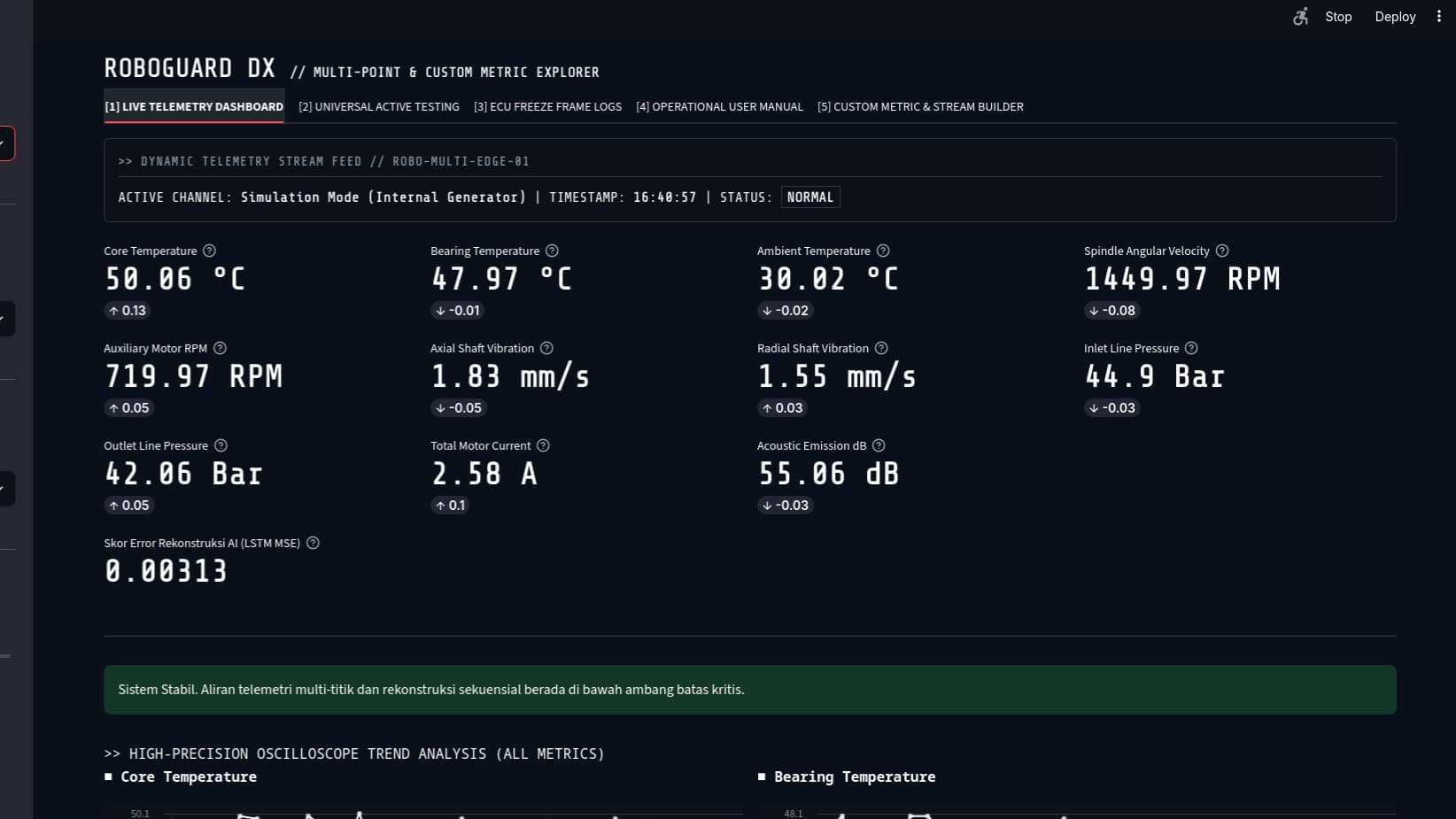
# RoboGuard DX // Enterprise Diagnostic Terminal & Industrial IoT Co-pilot RoboGuard DX is a cutting-edge, AI-powered industrial diagnostic terminal engineered to revolutionize predictive maintenance, edge monitoring, and real-time troubleshooting in modern industrial environments (Industry 4.0 / Intelligent Industry). Inspired by professional automotive ECU diagnostic tools, RoboGuard DX provides plant engineers and field technicians with deep visibility, sub-system isolation, and hands-on interventional control all wrapped in a high-performance, dark-mode terminal interface. 1. Live Telemetry & Custom Metric Explorer * **Multi-Point Streaming:** Real-time monitoring of core industrial parameters across thermal, mechanical, hydraulic, and electrical sub-systems. * **Dynamic Custom Metric Builder:** Instantly register and inject custom field sensors (e.g., motor temperatures, vibration axes, return pressures) directly through the GUI. The underlying AI and oscilloscope streams adapt their vector dimensions automatically in real time. 2. Universal Active Testing (Interactive Interventions) * Unlike passive monitoring dashboards, RoboGuard DX enables technicians to execute real-time physical interventions. * Toggle system actuators like **Cooling Pumps**, **Pressure Relief Valves**, or **RPM Limiters** to actively mitigate anomalies. Interventions immediately influence live sensor readings and oscilloscope charts without triggering false-positive alerts. 3. LSTM Autoencoder AI Engine & Root-Cause Isolation * Powered by a multivariate **LSTM Autoencoder** model that evaluates continuous sliding windows of sequential telemetry data. * Calculates real-time Reconstruction Error (MSE) to detect subtle anomalies before catastrophic failures occur. * Automatically pinpoints the worst-performing sensor dimension to isolate the root-cause subsystem. 4. ECU Freeze Frame & Root-Cause Memory (Black Box) 5. Interactive User Manual & Stream Protocol Support

Community Connect

Community Connect

People often need practical, non-emergency help but don’t know which local group to contact, while students, volunteers, local businesses, and organisations who could help are hard to find. CommunityConnect brings both sides together. Providers publish self-reported skills, availability, languages, and travel distance. Seekers write their need in ordinary language (Italian or English) and can review and edit suggested category, skills, place, urgency, and availability before submitting. Emergencies and requests needing medical or legal professionals are screened out of ordinary matching. Businesses can use CommunityConnect to reach the people who need what they offer. A local business, social enterprise, or NGO registers as an organisation, lists its services in the public directory, and receives matched requests from nearby people who are looking for that kind of help. It decides which requests to accept, so it only spends time on relevant ones. The app checks provider eligibility first, then ranks eligible providers using multilingual text embeddings plus structured signals such as municipality distance. It shows the score components rather than a black-box number. A provider accepts, then the seeker separately confirms, and only then do contact details appear, so both sides stay in control of their privacy. AI is optional: if the service is down, local rules keep basic intake working. It is an early prototype with self-reported profiles, and the next step is a small Genova pilot with local businesses and organisations.

MediGuide AI Multilingual Healthcare Intelligence

MediGuide AI Multilingual Healthcare Intelligence

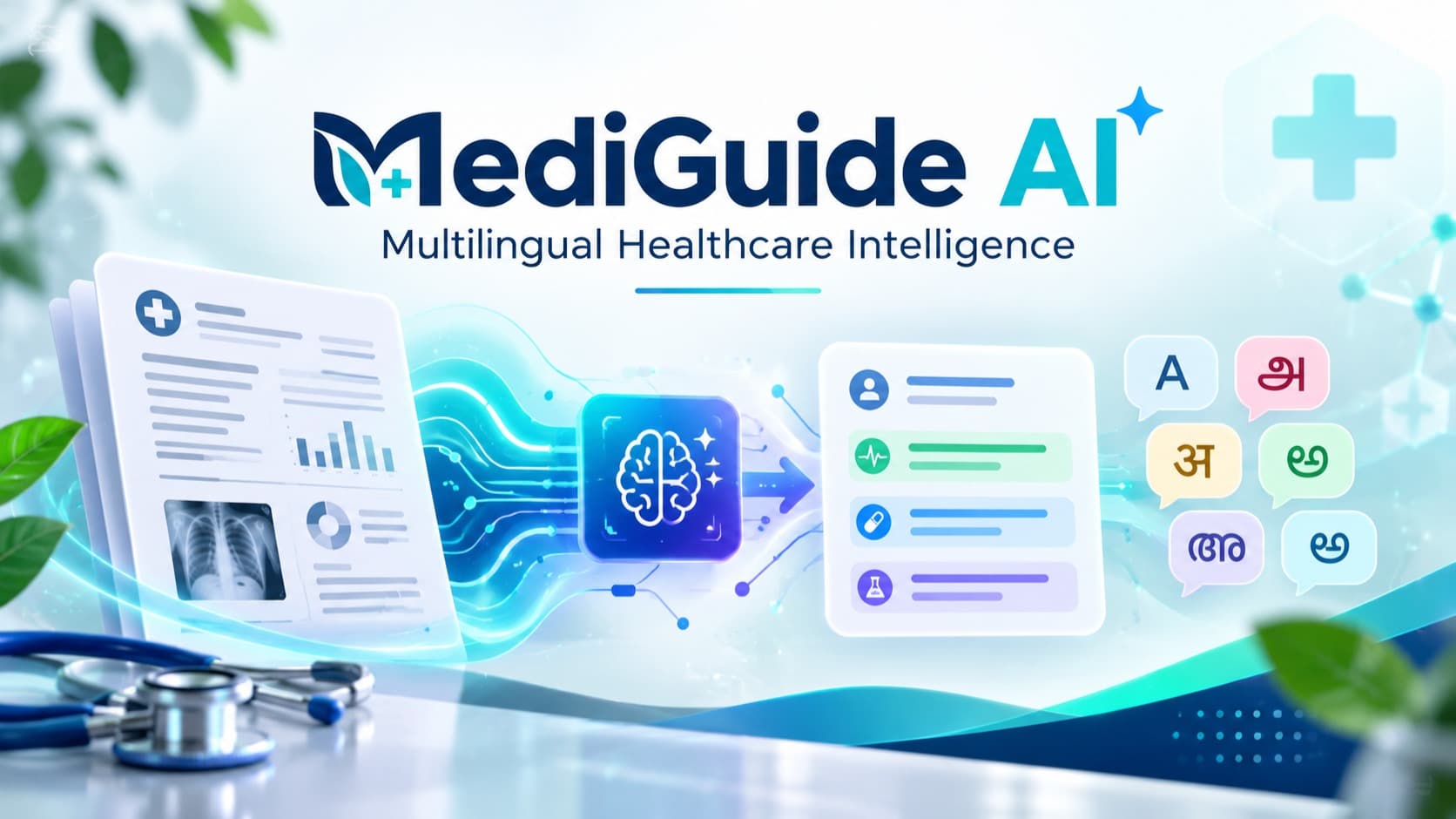
## MediGuide AI – Multilingual Healthcare Intelligence MediGuide AI is an AI-powered healthcare accessibility platform designed to help patients understand complex medical reports in their preferred language. ### The Problem Medical reports often contain complex terminology that patients struggle to understand. Language barriers can make healthcare information even more difficult to access, affecting patients' ability to prepare for consultations and ask informed questions. ### Our Solution MediGuide AI transforms medical documents into more accessible, patient-friendly information through an intelligent document-processing pipeline. ### Key Features - **Medical Document Extraction:** Uses PaddleOCR and text extraction to process uploaded medical reports. - **Clinical Entity Recognition:** Identifies important medical terms and entities using a pretrained biomedical NER model. - **Report Summarization:** Produces concise summaries to make medical information easier to review. - **Multilingual Accessibility:** Supports English, Tamil, Hindi, Telugu, Malayalam, and Kannada. - **AI Health Assistant:** Helps patients understand medical terminology and prepare questions for their doctors. - **Emergency Awareness:** Detects potentially urgent symptom descriptions and advises users to seek appropriate medical care. ### Technology Stack - Frontend: React - Backend: Python, FastAPI - OCR: PaddleOCR and PyMuPDF - NLP: Transformers and biomedical named entity recognition - Database: SQLite - Multilingual processing: Local language detection and translation components ### Innovation and Impact MediGuide AI combines medical document processing, clinical NLP, summarization, and multilingual accessibility in one platform. It aims to reduce language barriers and help patients participate more confidently in healthcare discussions. MediGuide AI is an educational support tool, not a replacement for professional medical advice, diagnosis, or treatment.

IGNIS: Traceable maintenance intel & audit reports

IGNIS: Traceable maintenance intel & audit reports

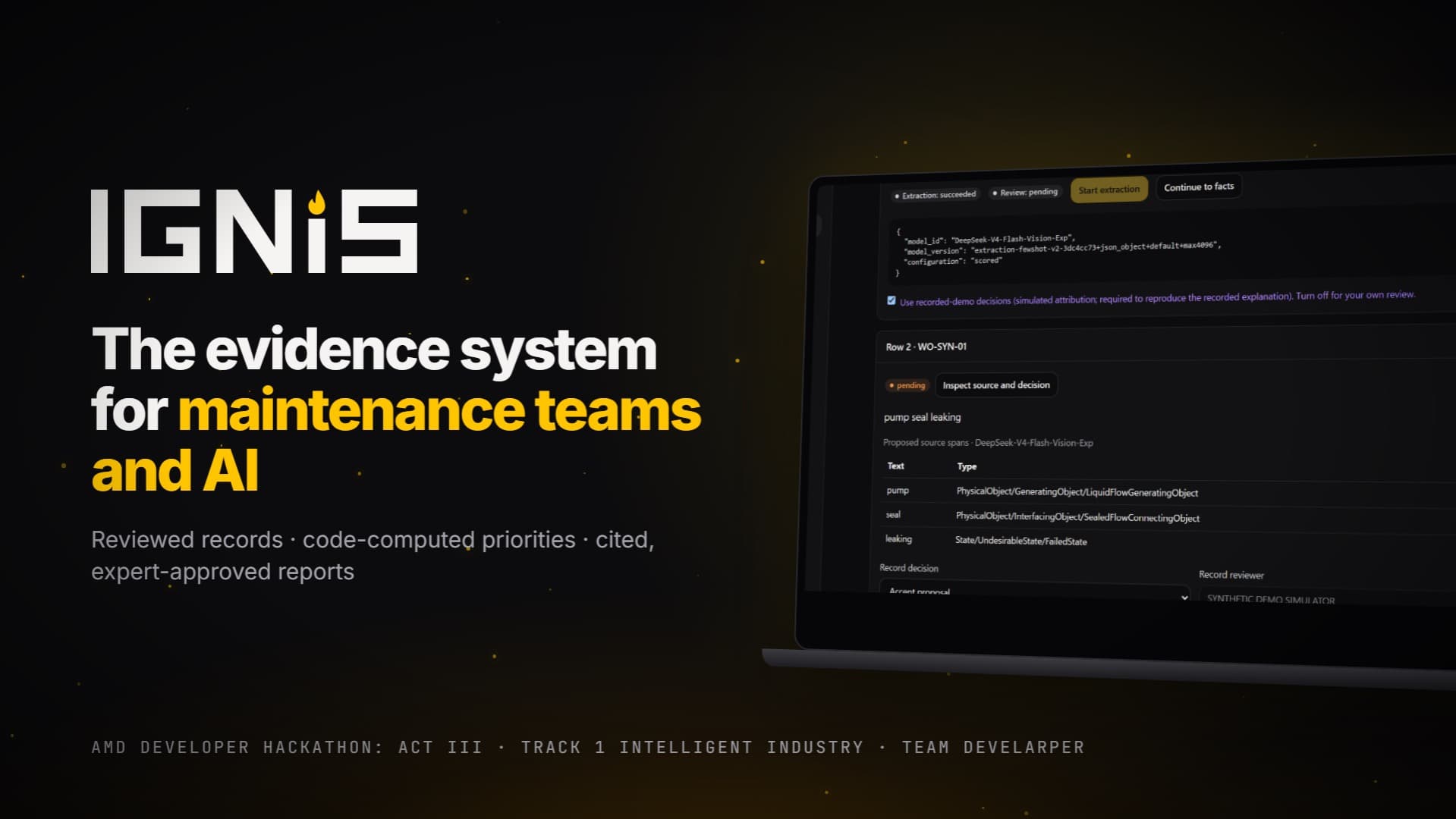
Maintenance teams are stretched and their history is hard to trust. In MaintainX's 2025 survey of 1,320 maintenance professionals, 71% called preventive maintenance a core strategy, yet under 35% spend most of their time on it and 58% spend over half their time reacting to breakdowns. The records meant to guide them are often weak: a peer-reviewed 2024 Semantic Web study (Woods et al.) found data-quality issues in 55% of eight years of work orders for one centrifugal pump. Meanwhile, Siemens (True Cost of Downtime, 2024) estimates one hour of unplanned downtime costs a large automotive plant $2.3 million. That is why we built IGNIS: an evidence desk for supervisors and reliability engineers who must turn messy work orders into decisions they can defend. Models propose, code computes and people approve. Users import CSV or Excel exports, confirm column mappings and review AI-suggested components, faults and actions anchored to exact spans of the original text. Approved records form a versioned snapshot. Code calculates counts, priorities and alerts, so numbers stay reproducible. A reviewed asset-and-component graph keeps wrong-model and superseded manuals out of retrieval, and the top passages feed a cited draft with alternatives and uncertainty, or an abstention when evidence is missing. Validators check every citation and numeric binding; an expert signs off before IGNIS can issue an evidence-linked PDF report. IGNIS runs on AMD Token Factory: DeepSeek-V4-Flash-Vision-Exp extracts work-order entities, DeepSeek-V4-Flash drafts cited explanations, and MinerU2.5-Pro reads scanned manuals, behind one rate-aware API gateway with recorded replay. On MaintIE's held-out test split, 105 of 108 extraction outputs were valid. Unlike chat assistants, IGNIS never lets a model set a number or approve a finding, and every claim resolves to a record and passage. The demo labels synthetic, replay and live data; it claims no failure prediction or measured production savings yet.