IBM watsonx Assistant

IBM watsonx Assistant is a cutting-edge conversational AI platform designed to help businesses and developers create intelligent, generative AI-powered virtual assistants and chatbots. This technology enhances customer service, employee support, and marketing engagement through advanced natural language understanding (NLU) and retrieval-augmented generation (RAG). With a no-code/low-code interface, watsonx Assistant allows users to build and deploy personalized and contextually accurate conversations across multiple channels, improving user satisfaction and business efficiency.

General
Relese dateReleased as part of IBM watson's evolution, continuously updated with the latest being in October 2024.
AuthorIBM
WebsiteIBM watsonx Assistant Product Page
Documentationhttps://cloud.ibm.com/docs/watson-assistant
TypeConversational AI, Virtual Assistants, Machine Learning, Natural Language Processing (NLP)

Key Features

  • Generative AI with LLMs: watsonx Assistant leverages large language models to generate context-aware, accurate, and dynamic conversational responses.

  • Natural Language Understanding (NLU): It supports advanced NLU, enabling it to comprehend complex queries and provide personalized responses.

  • Retrieval-Augmented Generation (RAG): The assistant integrates with a company’s knowledge base to provide up-to-date and accurate information.

  • Visual Builder Interface: A user-friendly, drag-and-drop interface that requires no coding experience, making it accessible for non-developers.

  • Omnichannel Integration: It supports deployment across multiple channels such as websites, mobile apps, messaging platforms, and more.

  • AI-Powered Insights and Analytics: Provides in-depth analytics and reporting to track performance and optimize user interactions.

  • Security and Compliance: Built with enterprise-grade security features and compliance with standards such as HIPAA​.

Applications

  • Customer Service: Automate customer interactions, provide 24/7 support, and deliver personalized assistance for common customer inquiries, improving satisfaction and reducing operational costs.

  • Human Resources (HR): Simplify employee support by automating HR-related queries, improving the employee experience, and reducing the burden on HR departments.

  • Healthcare: Streamline patient services by providing quick access to medical information, appointment scheduling, and FAQs.

  • Retail: Enhance the shopping experience by offering personalized product recommendations, resolving customer issues, and facilitating purchases across multiple channels.

  • Telecommunications: Optimize customer service and technical support operations, offering immediate responses to customer inquiries.

IBM watsonx Assistant top builders

Explore the top contributors showcasing the highest number of IBM watsonx Assistant app submissions within our community.

IBM IBM watsonx Assistant AI technology Hackathon projects

Discover innovative solutions crafted with IBM watsonx Assistant, developed by our community members during our engaging hackathons.

ErrLens

ErrLens

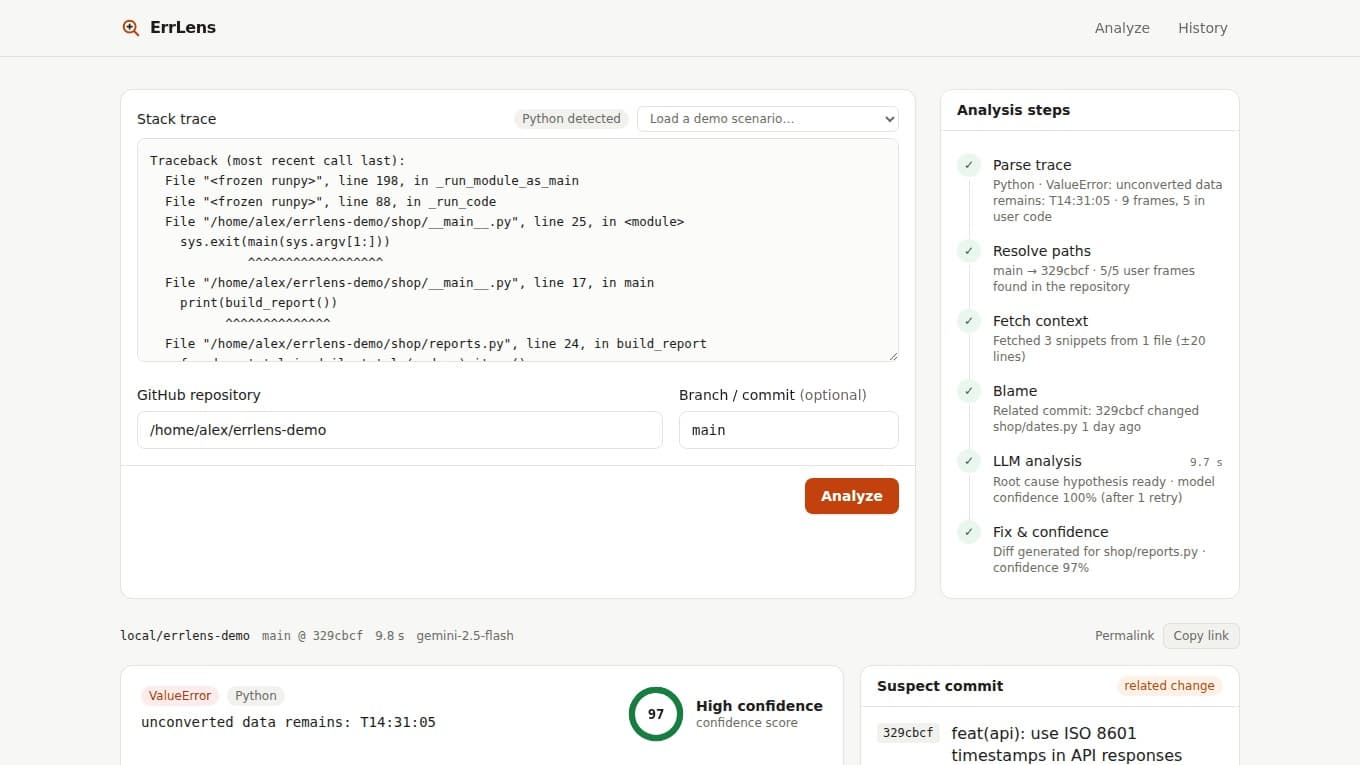
The pipeline is a single async generator (backend/app/pipeline.py). Each step emits an event, and the last one carries the full result. parse: Detects the language, the exception type and message, and all frames (innermost first), and separates user code from library code. Handles chained exceptions and warns about minified traces. resolve_paths: Resolves the ref to a commit SHA, fetches the repository tree and maps absolute trace paths (/home/deploy/app/user.py) to repository paths (app/user.py) by longest suffix match. fetch_context: Fetches ±20-line snippets for the first 3 user frames. If the source line in the trace does not match the repository, it warns and lowers the confidence. blame: Blames the lines around each error line. It then runs a related-commit search: if the error lines have not changed since then, it scores the patches of later commits in the same language against the identifiers and string literals on the error lines (for example '%Y-%m-%d'). This finds the cause when the line the trace points to is not the one that changed. analyze: Calls the LLM with a forced tool call. The output is validated in two layers: first the schema, then the semantics (the file and line range must be inside the shown snippet, the diff must build, and the code must pass a Python/JS syntax check). On failure, the error goes back to the model and it gets one retry. If it still fails, the result is returned without a fix. build_fix: Turns the edit into a unified diff with difflib; the LLM never writes the diff itself. The confidence score is 0.6 × LLM confidence + 0.4 × average of signals. The signals are: user frame resolved, change within the last 14 days, error type matches the line, fix validated, trace lines match the commit. done: Saves the result to SQLite. The cache key is a hash of the normalized trace, the repository and the SHA, so an identical request returns without calling the LLM. The pipeline only stops on parse errors and user input errors (invalid URL, repository or ref not found). If any other step fails, it is marked error or skipped and the analysis continues with what it has.

OnboardAI: Smart Dev Assistant

OnboardAI: Smart Dev Assistant

Problem: Joining a new engineering team or diving into a large open-source codebase is notoriously overwhelming. New developers spend days or even weeks struggling with undocumented code structures, setting up complex local development environments, tracing architecture dependencies, and trying to figure out where they can safely make their first contribution. This steep learning curve delays productivity, frustrates developers, and slows down overall team velocity. Solution: We built OnboardAI, an intelligent developer onboarding assistant designed to bridge this gap instantly. By leveraging IBM Bob, our system deeply analyzes codebases, breaks down system architectures, auto-generates step-by-step local setup instructions, and pinpoints tailored "good first issues" or starter tasks based on the developer's experience level. Target Users: New software engineers entering corporate tech environments. Open-source maintainers and contributors looking to lower the barrier to entry for newcomers. Engineering managers aiming to ramp up team members faster. User Interaction & Workflow: Developers point the assistant to a repository link. OnboardAI instantly scans the project files, renders an interactive architectural overview map, provides automated setup commands, and offers an interactive conversational guide where developers can ask questions like, "Where is user authentication handled?" or "What task should I pick up first?" Creativity, Uniqueness & Efficiency: Unlike generic documentation scrapers, OnboardAI dynamically parses context directly from the code structure in real-time. By turning static, boring documentation into an interactive, AI-driven mentor, it cuts traditional multi-week onboarding timelines down to just a few hours.

Reforge

Reforge

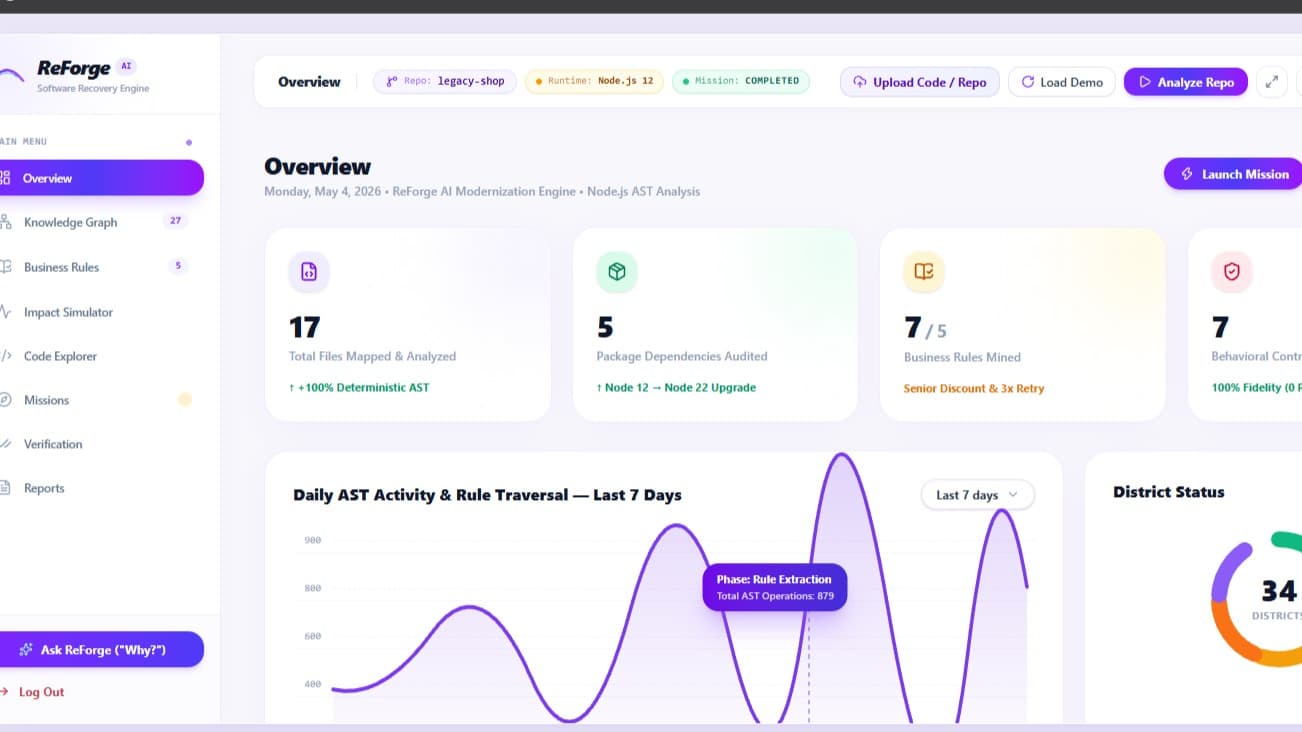
The Problem: The Legacy Knowledge Void Trillions of dollars of global enterprise infrastructure—spanning banking, logistics, retail, and healthcare—run on aging legacy codebases. When the original engineers depart, this software becomes an impenetrable black box. Development teams face a critical dilemma: Undocumented Architecture: Microservice routes, database operations, and external dependencies are untracked. Hidden Business Rules: Vital domain rules (e.g., custom discount thresholds, idempotent settlement checks, retry fallbacks) are buried deep inside undocumented conditional branches. High Regression Anxiety: Touching legacy code risks catastrophic breaking changes across unmapped callers. The AI Rewrite Trap: Modern generative AI tools attempt blind syntactic rewrites without understanding domain semantics, frequently stripping critical edge-case logic and introducing silent production bugs. The Solution: ReForge ReForge is an AI Software Recovery & Evolution Engine built on a fundamental principle: "Don't just rewrite legacy code; recover the institutional knowledge trapped inside it." ReForge flips modernization from a risky code replacement into a structured, knowledge-first recovery lifecycle: Understand (AST Grounded Graph): Parses codebase Abstract Syntax Trees (AST) deterministically to reconstruct an interactive Knowledge Graph mapping microservices, endpoints, database queries, and security vulnerabilities without hallucinations. Mine Institutional Memory: Automatically extracts undocumented domain rules from conditional branches, surfacing them as verified business logic with exact file and line coordinates. Simulate Blast Radius: An interactive Impact Simulator models upstream callers and downstream dependencies to calculate risk levels before making code changes. Software Archaeology ("Ask Why"): An AI reasoning agent answers architectural inquiries citing ground-truth source code citations. Human-in-the-Loop Decision Gates: An autonomous 9-phase mission workflow pauses at critical architectural junctures, requiring human approval before legacy behaviors are modernized or deprecated. Behavioral Contract Verification: Live test execution and zero-regression behavioral contracts verify input/output parity between legacy and modernized systems. Target Users & Interaction Designed for enterprise software engineers, modernization architects, tech leads, and technical auditors. Users interact through a high-fidelity visual dashboard where they can upload repository ZIPs or source files, inspect dependencies in an interactive React Flow blueprint, confirm discovered business rules, trigger human-gated migrations, and download audit-ready compliance reports in Markdown and JSON. Creativity, Uniqueness & Impact Unlike generic AI coding assistants that generate untrusted code in isolation, ReForge enforces deterministic static analysis as an anchor for LLM reasoning, combines autonomous agents with mandatory Human Decision Gates, and validates migrations through empirical test execution. It cuts legacy onboarding and modernization time from months to minutes while guaranteeing zero functional regression.

Ongoing Copilot

Ongoing Copilot

Problem Joining a new codebase is one of the slowest, most frustrating parts of a developer's job. New hires, open-source contributors and students face hundreds of unfamiliar files, outdated or missing documentation, and no clear place to start. Senior engineers lose hours answering the same questions, and newcomers can spend weeks before making a first meaningful contribution. Generic tutorials don't help: every repository is different, and every developer arrives with a different skill level and role. Solution Developer Onboarding Copilot turns any GitHub repository into a personalised, interactive learning journey, from first clone to first pull request. The user pastes a repository URL, and the system automatically analyses it: languages, frameworks, entry points, directory structure and test suites. It then combines this analysis with the developer's profile (experience level, role such as frontend, backend or fullstack, and personal goals) to generate a day-by-day onboarding plan with concrete tasks, time estimates and the exact files to read. Target users New team members onboarding into company codebases Open-source newcomers who want to contribute but don't know where to begin Students and junior developers learning from real-world projects Engineering managers and maintainers who want to scale onboarding without spending their own time How users interact with it Through a clean web dashboard, the developer follows their plan and tracks progress task by task. When stuck, they ask questions in a codebase-aware chat that answers with references to specific files, like a senior colleague who is always available. After completing a task, they submit their code and receive instant AI feedback against the task's acceptance criteria. When ready, the copilot suggests beginner-safe first contributions based on real gaps in the codebase, and generates a pull request title, description and pre-merge checklist. What makes it creative and unique Most AI coding tools help developers write code. Ours helps them understand code, and it covers the whole path from confusion to contribution in one guided flow instead of isolated features. Plans adapt to the person, not just the project: a beginner fullstack developer and an advanced backend engineer get different journeys through the same repository. The backend also exposes standard MCP endpoints, so its tools can plug directly into IBM watsonx Orchestrate and other agent workflows. Built with IBM Bob and watsonx We used IBM Bob throughout development to design the architecture and to generate and refine the FastAPI backend, React components, prompt templates, tests and documentation. This let a small team ship a full-stack product within the hackathon timeline. All AI reasoning runs on IBM watsonx with Granite models, through a vendor-agnostic provider layer. Impact By replacing weeks of unstructured exploration with a tailored, step-by-step plan, instant answers and validated practice, the copilot shortens time to first contribution, reduces the burden on senior engineers, and makes any codebase approachable for anyone.

Trishul

Trishul

Trishul is an AI-powered, repository-aware code review agent that helps you catch issues before they reach a pull request — without giving up control over what gets posted publicly. Point it at a local git diff, staged changes, a commit range, or a GitHub pull request, and Trishul analyzes the change using dedicated agents for bugs, security, tests, performance, and maintainability. Every finding is required to cite an actual added line in the diff — anything that can't be verified against the code is dropped, so you're not stuck sifting through noise or hallucinated issues. Under the hood, a FastAPI backend coordinates a RepositoryAnalyzer, a DiffParser, and the review agents, with results shown in a React-based web UI, printed to the terminal, or surfaced in chat via an IBM Bob integration (/coach). It runs out of the box with a deterministic mock provider (no API key required), or can be pointed at an OpenAI-compatible endpoint for deeper, model-driven analysis. Trishul fits into however you already work: CLI — run reviews directly in your working repo, with CI-friendly exit codes (0/1/2) and --json/--proof output for scripts and shareable Markdown reports Pre-push git hook — blocks pushes that need attention, with a --no-verify escape hatch for emergencies GitHub Actions — runs automatically on incoming PRs and posts results to the job summary VS Code extension — review your working tree, staged changes, or a branch range from the Command Palette Beyond flagging problems, Trishul can also propose and verify fixes: it spins up an isolated workspace, applies a high-confidence fix, re-runs checks before and after, and compares results — never fabricating pass/fail evidence when a repo has no runnable checks. Every review ends in an evidence-based verdict — READY TO MERGE, NEEDS ATTENTION, or BLOCKED — computed from verified finding severity, test coverage gaps, and review execution errors, not an arbitrary LLM confidence score. Crucially, Trishul only comments on a live pull request when you explicitly pass --publish (or publish: true via the API) — by default, everything stays local to you.

QUBOB: Quantum-Inspired Microservice Optimizer

QUBOB: Quantum-Inspired Microservice Optimizer

### Problem Statement Modern cloud-native applications frequently consist of dozens to hundreds of microservices deployed across distributed Kubernetes clusters and multiple availability zones. Placing these services optimally across nodes is an NP-hard combinatorial optimization problem with an S^N search space (yielding over 10^20 possible configurations for a modest 20-service, 10-node cluster). Standard Kubernetes schedulers evaluate only static CPU and memory limits, remaining blind to real-time inter-service network traffic. Consequently, high-throughput service pairs are routinely scattered across different availability zones. Each cross-zone hop introduces an extra 5 to 10 ms of round-trip time (RTT), causing cascading latency bottlenecks, SLA breaches, and thousands of dollars in unmonitored cloud egress bandwidth fees ($0.01–$0.09/GB). Classical greedy algorithms get trapped in local minima by greedily filling individual nodes, while physical quantum processing units (QPUs) suffer from queue latency, high operational costs, and rapid depletion of compute budgets. ### The Solution: QUBOB QUBOB (Quantum-Inspired Unconstrained Binary Optimizer for IBM Bob 2.0) resolves this dilemma by running quantum-inspired optimization natively on standard classical CPUs. 1. **QUBO Hamiltonian Formulation:** QUBOB decodes workload manifests (Kubernetes Deployments, StatefulSets, and Docker Compose) into a weighted communication graph and constructs a multi-objective Hamiltonian: $$\mathcal{H} = \mathcal{H}_{\text{latency}} + \mathcal{H}_{\text{resource}} + \mathcal{H}_{\text{affinity}} + \mathcal{H}_{\text{penalty}}$$ This formula balances latency minimization against CPU/RAM capacity bounds and PCI-DSS compliance constraints. 2. **Quantum-Inspired Solver (QIEA):** Decision states are modeled as quantum Q-bits in superposition. Using Han & Kim dynamic rotation gates and Pauli-X catastrophe tunneling operators, QIEA explores billions of states and avoids local optima without requiring actual quantum hardware. 3. **Actionable DevOps Output:** QUBOB automatically generates unified git diffs injecting production-ready Kubernetes `nodeAffinity` and `topologySpreadConstraints` directly into deployment YAMLs. ### Unique Innovation & Measured Impact In an enterprise benchmark of a 20-microservice PCI-DSS digital banking platform, QUBOB analyzed 48 dependency edges and resolved a 3,500 req/s critical bottleneck between payment and fraud services. Across availability zones, this single edge wasted 28,000 ms of cumulative latency every second. QUBOB solved this 60-variable QUBO in just 0.242 seconds, co-locating the critical pair with zero constraint violations and achieving a verified 99.6% latency reduction. QUBOB operates with a peak RAM footprint of just 0.39 MiB (<1% of the hackathon Bobcoin budget) and is verified by 228 passing tests with 100% core coverage.