Intel Core Ultra

Intel Core Ultra is Intel's line of client processors built for AI PCs, pairing a CPU and GPU with a dedicated Neural Processing Unit (NPU) so AI workloads can run locally instead of relying on the cloud. Core Ultra Series 2 (code-named Arrow Lake and Lunar Lake) launched in 2024, and Series 3 processors are the current generation used in Intel's latest Physical AI and edge AI reference designs.

General
Release dateSeries 2 desktop: October 10, 2024
DeveloperIntel Corporation
TypeClient CPU with integrated GPU and NPU
LicenseCommercial hardware
DocumentationCore Ultra Series 2 product page

Core Features

  • Intel AI Boost NPU — the 200V series NPU delivers up to 48 TOPS, built from two Neural Compute Engine tiles with configurable MAC engines and Movidius SHAVE DSPs.
  • Combined platform performance — Intel cites up to 120 TOPS of combined CPU, GPU, and NPU AI performance on Core Ultra Series 2.
  • On-device inference — runs optimized models through OpenVINO without a network round trip, reducing latency for vision and language workloads.
  • Robotics and physical AI — used as the compute target for Intel Physical AI Studio VLA policies, providing low-latency control loops for robotic systems.

Model Variants

VariantNPU TOPSCombined Platform TOPSBest for
Core Ultra 200VUp to 48—Thin-and-light AI PCs
Core Ultra 200S (Desktop)13 (Int8)—Desktop AI PC workloads
Core Ultra Series 2 (platform)—Up to 120Combined CPU/GPU/NPU AI workloads

Tools and Resources

  • Core Ultra Series 2 product page — intel.com, full spec listings by SKU.
  • Intel NPU driver documentation — Intel NPU datasheet, NPU architecture details.

Ecosystem and Integrations


See the Core Ultra Series 2 product brief for full SKU-level specifications.

Intel Core Ultra top builders

Explore the top contributors showcasing the highest number of Intel Core Ultra app submissions within our community.

intel Intel Core Ultra AI technology Hackathon projects

Discover innovative solutions crafted with Intel Core Ultra, developed by our community members during our engaging hackathons.

Community Connect

Community Connect

People often need practical, non-emergency help but don’t know which local group to contact, while students, volunteers, local businesses, and organisations who could help are hard to find. CommunityConnect brings both sides together. Providers publish self-reported skills, availability, languages, and travel distance. Seekers write their need in ordinary language (Italian or English) and can review and edit suggested category, skills, place, urgency, and availability before submitting. Emergencies and requests needing medical or legal professionals are screened out of ordinary matching. Businesses can use CommunityConnect to reach the people who need what they offer. A local business, social enterprise, or NGO registers as an organisation, lists its services in the public directory, and receives matched requests from nearby people who are looking for that kind of help. It decides which requests to accept, so it only spends time on relevant ones. The app checks provider eligibility first, then ranks eligible providers using multilingual text embeddings plus structured signals such as municipality distance. It shows the score components rather than a black-box number. A provider accepts, then the seeker separately confirms, and only then do contact details appear, so both sides stay in control of their privacy. AI is optional: if the service is down, local rules keep basic intake working. It is an early prototype with self-reported profiles, and the next step is a small Genova pilot with local businesses and organisations.

FactoryGuard:AI-Powered Industrial Intelligence

FactoryGuard:AI-Powered Industrial Intelligence

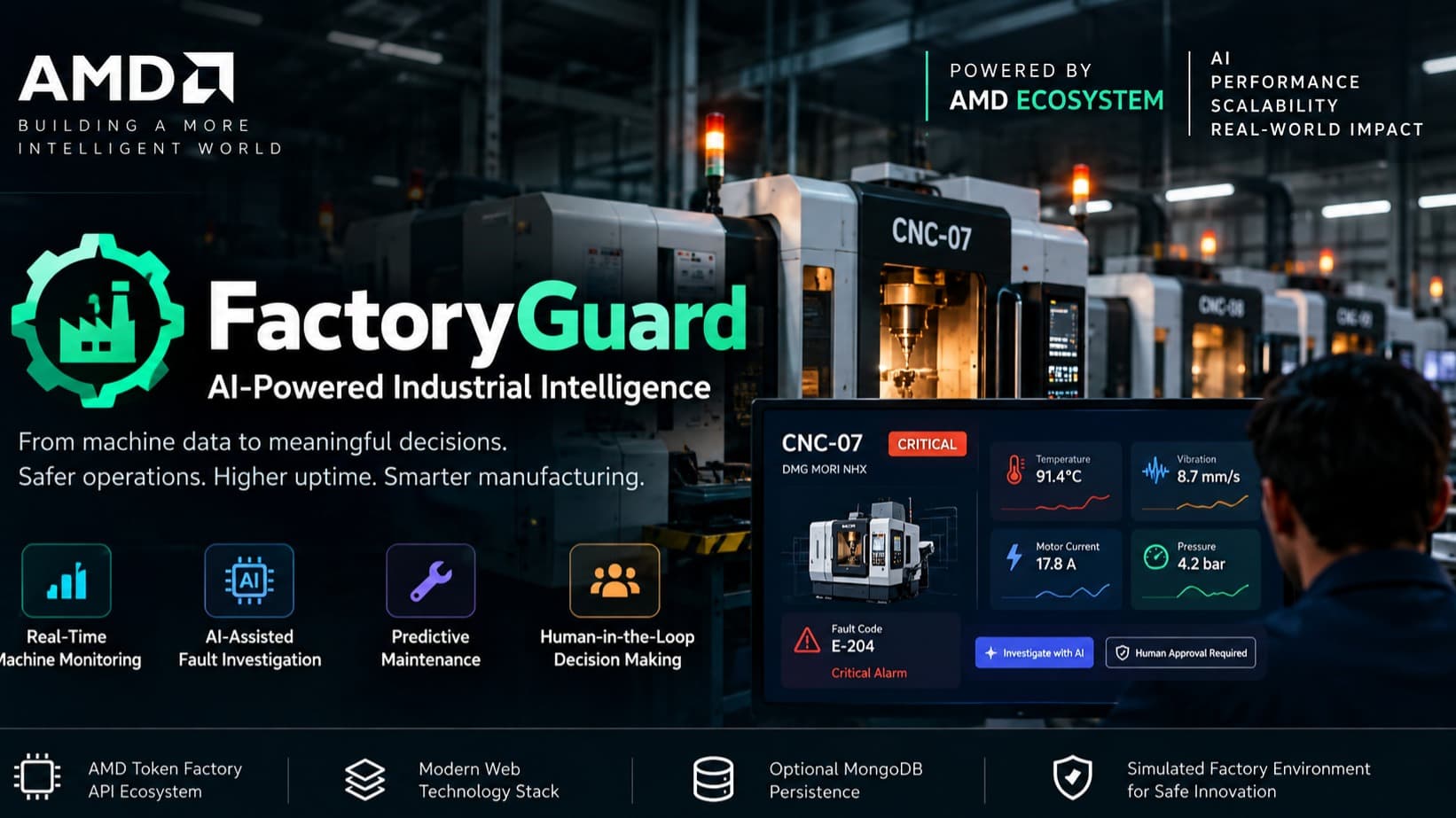
FactoryGuard is an AI-assisted industrial incident intelligence platform designed to demonstrate how intelligent monitoring can support predictive maintenance and better operational decisions in manufacturing. The project features an interactive dashboard for a simulated factory containing 10 CNC machines. It monitors telemetry such as temperature, vibration, motor current, and pressure, identifies abnormal conditions using rule-based detection, and presents incident severity, supporting evidence, potential causes, and recommended maintenance actions. FactoryGuard follows a human-in-the-loop workflow: operators review investigation results and approve or reject proposed interventions rather than allowing AI to control machinery autonomously. It also demonstrates incident lifecycle tracking, from detection and investigation through maintenance, recovery, and closure. The project explores the AMD developer ecosystem and AMD Token Factory's API-based model ecosystem as a potential path for AI-assisted industrial investigations. An Evolus chat widget integrated into the dashboard supports Italian-language interaction about simulated incidents. The application combines a responsive web interface, deterministic fault-detection logic, optional model-integration paths, and optional MongoDB persistence. FactoryGuard demonstrates a practical approach to evidence-led industrial AI, with an emphasis on transparency, uncertainty awareness, and human oversight. Machine telemetry and faults are simulated; the project is a prototype and is not connected to real industrial equipment.

Craft.ai – Agentic AI App Builder

Craft.ai – Agentic AI App Builder

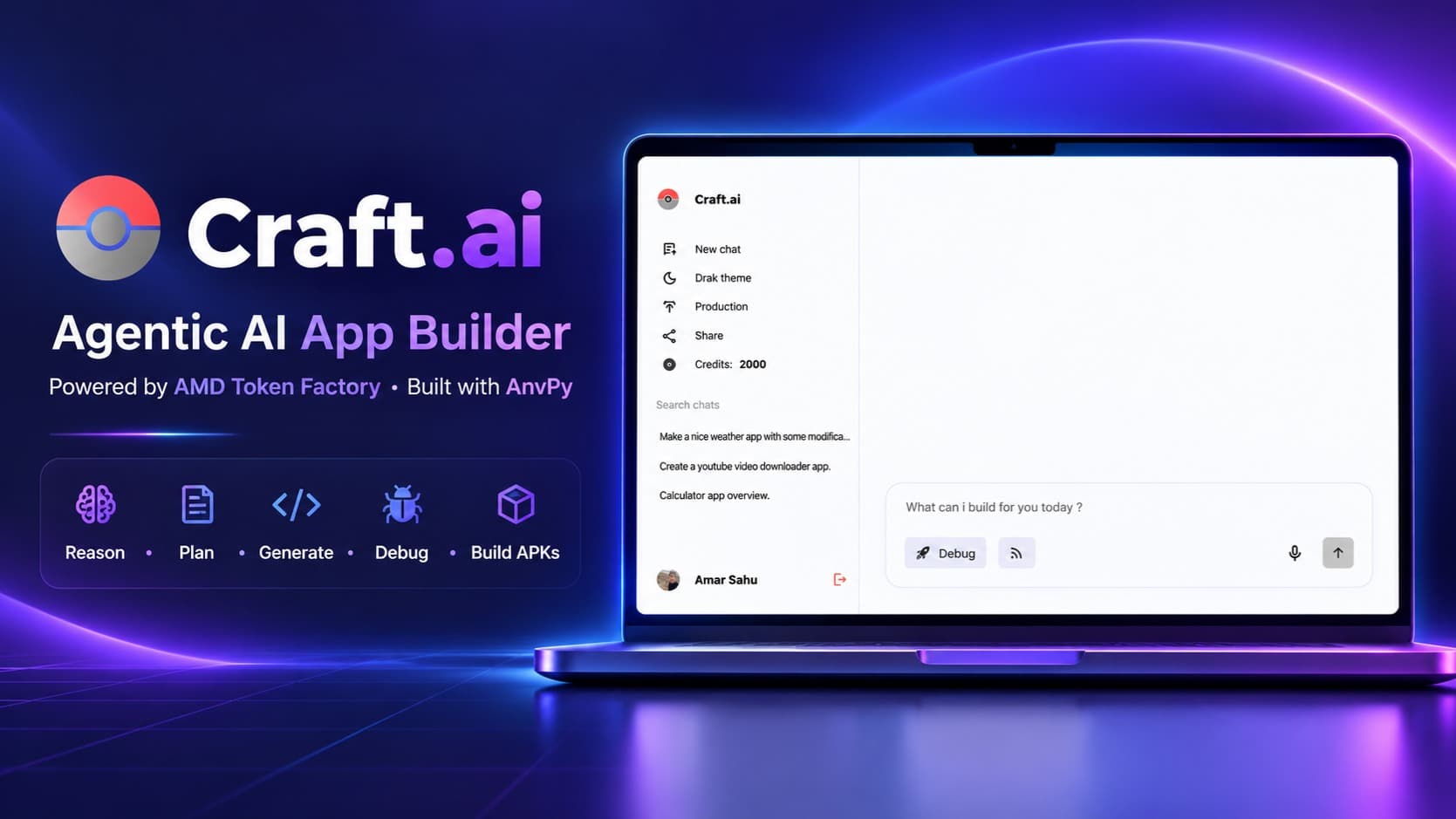
Craft.ai is an agentic AI app builder that transforms natural-language ideas into functional Python applications and installable Android APKs. Powered by AMD Token Factory, Craft.ai uses AI-driven reasoning to understand requirements, create development plans, generate code, diagnose errors, and iteratively improve applications. Unlike conventional AI app builders that primarily produce web applications, Craft.ai integrates with AnvPy, a Python development and execution environment designed for Android. AnvPy enables supported Python applications to run directly on mobile devices using a local CPython runtime, reducing the need for dedicated application servers for on-device functionality. The platform combines Python's flexibility with native Android capabilities, enabling access to Android APIs and integrations such as Google services and AdMob. It also supports a broad ecosystem of Python libraries, including OpenCV, NumPy, Pandas, and compatible machine-learning packages, opening possibilities for mobile AI, computer vision, data processing, and automation. Craft.ai connects AI-assisted development with the application build process, helping users move from an idea to generated code, debugging, and APK packaging. Rather than stopping at code snippets or browser previews, it aims to deliver installable applications that can use device capabilities beyond the browser. Our vision is to make mobile software development more accessible by combining AMD Token Factory's AI capabilities with Python and AnvPy's native Android execution environment. Craft.ai aims to empower developers and creators to build sophisticated mobile applications through natural language, with greater flexibility, local execution, and access to the Android ecosystem.

Spec-First Dark Factory: tablekeeper

Spec-First Dark Factory: tablekeeper

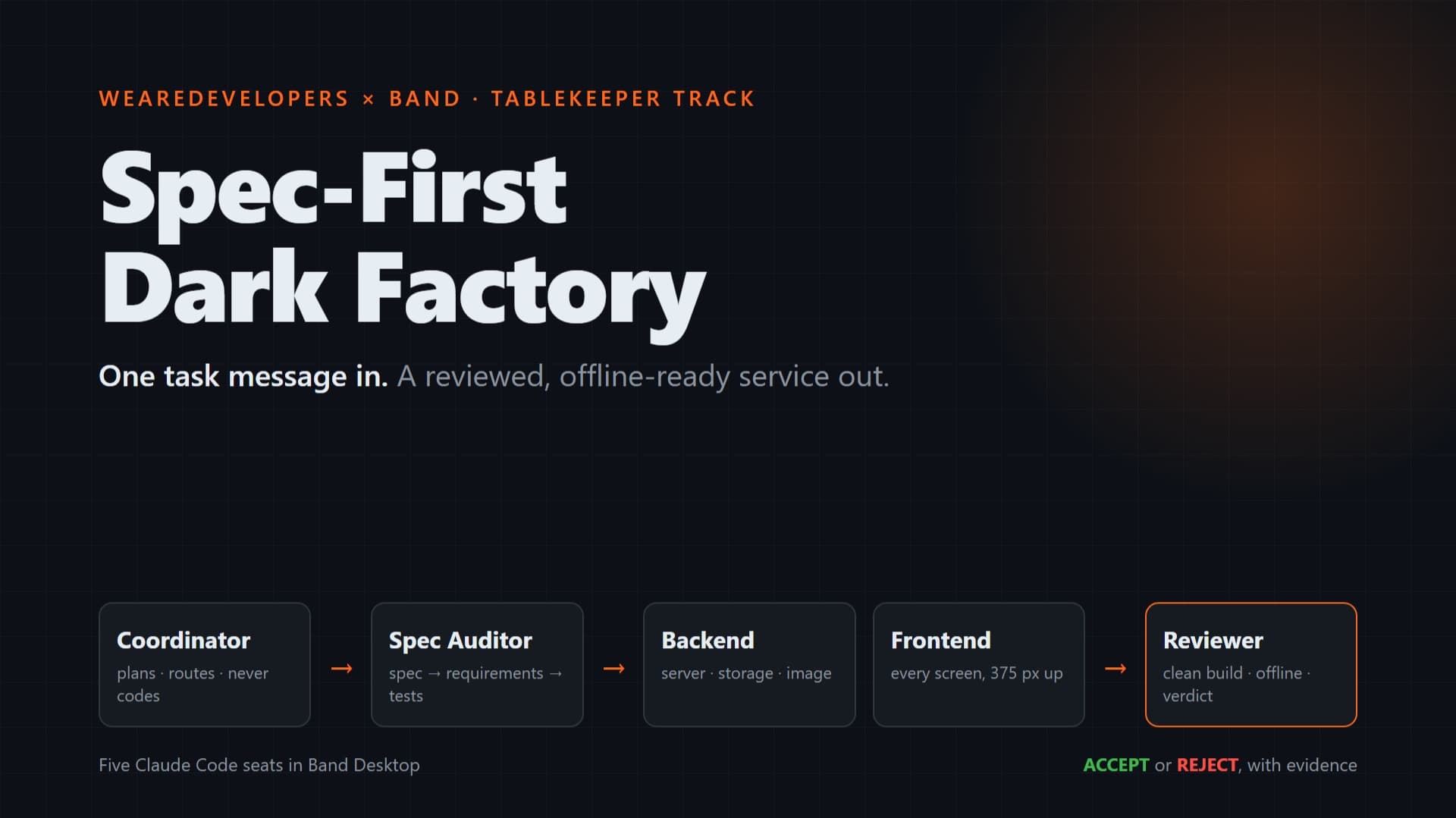
We built a factory, not an app. Five Claude Code seats in Band Desktop share one room and one Git repository, and the task message is the only human input. The Coordinator plans and routes work but never writes code. The Spec Auditor turns every sentence of each stage specification into a numbered requirement, lists the edge-case hazards (races, retries, time zones, upgrades) and writes black-box acceptance tests from the spec. That way the band builds to the specification, not to the partial checks it can see. The Backend and Frontend Engineers each take one scoped work item at a time and hand off the full commit id. The Reviewer checks out that exact commit in a clean worktree and builds it with no runtime network. It runs every suite so far plus the event checker in isolated mode, looks at every screen at phone and desktop width, and returns ACCEPT or REJECT with evidence. A REJECT goes back to the owner through the room until the stage closes. In the submitted run the factory reached stage ⟨N⟩ of 4 in ⟨X⟩ hours for ⟨$Y⟩ of model spend, with ⟨Z⟩ reviewer rejections that changed the work. Before the judged run we rehearsed the whole loop on the practice track, where all four stages were accepted and every suite passed. We fed each failure from that rehearsal back into the mandates. Every seat's mandate is generic: point it at a different specification and it still applies. FACTORY.md explains how to stand the factory up, what each design choice cost, and how it catches bad work.

TANNY - Voice-First JARVIS-Style AI Agent

TANNY - Voice-First JARVIS-Style AI Agent

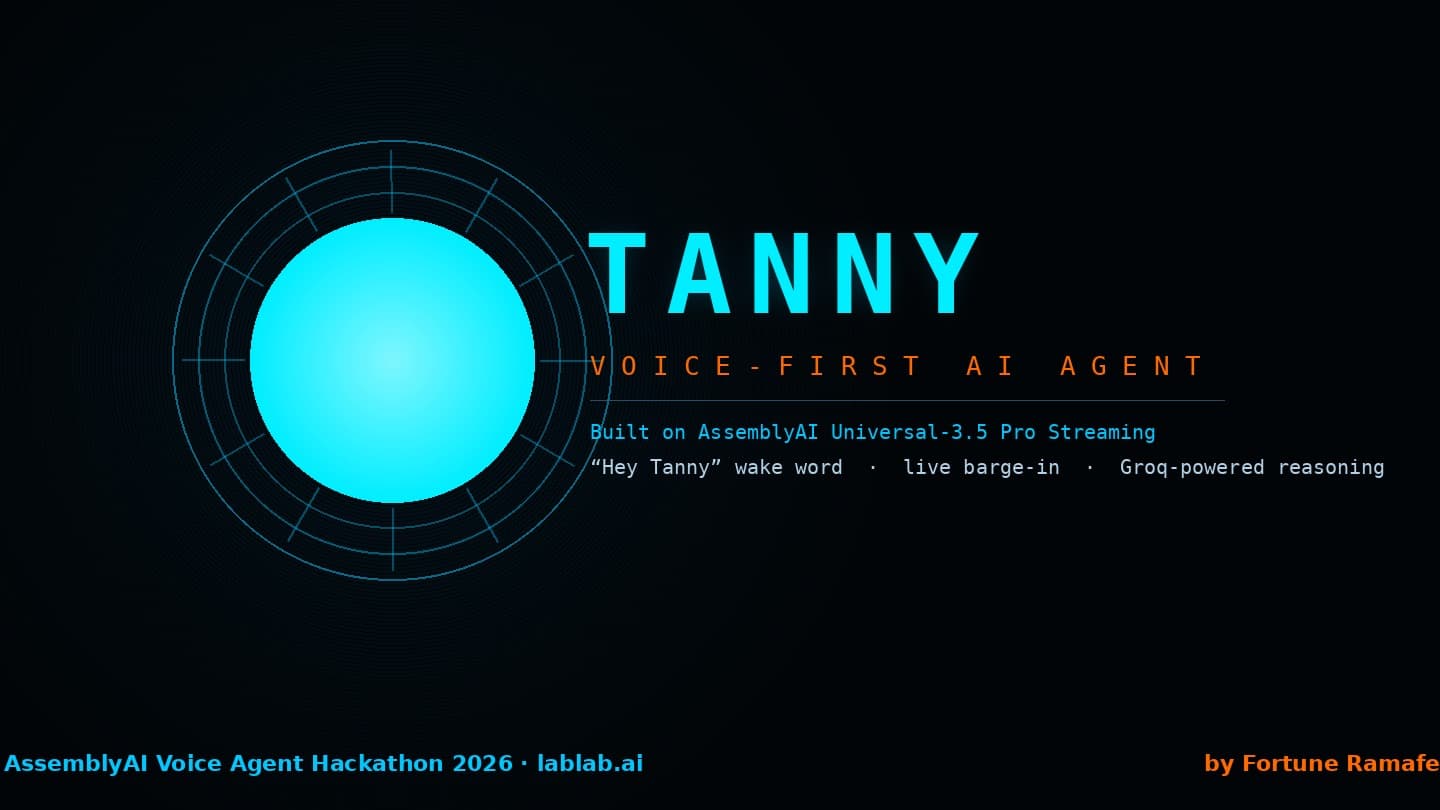
Most "voice assistants" are chat apps with a mic button bolted on: push-to-talk, no interruption, noticeable lag. TANNY is built the other way around, voice-first from the ground up. Say "Hey Tanny" and it responds, no button required. Your microphone streams directly into AssemblyAI's Universal-3.5 Pro streaming model over WebSocket, which returns live partial transcripts as you talk and a fully formatted final transcript the instant you stop. That final transcript both displays in TANNY's HUD and drives its wake-word matching, so the whole interaction stays hands-free. The feature we're proudest of is barge-in. AssemblyAI's SpeechStarted event fires the moment you start speaking, even while TANNY is mid-reply, and we use that signal to cut its voice output off immediately. It is the difference between a script reading answers at you and something that feels like an actual conversation, where either side can jump in. Reasoning is handled by Groq's Llama 3.3 70B running behind a local daemon, wrapped in a JARVIS-style persona: witty, precise, and always in character. The whole experience lives inside a from-scratch Iron Man HUD interface, complete with an arc reactor boot sequence, live physics/particle/neural/fractal simulations, and system telemetry panels, because a voice-first assistant should look like one too. On the security side, the AssemblyAI API key never touches the browser. A small standalone token server mints short-lived temporary tokens server-side, and the client only ever holds a token valid for a single session.

TableMate — Voice-Driven Bimanual Physical AI

TableMate — Voice-Driven Bimanual Physical AI

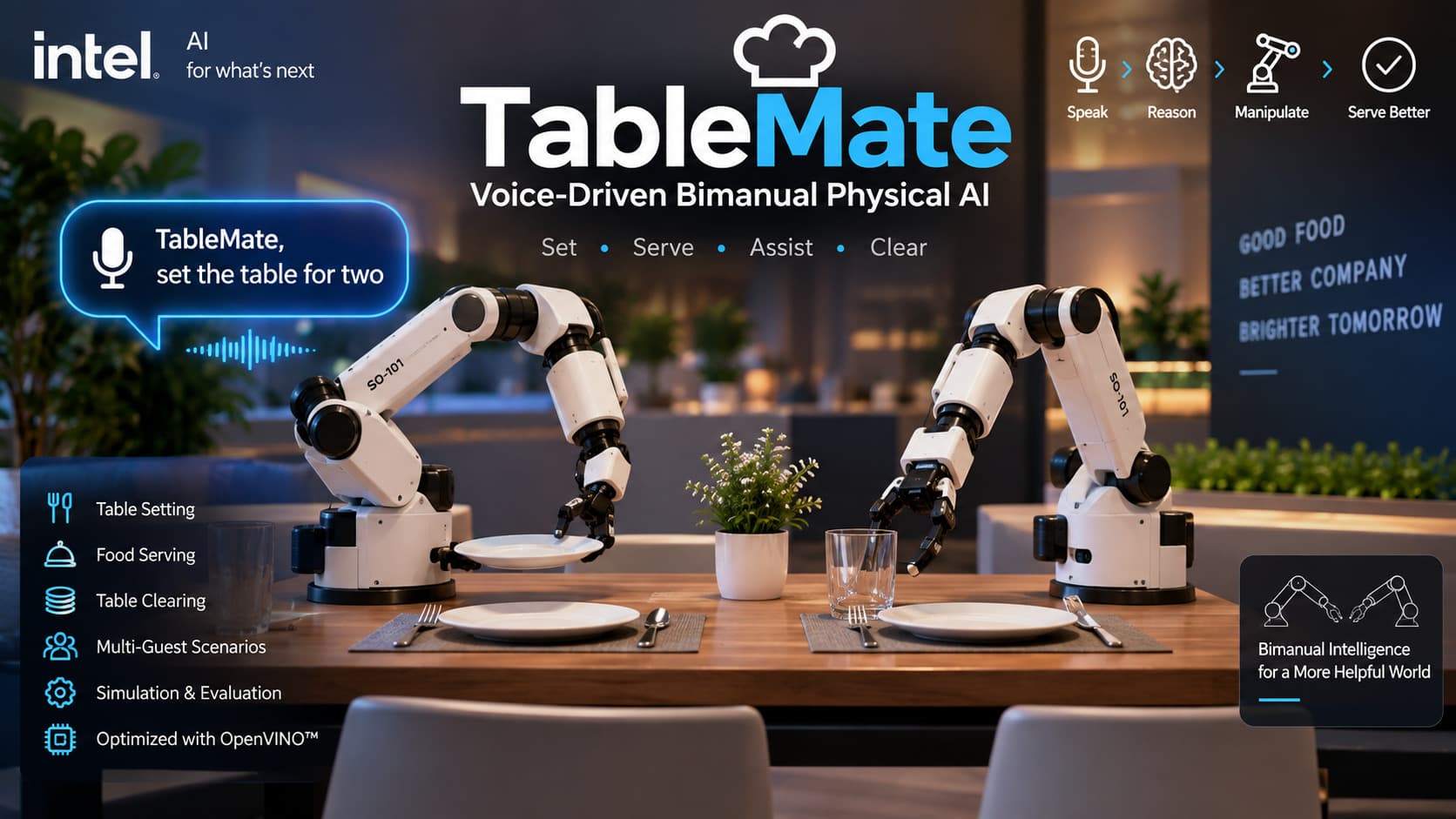
TableMate is a voice-driven Physical AI system for intelligent bimanual robotic manipulation in restaurant and table-service environments. The project uses two simulated SO-101 robotic arms in MuJoCo to transform natural-language instructions into coordinated, multi-step physical actions. Rather than executing a fixed sequence, TableMate represents restaurant requests as structured task plans and dynamically assigns actions to the left arm, right arm, or both arms cooperatively. The system supports parallel operations such as placing a plate and cutlery simultaneously, as well as cooperative bimanual tasks such as transporting a main dish. Current scenarios include fine dining, quick lunch, shared dinner, selective table clearing, and changing guest requests. TableMate is designed around the hackathon’s multimodal Physical AI challenge: combining language understanding, visual scene information, task context, bimanual coordination, manipulation, and verification. The architecture is being developed to support randomized MuJoCo environments and evaluation across multiple seeds to measure robustness to changes in object placement and scene conditions. The deployment pipeline targets Intel Core Ultra Series 2/3 and uses OpenVINO for supported AI inference optimization. The project also incorporates Intel Physical AI tooling and a reproducible simulation, evaluation, and benchmarking workflow. Speechmatics integration extends the interface from written commands to real-time spoken instructions, allowing a guest or operator to naturally request actions such as setting, serving, modifying, or clearing the table. The goal of TableMate is to demonstrate how Physical AI can move beyond isolated robotic actions toward an interactive agent that can understand what a person wants, reason about a changing environment, coordinate two arms, execute safely, and verify that a real-world-style task has been completed correctly.