Kraken CLI

Kraken CLI is an open-source command-line execution engine for Kraken's markets, launched on March 11, 2026. Built under the MIT license, it gives developers and AI agents direct access to market data, account management, and order execution across spot, futures, xStocks, and forex through 151 commands. It also ships a built-in Model Context Protocol (MCP) server, making it directly usable in AI coding tools like Claude Code, Cursor, and Gemini CLI.

General
ReleasedMarch 11, 2026 (v0.3.2 as of April 2026)
DeveloperKraken (Payward Inc.)
TypeOpen-source CLI / MCP server
LicenseMIT
GitHubkrakenfx/kraken-cli
Documentationkraken.com/kraken-cli

Core Features

  • 151 commands covering market data, account, trading, funding, futures, and WebSocket streaming.
  • Paper trading: sandbox mode using live prices with no real funds required and no Kraken account needed.
  • Built-in MCP server: launch with kraken mcp to expose commands as tools in any MCP-compatible AI agent.
  • Real-time WebSocket streaming: live tickers, order books, trades, and Level 3 data from the command line.
  • 50 pre-built Agent Skills for common trading workflows, ready to use in any AI agent.
  • Dead man's switch: auto-cancels open orders on disconnect to prevent unintended exposure.
  • Least-privilege API keys: supports scoped API keys; secrets are never logged.
  • Binary verification: release binaries are signed with minisign for supply chain integrity.

Command Groups

GroupDescription
Market DataTicker, order book, OHLC, recent trades, spreads (public, no auth)
AccountBalances, open orders, trade history, ledgers, positions
TradingBuy/sell, batch orders, amend/cancel (spot, xStocks, forex)
FundingDeposits, withdrawals, wallet transfers
FuturesOrders, positions, paper trading, all 8 order types
WebSocketReal-time streaming for tickers, trades, order books, Level 3
MCP Serverkraken mcp starts the MCP server over stdio

Installation

curl --proto '=https' --tlsv1.2 -LsSf \
  https://github.com/krakenfx/kraken-cli/releases/latest/download/kraken-cli-installer.sh | sh

Alternatively, install via Rust: cargo install --git https://github.com/krakenfx/kraken-cli

Pre-built binaries for macOS and Linux are available on GitHub Releases.


Tools and Resources


Ecosystem and Integrations

  • MCP server integrates natively with Claude Code, Cursor, GitHub Copilot, Gemini CLI, Goose, and Codex.
  • Paper trading mode works without a Kraken account for development and testing.
  • Live trading requires a Kraken account and API keys with appropriate permissions.
  • Public market data commands require no authentication and no account.

Install the CLI and run kraken --help to explore all commands, or kraken mcp to start the MCP server for AI agent access.

Kraken cli top builders

Explore the top contributors showcasing the highest number of Kraken cli app submissions within our community.

kraken Kraken cli AI technology Hackathon projects

Discover innovative solutions crafted with Kraken cli, developed by our community members during our engaging hackathons.

Codebase Autopsy

Codebase Autopsy

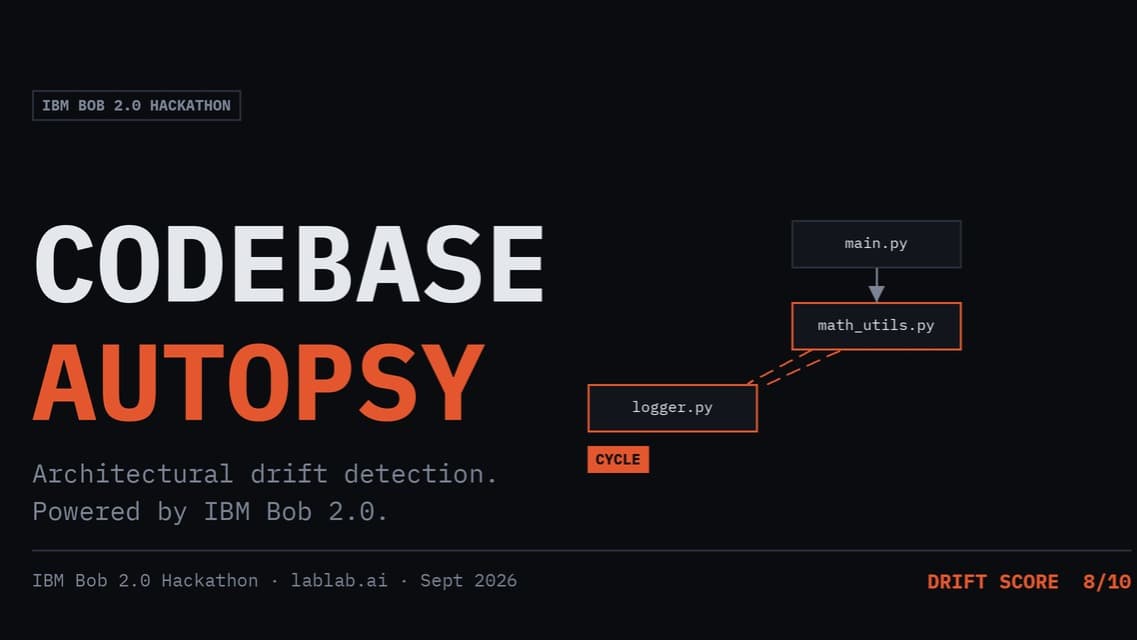
The problem: Documentation drift is one of the most common and hardest-to-catch forms of technical debt. A docstring says a function is "pure" or "read-only," but six refactors later it's quietly writing to disk or making network calls and nothing flags it. Code review catches this only if the reviewer happens to read both the docstring and the diff carefully; most don't. Static analysis tools check types and syntax, not whether a module still does what it says it does. The solution: Codebase Autopsy is a CLI pipeline that performs a structural and semantic audit of a Python codebase in three stages. First, it walks the repo and parses every file with Python's ast module, extracting each module's docstring, functions, classes, imports, and every call made at module and function scope without executing any code. Second, it builds a full import-dependency graph from that data, resolving both absolute and relative imports, detecting circular dependencies, and ranking modules by in-degree to surface architectural hubs. Third, for every module that has a docstring, it hands a structured summary of that module (its stated purpose plus what its functions actually call) to an LLM, which judges whether the declared purpose and the observed behavior still agree. The LLM returns a 0–10 drift score with concrete evidence not just a gut-feeling flag, but a paper trail: "this function claims no side effects, but it calls open() and a logger." Target users: engineering teams and solo maintainers with any codebase old enough to have accumulated drift which is nearly all of them. A developer runs one command against a repo path and gets back a ranked report: import cycles first, then the modules whose documentation and implementation have diverged worst, each with plain-English evidence they can act on immediately. What makes it unique: most drift/quality tools measure code against code (types, lint rules, test coverage). This measures code against its own stated intent, using structural facts extracted by ast not vibes as the evidence the LLM has to reason over. The graph layer also means drift scores aren't judged in isolation: a highly depended-upon module with a wrong docstring is a much bigger problem than an isolated one, and the report reflects that. Efficiency: parsing and graph-building are pure static analysis fast and free. The only paid step is the LLM call, and only for modules that actually have a docstring worth checking, so cost scales with how well-documented (and therefore how checkable) a repo already is.

Fresno LUX: A Living City

Fresno LUX: A Living City

Fresno LUX is a prototype for a living intelligence layer across an entire city. Fresno already contains enormous amounts of intelligence: residents know where problems exist, nonprofits know where help is needed, businesses know where opportunities exist, educators understand gaps in learning, researchers generate knowledge, and government maintains critical infrastructure and data. The problem is that much of this intelligence is fragmented across disconnected systems. Fresno LUX connects those pieces. The platform creates a shared city graph where people, organizations, resources, needs, projects, observations, experiments, and outcomes become connected nodes. Instead of simply collecting data, LUX continuously asks: What is happening? What do we know? What is missing? What can we test? What changed? A community problem can become an observable signal. That signal can become an experiment. The experiment produces evidence. Evidence changes the system's understanding. That updated understanding informs the next action. Observe → Connect → Understand → Act → Measure → Learn → Converge. The goal is to move Fresno from disconnected information toward collective intelligence—a system where knowledge can travel across boundaries and successful solutions can be discovered, tested, measured, and replicated. LUX is designed to make the invisible connections visible: the relationship between a neighborhood and its resources, between a student and educational opportunity, between a business and workforce capacity, between environmental conditions and community health, and between an idea and measurable real-world impact. This hackathon prototype demonstrates the beginning of a Living Fresno Graph: a city that can observe itself, learn from evidence, and coordinate toward better outcomes.

GhostchainAI+SafeFi {{~/ A.M.I.R.A}}

GhostchainAI+SafeFi {{~/ A.M.I.R.A}}

The Ghostchain Command Hub is an advanced, production-grade autonomous agent ecosystem and decentralized financial infrastructure designed to bridge cloud environments with local execution nodes (Termux, Firebase, AI Studio, and native.ai). Built to operate continuously with zero manual intervention, the platform orchestrates real-time data flows, decentralized exchange interactions, and automated digital asset monetization models directly from a unified control terminal. Core Architecture & Technical Specifications Autonomous Multi-Agent Orchestration: Powered by localized and cloud-synced AI models that autonomously execute complex workflows, monitor system health, and adapt strategies in real time. Hybrid Execution Pipeline: Seamlessly bridges remote cloud backends (Firebase, Google Cloud) with edge computing terminals (Termux/Android integration), enabling instant local-to-cloud script provisioning and auto-deployment. Real-Time Financial & Crypto Engine: Interfaces directly with live liquidity pools, Web3 protocols, and exchange REST APIs to execute automated yield strategies, arbitrage flows, and real-world currency generation models. Zero-Touch DevOps & Security: Features an automated provisioning framework that self-configures environment variables, securely manages secrets encryption, and auto-pushes code modifications straight to live production servers. Resilient Infrastructure: Engineered for high availability with built-in failover safeguards, ensuring persistent online status, continuous background script execution, and autonomous state recovery. Ghostchain Command Hub redefines decentralized automation by eliminating the barrier between rapid AI prototyping and live, revenue-generating production environments. By combining secure multi-agent coordination with real-time financial tracking and instantaneous cross-platform deployment, it delivers a fully autonomous ecosystem capable of sustaining itself and generating real-world economic value at scale.

TradeMind AI: Market Intelligence Platform

TradeMind AI: Market Intelligence Platform

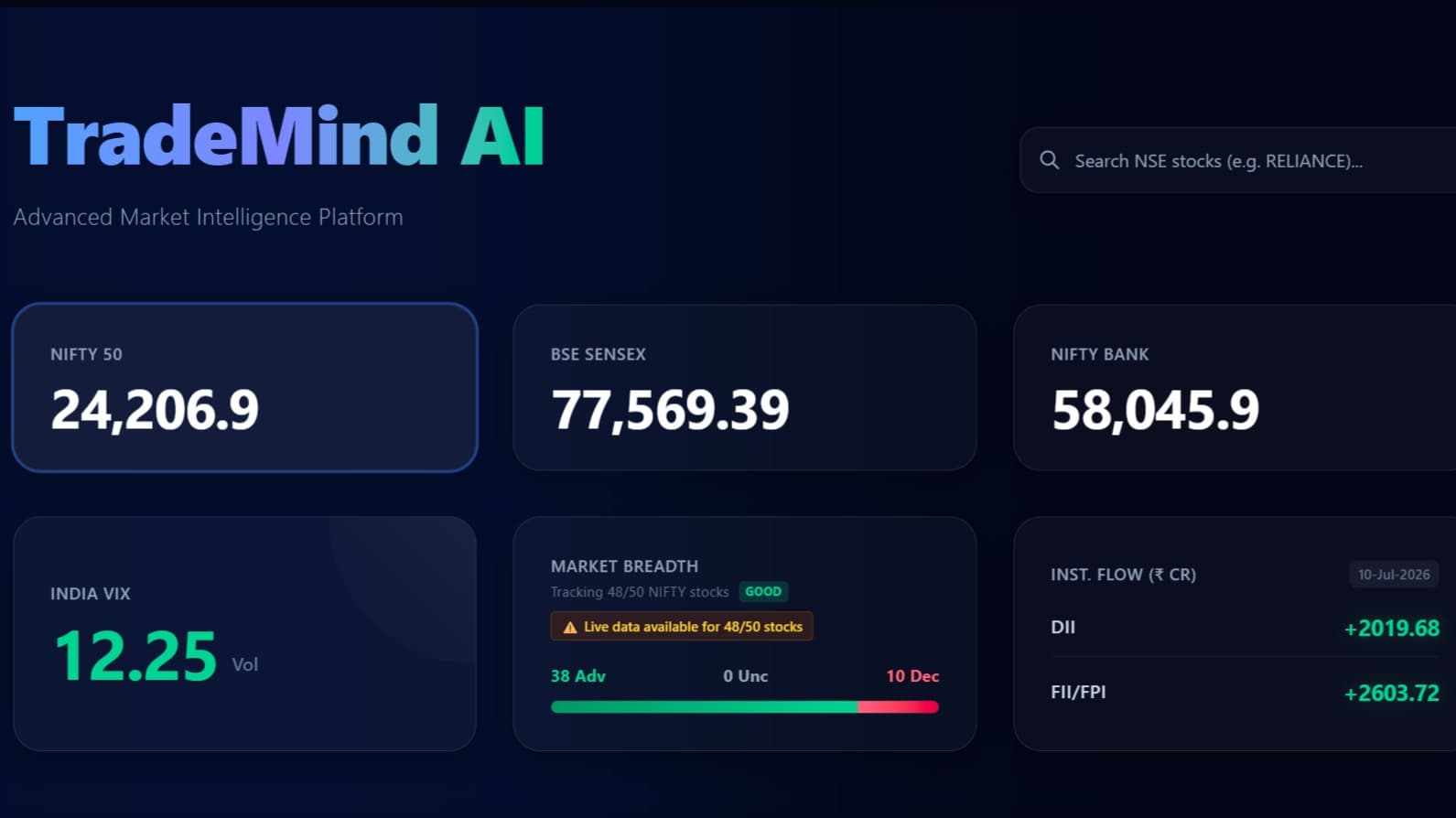
TradeMind AI is an AI-powered market intelligence platform designed to simplify stock market analysis for traders, investors, and students. Modern traders often rely on multiple websites and tools to monitor market indices, institutional activity, news sentiment, company fundamentals, and technical trends. TradeMind AI solves this fragmentation problem by combining all of these insights into a single unified dashboard. The platform provides real-time tracking of major Indian market indices including NIFTY 50, BSE Sensex, NIFTY Bank, and India VIX using live market data. It also performs market breadth analysis by monitoring NIFTY constituents and identifying advances, declines, and overall market participation. TradeMind AI includes sector performance analytics, top gainers and losers tracking, personalized watchlists, and intraday charting capabilities to help users identify trends and opportunities quickly. One of the platform's key features is its financial news intelligence system. Market news is aggregated and automatically classified as positive, negative, or neutral using the VADER sentiment analysis engine, allowing users to understand market sentiment at a glance. The project also features an AI-powered market assistant capable of answering finance-related questions using live market context, news sentiment, and institutional flow information. This enables users to interact with market data conversationally and receive context-aware explanations rather than generic responses. The frontend is built using React and Vite, while the backend uses FastAPI. The platform integrates Yahoo Finance for market data, NewsAPI for financial news, VADER for sentiment analysis, and Fireworks AI models for conversational intelligence. The entire application is containerized using Docker and deployed using Vercel and Render. TradeMind AI aims to make financial intelligence more accessible, understandable, and actionable for everyone participating in the market.

SplitLLM  – Explainable Hybrid AI Routing

SplitLLM – Explainable Hybrid AI Routing

SplitLLM is a production-inspired hybrid AI routing platform designed to make large language model deployments faster, more cost-efficient, and fully explainable. Instead of sending every request to a single cloud model, SplitLLM first analyzes each prompt using a multi-stage reasoning pipeline to determine its complexity, confidence requirements, expected cost, and execution strategy. Based on this analysis, it intelligently routes requests to either lightweight local models or powerful cloud models, ensuring the right model is used for the right task. Unlike traditional routers that only decide where to send a request, SplitLLM explains why every routing decision was made. Every prediction includes transparent reasoning, confidence estimates, routing factors, telemetry, and performance metrics, enabling users and organizations to understand and trust the system's decisions. The platform includes modular routing, configurable budget policies, live telemetry, benchmarking tools, a reasoning profiler, CLI utilities, REST APIs, Docker support, automated testing, and CI/CD workflows. It is designed with production engineering principles, making it easy to deploy, monitor, and extend. Built with AMD's AI ecosystem in mind, SplitLLM supports efficient local inference workflows and hybrid deployment strategies that reduce unnecessary cloud usage while maximizing available compute resources. The architecture is modular, scalable, and optimized for future integration with additional models and routing strategies. Our vision is simple: AI should not always use the biggest model—it should use the smartest one. SplitLLM delivers intelligent, explainable, and efficient AI routing for modern applications while helping developers reduce operational costs, improve response times, and maintain high-quality outputs.

MAITS/BANDA

MAITS/BANDA

The platform is written in Python and operates in a multi-threaded architecture managed by a centralized Orchestrator. It simulates multi-agent algorithmic trading (Paper Trading mode) while enforcing strict operational constraints through specialized modules: Multi-Threaded Orchestrator: Manages individual, isolated Trading Units (bots), ensuring concurrency and stability. Security Sentinel: Processes and validates all trade intents before execution to prevent out-of-bounds order sizes or unauthorized operations. Data Optimizer: Calculates real-time financial metrics, risk exposure, and tracks critical analytics such as Max Drawdown for every active bot. BandConnector: Integrates directly with Band Protocol oracles to fetch decentralized price feeds. These feeds are used as a ground-truth reference to audit local exchange data, detect price anomalies, and prevent execution based on manipulated or stale data. Logging and Auditing (Логування та аудит) The system separates operational concerns into distinct file structures to maintain clean state tracking: Bot Logs: Isolated runtime logs for individual bots are written to /home/ubuntu/kucoin_prod/bots/logs/n_bot.log (where n is the bot ID). Analytical Ledger: Trade history and portfolio metrics are committed to JSON Lines format at state/trades_history.lsonl for each bot container. System Auditor: A standalone tool (auditor.py) evaluates historical logs and real-time state to compile performance reports.